MICHELIN Guide Thailand: what the map says about a neighbourhood
Thailand's guide lists 468 establishments and 137 Bib Gourmand in 2026. Where they cluster, what research infers from that, and what it does not.
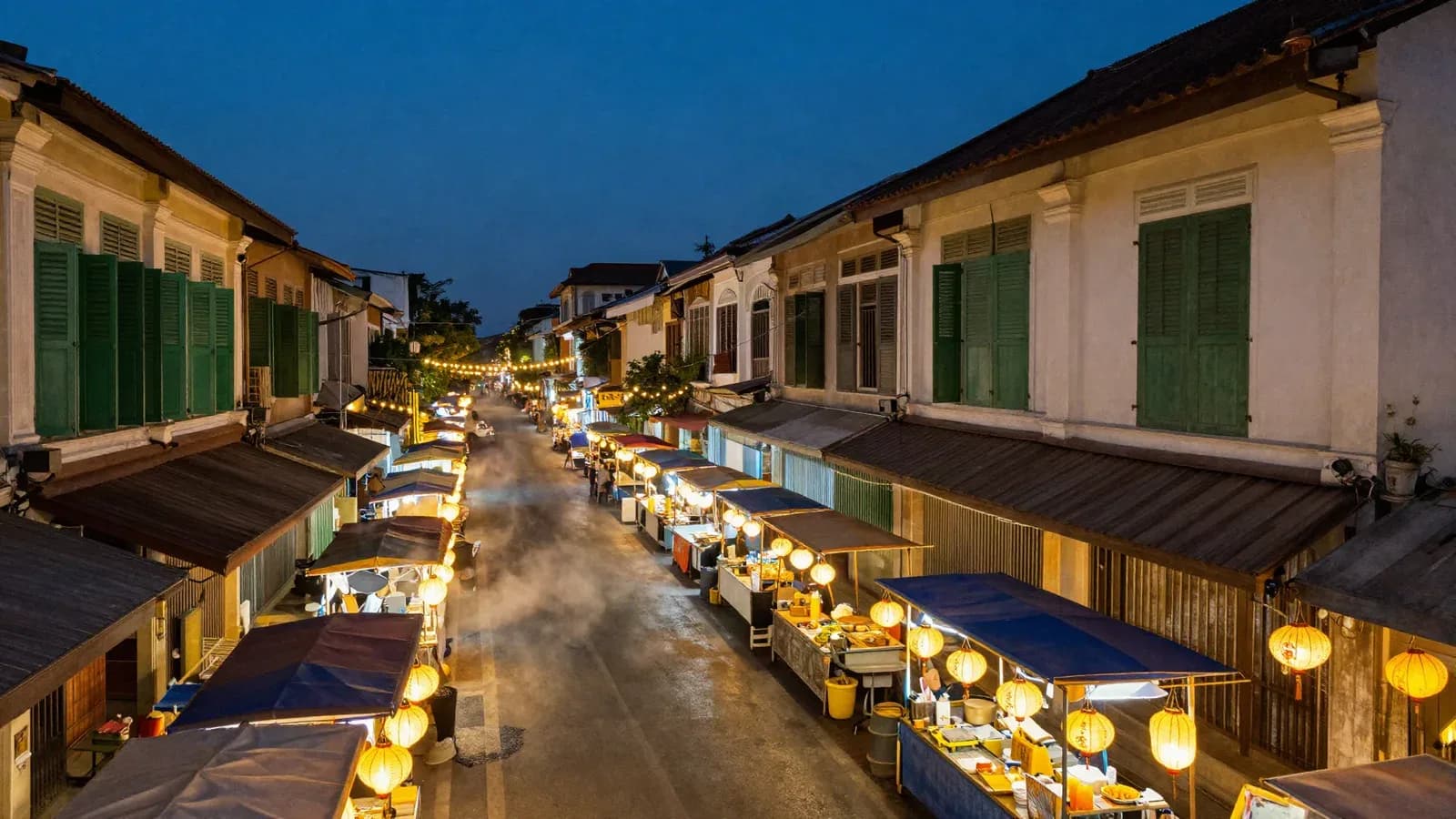
Thailand's guide lists 468 establishments and 137 Bib Gourmand in 2026. Where they cluster, what research infers from that, and what it does not.
What does a guide measure when a country invites it in?
The Red Guide did not arrive in Thailand on market forces alone. Its Thai edition grew out of a partnership with the Tourism Authority of Thailand announced on 20 April 2017, and the stated aim at the time was explicit: to raise food spending per tourist by around 10%. The first edition, celebrated on 6 December 2017, covered Bangkok alone and listed 98 restaurants and 28 street-food stalls — without a single three-star.
The arrangement has been renewed once. On 6 October 2021, the Thai Cabinet approved a budget of THB 135.5 million (€3.53 million) for the 2022–2026 period, paid to the guide's French subsidiary. One business-press source describes the amount as annual rather than five-yearly: both readings exist, and we report the one in the decision.
That funding explains the guide's geography better than any culinary ranking. Destinations came in waves, and each wave was announced jointly by the publisher and the tourism authority: Phuket and Phang Nga in 2019, Chiang Mai in 2020, Ayutthaya in 2022, four Isan provinces in 2023, Koh Samui and Surat Thani in 2024, Chon Buri in 2025. A reader looking for where to eat well in Thailand is in fact reading, in part, where Thai tourism has chosen to draw the eye. That is a reason never to read this map on its own, and to set it against what holds a city together beyond its restaurants — which is what we did city by city in our comparison of six Thai destinations.
Two facts about the 2026 edition are worth setting side by side. It adds no new destination — the coverage is, word for word, that of 2025. And the known contract expires at the end of 2026, with no renewal announced. After six years of annual expansion, the map stops growing at the very moment its funding runs out.
The 2026 geography, as published
The publisher releases the geographical breakdown for only one of its distinctions: the Bib Gourmand, which rewards good value for money. For our purposes it is the most interesting — it points to neighbourhoods where people eat well every day, not to special-occasion destinations.
The 137 Bib Gourmand of the 2026 edition, by area:
| Area | Bib Gourmand 2026 | of which new |
|---|---|---|
| Bangkok and neighbouring provinces | 44 | 4 |
| Isan — four provinces | 28 | 2 |
| Phuket | 19 | — |
| Chiang Mai | 18 | 3 |
| Ayutthaya | 8 | 1 |
| Surat Thani | 7 | 2 |
| Phang Nga | 6 | 1 |
| Chon Buri | 5 | — |
| Koh Samui | 2 | — |

Three readings stand out. On this measure, Isan outranks Phuket and Chiang Mai, each taken on its own, which runs against the mental map of most foreign buyers. Koh Samui has two, even though the island accounts for a notable share of the high-end residential supply: the dining scene there does not follow the property market. And the total is falling, from 156 to 137 from one edition to the next, even though thirteen establishments came in — which implies some thirty removals, on which the publisher does not comment. Isan itself has gone from 33 Bib Gourmand in 2023 to 28 today, without leaving the guide's coverage.
The gap between Phuket and Koh Samui is worth pausing on, because it runs against a buyer's intuition: nineteen establishments on one side, two on the other, on two islands that brochures happily present as equals. Two factors combine, and neither is a judgement on the cooking. The islands joined the guide five years apart — Phuket in 2019, Koh Samui in 2024 — which gives one seven inspection rounds and the other two. And Phuket has a markedly larger permanent resident population, and therefore a local clientele able to keep a restaurant going out of season. For anyone comparing the two islands as places to live rather than as holiday destinations, it is one more item for the file — we have gathered the others in our look at Phuket as a main residence.
One last distinction deserves a word, because it is recent and little read: five establishments hold a Green Star, which rewards sustainable sourcing and management and sits on top of the other awards rather than replacing them. Five out of four hundred and sixty-eight is not many. But it is the only category in the guide that speaks of something other than the plate, and it overlaps with what draws buyers who look at Thailand for its everyday quality of life more than for its yield — a motivation we examine in its own right in our article on wellness as a buying criterion.
A count is not a league table.
The number of distinguished establishments in an area depends first on when that area entered the guide, and on how many inspectors pass through. A province covered since 2019 has had six years to fill up; a province covered since 2025 has had one. Comparing totals without comparing seniority leads to the wrong conclusions.
Does a cluster of good restaurants measure a neighbourhood's wealth?
It is the most widespread intuition, and the available research contradicts it.
The clearest evidence comes from Milan. Until 2005, a minimum-distance rule between restaurants kept them spread almost evenly across the city. Its abolition served as a quasi-natural experiment for Marco Leonardi and Enrico Moretti, covering 6,057 restaurants across 180 neighbourhoods. Between 2004 and 2012, concentration rose sharply — the standard deviation of restaurants per resident increased by 26.7% — but the decisive result lies elsewhere: the characteristics of 2004, including house prices, the value of commercial premises and access to transport, do not jointly predict where restaurants would multiply. Concentration is self-reinforcing; it does not stem from pre-existing wealth.
Two American studies point the same way and supply the mechanism. Will Payne, examining twenty-five years of New York restaurant selections, concludes that quality restaurants are a leading, not a lagging, indicator of demographic change: the first listings appear in neighbourhoods whose residents cannot yet afford them. Edward Glaeser, Hyunjin Kim and Michael Luca show, for their part, that restaurant activity anticipates changes in house prices.
That leaves the study closest to our subject, Chun Kuang's work on Washington. Using 28,307 residential transactions, he compares the period before online reviews became widespread with the period after. Before, the quality of a neighbourhood's restaurants could not be told apart from their sheer number in property prices. After, one additional standard deviation of well-rated restaurants goes with a value around 9.5% higher, while poorly rated restaurants no longer have any measurable effect. In other words: it is not quality that gets capitalised, it is quality made public.
A guide is exactly that — a quality signal, published on a fixed date, widely consulted. The analogy is strong. It is not proof: these studies concern Western markets and online reviews or American selections, not Thailand and not this guide. We put it forward as a working hypothesis, not as a finding.
What nobody publishes, and what we are going to measure
The guide stops at “Bangkok and neighbouring provinces”. It publishes no breakdown by district, and no public source reconstructs one. The only data of this kind ever released came from the publisher itself, in June 2018: seven of the city's seventeen starred restaurants were then in Pathumwan district alone. The country now has forty-three starred restaurants, and the guide does not say how many are in Bangkok: the only known breakdown is eight editions out of date.
That is precisely the gap our database can fill. Cross-referencing the location of every distinguished establishment with our sub-district index of developments produces a geography that neither the publisher nor the consultancies publish — and, if you add the year of entry into the guide, something rarer still: the chance to see what prices do after a first distinction, compared with a similar neighbourhood that received none. That is the protocol we have settled on, and we will publish its method together with the results, whatever they turn out to be.
A word on what we will not do, because the mistake is an easy one. Comparing the average price of a neighbourhood with distinguished restaurants against one without would prove nothing: the two differ in a hundred other ways, and the distinction would be just one of the hundred. The only set-up that supports a reading is to observe the same neighbourhood before and after a first entry into the guide, and to compare that trajectory with comparable neighbourhoods over the same period. That set-up must itself pass a prior test: checking that the two groups were moving in parallel before the distinction. If it fails, the result is worthless, and we will publish it as such.
The street, and what the distinction did not protect
The most instructive story in Thailand's guide is also the least told. The first edition recognised twenty-eight street stalls, and one of them, in Bangkok, received a Star — a first for pavement cooking in the capital.
At the same time, the city was running a campaign to reclaim its pavements. The work of Chaitawat Boonjubun, published in the journal Cities in 2017, documents an operation launched on 30 July 2014 that affected some three hundred vendors in the Tha Chang area of the old town alone. Thailand's English-language press set out the paradox as early as February 2018, in an article whose headline said it all: from a Star to a fight against eviction.
That tension is useful to anyone looking at a neighbourhood. A distinction consecrates an address; it does not protect the informal trade around it, and it is often that trade that makes a street's daily life. A buyer who chooses a neighbourhood for its buzz is buying something more fragile than the list that led them there.
One last point of vocabulary, because it causes errors: the publisher currently classes twenty-nine Thai establishments under the cuisine type “street food”, eight of them in Bangkok. That is not a business format and it is not a count of distinguished stalls: many pavement eateries are filed under “Thai” or “noodles”.
When we model the case of Joanne and Mark, choosing between two Bangkok addresses
Joanne, 54, and Mark, 58, are looking for a pied-à-terre in Bangkok, with a budget fixed at THB 12 million (€312,700). Two neighbourhoods fit that figure. The first has been established for twenty years, is well connected, and its prices no longer have much upward slope. The second is further from the centre, cheaper per square metre, and has seen four establishments enter the guide in three editions.
What the available research allows us to tell them: the density of distinguished establishments in the second neighbourhood is a signal about its trajectory, not its current state. It shows that restaurateurs, who choose their sites with care, have bet on the area before prices reflect it. It does not show how much prices will move, or when, or even that they will move at all.
What it does not allow us to tell them: that they will make a capital gain. No study establishes that for this guide, in this country. So we give them a body of evidence and its limits — and we suggest they look at what the four entries have in common, because four openings on the same street do not say the same thing as four openings scattered over three kilometres.
Modelled scenario. This profile is not a client; the parameters are working assumptions.
What our database can place in its neighbourhood
We index developments in six provinces by sub-district, with their location and price per square metre. Overlaying that geography on the map of distinguished establishments answers a question no brochure asks: is this neighbourhood expensive because it has arrived, or because it is arriving? The two are priced differently. To place a specific address, start by setting it in its surroundings.
One last framing point, worth more than all the neighbourhood signals put together. None of them can be read outside the cycle it falls in: in a market where new supply exceeds demand, an improving street can perfectly well see its prices stagnate along with everything else. The state of the Thai market — unsold stock, absorption times, gaps between provinces — is therefore the first filter to apply, and we keep it up to date in our reading of the Thai property market. The geography of good tables comes afterwards, as a way of deciding between two addresses in the same market. Never as a substitute for examining that market.
What you can do now
Three steps, before drawing any conclusion from a food map. Date the entries: an establishment distinguished since 2019 and one that came in last year do not say the same thing about the neighbourhood. Look at density, not the total: four establishments within a ten-minute walk are a signal; the same four scattered across a city are not. And go and see the street on a weekday evening: a neighbourhood that is alive at eight o'clock on a Tuesday holds its value for everyday living better than one that only comes alive at weekends. None of these three steps appears in a listing.
Frequently asked questions
How many establishments does the guide list in Thailand in 2026?
Four hundred and sixty-eight. Forty-three hold Stars — two at the highest level, eight at the second, thirty-three at the first — alongside one hundred and thirty-seven Bib Gourmand and two hundred and eighty-eight MICHELIN-Selected establishments, a tier the guide long called “the Plate”, which is why the figure still circulates under that name. Five establishments also hold a Green Star, which recognises a sustainable approach and comes on top of the other awards.
Which Thai cities does the guide cover?
Bangkok and five neighbouring provinces, Phuket and Phang Nga, Chiang Mai, Ayutthaya, four provinces of Isan, Surat Thani with Koh Samui, and Chon Buri. The coverage was built up in waves between 2018 and 2025, each extension announced jointly with the tourism authority. The 2026 edition adds none.
Is Thailand's MICHELIN Guide funded by the state?
Partly, and that has never been hidden. The tourism authority and the publisher have worked together since 2017, under an agreement renewed once. The public budget attached to that second agreement, THB 135.5 million, covers the 2022 to 2026 editions; it was set by the Cabinet in the autumn of 2021. Nothing so far indicates that a third agreement has been signed, which leaves open the question of what comes next for the Thai guide.
Does a distinguished restaurant push up prices in its neighbourhood?
Nobody has measured it. No study, in Thailand or elsewhere, links a culinary distinction to property prices. What related research establishes, in other markets and with other quality signals, is that good restaurants tend to arrive before a neighbourhood changes rather than after.
Where does the guide say you eat best for the price?
The award that answers that question is the Bib Gourmand. In 2026, Bangkok and its neighbouring provinces have forty-four, the four Isan provinces twenty-eight, Phuket nineteen and Chiang Mai eighteen. Isan therefore outnumbers Phuket and Chiang Mai taken one by one, which surprises most foreign visitors.
Is street food recognised?
Yes, since the first edition, and one Bangkok stall holds a Star. Be careful with the count, though: the twenty-nine establishments classed as “street food” are classed by type of cuisine, not by format of business, and many stalls appear under other headings.
Method and sources
Sources checked October 1, 2026
Exchange rate used: 1 EUR = 38.374 THB (1 October 2026)
- What this article draws on: the guide publisher's own publications for counts, coverage and dates — the press release for the first edition of 6 December 2017, the 2026 Bib Gourmand announcement of 20 November 2025, and the 2026 edition press release of 27 November 2025; the Tourism Authority of Thailand's releases on the partnership and its renewal; the Cabinet decision of 6 October 2021 for the amount, as reported by the Thai business press; and four research papers for the analytical part — Leonardi and Moretti in AER: Insights (2023), Payne in Environment and Planning A (2025), Glaeser, Kim and Luca in AEA Papers and Proceedings (2018), and Chun Kuang's working paper on Washington. The figures on the eviction of street vendors come from Chaitawat Boonjubun, Cities, volume 70 (2017). We reproduce no selection: the guide's lists are protected, and this article publishes only counts and distributions drawn from them, which are facts.
This article is general information, not legal or tax advice. The rules cited are dated: check with a qualified professional that they are still in force before acting.