Six Thai destinations, six ways of living
Where to buy in Thailand? 4,164 condos bought by foreigners in Pattaya in 2025 against 1,190 in Phuket: six markets compared, six ways of living.

You do not buy in Thailand. You buy in Bangkok, in Phuket, in Samui — and they are not the same country. In 2025, foreigners acquired 4,164 condominiums in Chonburi province, home to Pattaya, for THB 11,590 million (≈ €302 million), against 1,190 in Phuket for THB 6,087 million (≈ €159 million): 3.5 times as many units for 1.9 times the value, according to the REIC. That is an average ticket of THB 2.78 million on one side (≈ €72,500) and THB 5.12 million on the other (≈ €133,300). Two markets with neither the same buyer nor the same use — and six ways of living, which our overall reading of the market puts back into the wider picture.
One country, six markets: what the official statistics measure
Once a year, the Real Estate Information Center (REIC), the research centre of the Government Housing Bank, publishes the count of apartments transferred to foreign buyers, province by province. It is the only official measure of the market that we share, those of us who are buyers from elsewhere — provided you know what it covers. It concerns condominiums transferred in freehold, within the 49% quota of a building's floor area, and counts neither villas, nor houses, nor land, nor any acquisition by lease or through a Thai company. This scope is decisive, and we come back to it below.
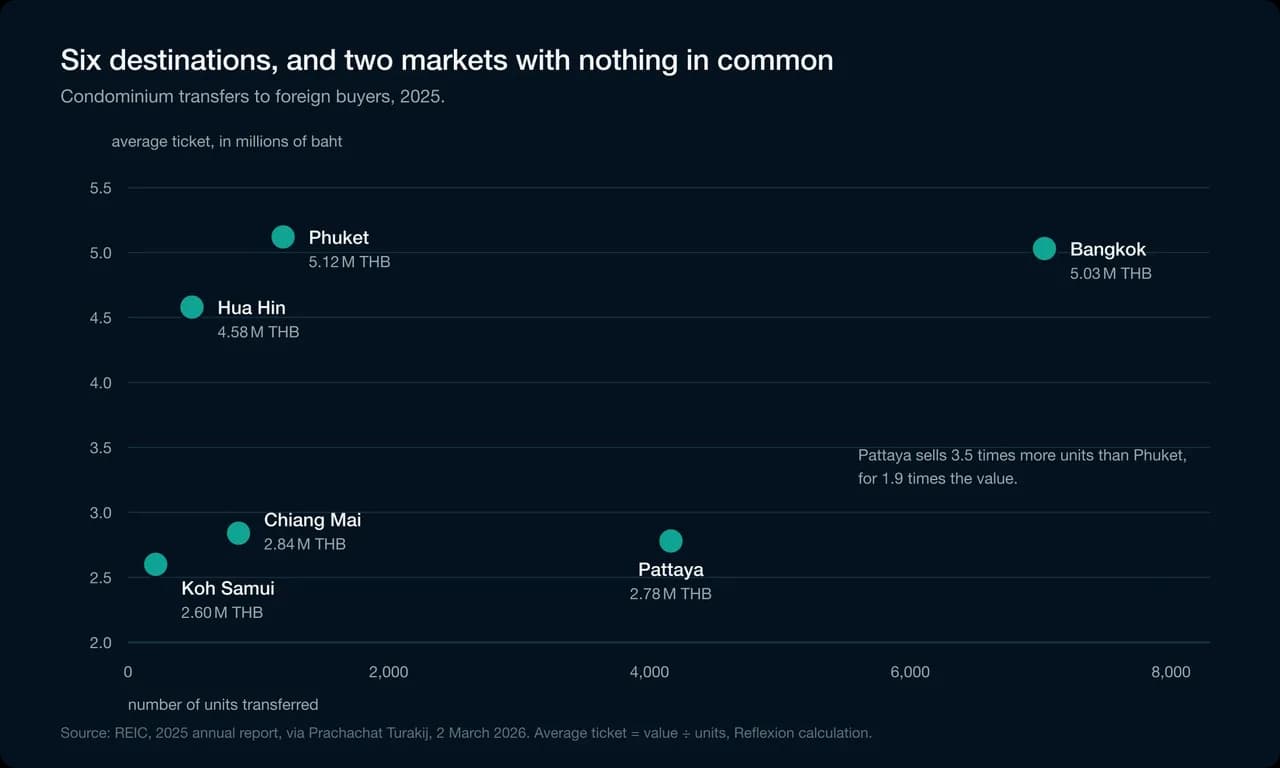
Within this scope, 2025 recorded 14,899 transfers for THB 60,921 million (≈ €1.59 billion) across ten provinces. The hierarchy has shifted: in 2023, Chonburi accounted for 41.7% of national units and Bangkok 37.5%; in 2025, Bangkok had climbed back to 47.2% and Chonburi had fallen back to 27.9%, with Phuket rising from 6.4% to 8.0%. The capital has taken first place back from the seaside resort.
Condominium transfers to foreign buyers, main provinces, full year 2025:
| Province (city) | Units | Value (THB m) | Value (EUR m) | Calculated average ticket (THB m) | Average ticket (EUR) |
|---|---|---|---|---|---|
| Bangkok | 7,029 | 35,386 | 922 | 5.03 | 131,200 |
| Chonburi (Pattaya) | 4,164 | 11,590 | 302 | 2.78 | 72,500 |
| Phuket | 1,190 | 6,087 | 159 | 5.12 | 133,300 |
| Chiang Mai | 848 | 2,409 | 63 | 2.84 | 74,000 |
| Prachuap Khiri Khan (Hua Hin) | 491 | 2,249 | 59 | 4.58 | 119,400 |
| Samut Prakan (Bangkok suburbs) | 429 | 1,394 | 36 | 3.25 | 84,700 |
| Surat Thani (Koh Samui) | 212 | 552 | 14 | 2.60 | 67,900 |
| National total (10 provinces) | 14,899 | 60,921 | 1,588 | 4.09 | 106,600 |
Two rows of this table deserve to be read side by side. Pattaya records 3.5 times as many units as Phuket for 1.9 times the value: that is the difference between a volume market with a low entry ticket and a value market with a high ticket, and it is the only official, measured way to say it. Another, less expected reading: Hua Hin shows the second-highest average ticket among the seaside destinations (THB 4.58 million, ≈ €119,400) on the scarcest volume after Samui.
One framing figure is added for French-speaking readers: in the first half of 2026, France was the sixth-largest buyer nationality for condominiums in Thailand by value of transfers, according to the REIC — behind China, Russia, Myanmar, the United States and Taiwan. The rank is all that is public: neither the amount in baht nor the number of units.
Where to buy in Thailand depending on what you are looking for?
Bangkok — depth
7,029 transfers for THB 35,386 million (≈ €922 million), 58% of national value: Bangkok is by far the largest market, and the only one for which both prices and yields are known. CBRE describes a market pulling apart in two: the average asking price for downtown launches is expected to rise from THB 315,000/m² in 2025 to THB 360,000/m² in 2026 (+14.3%), while the suburbs are expected to fall from THB 84,000 to 76,000/m² (−9.5%) — these are forecasts published in February 2026, not observed transactions. On the rental side, Global Property Guide publishes a gross yield of 6.22% for Bangkok and 8.52% for Samut Prakan, measured in February 2026, against a national average of 6.49%. These are the only Thai yields published by a source with a methodology.
What people come here for fits in three words: transport, schools, hospitals. The BTS and the MRT, with the eastern section of the Orange Line announced for the end of 2027; the Lycée Français International de Bangkok, a school under agreement with the AEFE (the French agency for education abroad), with 1,057 pupils from nursery to the final year of secondary school; several JCI-accredited hospitals — Bumrungrad, Bangkok Hospital, BNH, Samitivej — though the national total cannot be publicly verified. It is the destination for those who work, school their children and receive care locally; the detail by neighbourhood can be found in our Bangkok guide. And if you are comparing two towers, the filing date of their permit tells you under which seismic regime they were designed — the subject of our article on construction in Bangkok.
Phuket — value
1,190 transfers for THB 6,087 million (≈ €159 million), and the highest average ticket in the country: THB 5.12 million (≈ €133,300). Phuket sells fewer units than Pattaya and sells them for almost twice as much. It is also Asia's leading resort market for branded residences, with 3,465 units recorded by C9 Hotelworks in 2026.
The island is acquiring infrastructure for living, not just for holidays — the subject of our article on settling in Phuket. Bumrungrad, Thailand's leading private hospital group, is building its first campus outside Bangkok there: THB 4.3 billion, 16.5 rai less than ten minutes from the airport, 120 beds in the first phase and 212 eventually; foundations started in February 2025, and opening is announced for 2027. North London Collegiate School signed an agreement with VLC Group in May 2026 for a school of 1,000 to 1,500 pupils in Cherng Talay, with opening announced for the third quarter of 2028 — agreement signed, construction not documented. And BCIS Phuket, in Chalong, is accredited by the AEFE with partner status, from nursery to the final year of secondary school.
On prices, only one series exists, and it has to be dated: in May 2025, C9 Hotelworks measured a median of THB 144,000/m² for condominiums across all segments, THB 181,000/m² for a branded condominium against 141,000 for an unbranded one, and THB 70,000/m² for villas. No public update since — these figures are sixteen months old. Our Phuket guide follows the detail beach by beach.
Pattaya (Chonburi) — volume and an industrial anchor
4,164 units, THB 11,590 million (≈ €302 million), an average ticket of THB 2.78 million (≈ €72,500): one of the three lowest tickets of the six, and the largest number of transactions after Bangkok. A volume market is a market where buyers can be found — to get in, and to get out.
Its particularity lies elsewhere. Pattaya is the only Thai seaside destination backed by an economic base that is not tourism: Chonburi belongs to the Eastern Economic Corridor, which concentrated about 79% of the value of foreign direct investment approved by the BOI in 2026, according to Cushman & Wakefield. It is also where data centres are being rolled out: Rayong and Chonburi received 33% and 32% of the projects promoted in 2025, according to Black & Veatch. A necessary clarification: no public source has so far established a quantified link between these investments and local housing prices — the documented effect concerns industrial land and the power grid.
Hua Hin (Prachuap Khiri Khan) — the discreet market
491 transfers for THB 2,249 million (≈ €59 million), an average ticket of THB 4.58 million (≈ €119,400): scarce and expensive, the exact opposite of Pattaya. The neighbouring province of Phetchaburi, home to Cha-Am, adds 47 units at a ticket of THB 4.74 million. People buy here to be here.
It is also the only seaside destination whose rail improvement has been delivered rather than promised: the Hua Hin – Prachuap Khiri Khan double track, 84 kilometres long, is in service, on the southern Nakhon Pathom–Chumphon corridor. Hua Hin is also home to Chiva-Som, opened in 1995, one of the oldest preventive-health addresses in Asia.
Koh Samui — the market the statistics do not see
212 condominiums transferred to foreigners in 2025, THB 552 million (≈ €14 million), 0.9% of national value. And, in the same year, 3,055 luxury holiday villas recorded by C9 Hotelworks, up 37% year on year. The contradiction is only apparent: Samui's residential market is a villa market, acquired by lease or through a company, and therefore outside the scope of a statistic that only counts freehold condominiums. There is consequently no public measure of Koh Samui's actual residential market — no other Thai destination shows this gap, and it is the first fact to know here.
The second concerns access. Samui airport is a private asset, owned by Bangkok Airways, with a regulatory cap of 73 flights a day; it accounts for about 70% of the owner group's revenue, which has announced for 2026 an expansion of THB 600 to 700 million aimed at 5 to 6 million passengers a year. Meanwhile, accommodation supply — 634 establishments, 24,188 keys — is growing by 1% a year over five years, while passenger numbers grew by 21% in 2024 alone, to 2.78 million. Constrained supply facing rising demand: it is the most readable market situation of the six.
A last point, and it speaks directly to our readers: Europe accounted for 56% of arrivals in Samui in 2024, led by Germany, the United Kingdom and France. Our Samui guide details the areas.
Chiang Mai — the lowest cost, and a calendar to respect
848 transfers for THB 2,409 million (≈ €63 million), an average ticket of THB 2.84 million (≈ €74,000): along with Pattaya, it is the most accessible entry point of the six. The consumer price index for the North rose by 2.83% in April 2026, below the national average of 2.89%, according to the Trade Policy and Strategy Office. The city has a JCI-accredited hospital, Bangkok Hospital Chiang Mai, but no AEFE-accredited school: for a family committed to French schooling, that question is settled before anything else.
And then there is the air. The annual PM2.5 average there was 18.2 µg/m³ in 2025 according to IQAir, 3.6 times the WHO guideline. Above all, this average is not spread evenly: the agricultural burning season runs from February to April, peaking in March, and it is what drives the average. The 2026 episodes were widely reported in the press; we were unable to cross-check them against a primary government document and therefore publish no figures for them.
This is not a hidden flaw: it is a calendar parameter, known, dated and recurring, and many residents are away for those three months. In Chiang Mai, the question is therefore not "should we come" but "how many months a year". The most favourable cost of living of the six destinations is traded against a quarter of the year to plan around.
Reading grid by destination:
| Destination | Dominant profile | What you buy there | What to check | Seasonality |
|---|---|---|---|---|
| Bangkok | Urban life: work, school, healthcare | Freehold condominium, downtown or suburbs | Position in the downtown/suburbs scissors; the foreign quota remaining in the building; the real distance to the BTS or MRT | No documented seasonality of use |
| Phuket | Long-stay or upscale second home, families | Condominium or villa; strong presence of branded residences | The date of the prices quoted (latest public series: May 2025); the exact nature of the title; the real timetable of announced facilities | Direct Paris–Phuket flight operated by Air France in the winter season, up to 3 flights/week |
| Pattaya (Chonburi) | Entry budget, proximity to Bangkok and the EEC | Freehold condominium, low ticket | The depth of the resale market; the gap between seafront and hinterland; the foreign quota | Not documented; market backed by EEC employment as much as by tourism |
| Hua Hin (Prachuap) | Long-stay residence, narrow market | Upscale condominium on scarce volume | The narrowness of the resale market; the complete absence of a public price series; the real journey time from Bangkok | Not documented |
| Koh Samui (Surat Thani) | European holiday destination | Mostly villas — hence lease or company, outside the REIC scope | The holding structure and its duration; air access under the 73 flights/day cap; the logistical cost of island life | Europe = 56% of 2024 arrivals (Germany, United Kingdom, France) |
| Chiang Mai | Low-cost urban life, long stays | Condominium, one of the three lowest tickets (THB 2.84 m) | The residence calendar (burning season, February–April); air quality; the absence of an AEFE-accredited school | Burning season documented from February to April, peaking in March |
What do we really know about prices, and what do we not know?
Here is the point that little content spells out, and which is best read before any comparison.
There is no public price-per-m² series for Pattaya, Hua Hin, Koh Samui and Chiang Mai.
Neither the REIC, nor CBRE, nor Colliers, nor Knight Frank, nor JLL, nor Cushman & Wakefield publishes one: the only series with an explicit methodology cover Bangkok and Phuket. Any "average price per m²" displayed for the other four destinations comes from listing portals and agencies — these are asking prices, not transaction prices, with no published methodology, no sample size and no measurement date. Likewise, no serious rental yield is published for any secondary destination: Global Property Guide covers only Bangkok and Samut Prakan. Any yield displayed for Pattaya, Phuket, Hua Hin, Samui or Chiang Mai comes from commercial players.
What remains, once everything unmeasured is removed, is solid: the average ticket by province, calculated on transfers actually recorded. And one rarely cited trade-off fact: the South — Phuket and Samui — has the highest inflation in the country, +3.91% in April 2026 against +2.89% nationally, according to the Trade Policy and Strategy Office. On a running budget held for ten years, the gap is not trivial. A reading note: these are changes, not levels; they say where prices are rising fastest, not where life is most expensive. No official cost-of-living level index exists for Thai cities.
This is exactly the space we work in. We track 7,865 projects across 6 provinces, 80 districts and 308 sub-districts, and at each of these three levels we calculate a median price per m² and a weighted price per m². The median tells you what the property in the middle is worth; the weighted price tells you what the stock on offer is worth, since a tower of several hundred units does not weigh the same as a residence of twenty. It is the granularity that is publicly missing for Pattaya, Hua Hin, Samui and Chiang Mai.
When we model a choice between Phuket and Hua Hin
The couple. Sixty-one and fifty-nine, recently retired, with no children to school. They are considering six to eight months a year in Thailand and are keeping a pied-à-terre in France. Purchase budget: THB 6 million, or about €156,400. They are hesitating between Phuket and Hua Hin.
What the data says. In Phuket, THB 6 million places them slightly above the province's 2025 average ticket (THB 5.12 million): they are buying in the middle of a market of 1,190 transactions a year. In Hua Hin, the same sum places them well above the average ticket (THB 4.58 million), at the top of a market of 491 transactions. Same budget, two opposite positions.
The three questions that decide it. How long, and when? Six to eight months a year is not a winter stay. Air France's direct Paris–Phuket flight is seasonal; it cannot underpin a long presence. Hua Hin has no international airport, but it is connected to Bangkok by road and by a double-track railway in service — and therefore to Suvarnabhumi, and therefore to year-round flights. What do they want to be able to resell? Phuket offers more foreign counterparties; Hua Hin offers fewer, but their budget places them in the upper segment of a market whose average ticket is already the second-highest among the seaside destinations. What running budget? Over eight months of presence a year, the regional inflation gap — +3.91% in the South against +2.97% in the Centre in April 2026 — weighs over time.
Their decision. They choose Hua Hin. Not because Phuket is worse: because their use is a long, regular presence, for which year-round air access via Bangkok is better than a seasonal direct link, and because their budget places them in a high position rather than an average one. In return, they accept a narrow resale market and the absence of a public price series — which is why they ask for a sub-district comparison before signing. A couple with two teenagers to school and three months of winter presence would, on the same figures, have chosen Phuket.
Modelled scenario. This profile is not a client; the parameters are working assumptions.
What you can do now
Start with the question of use, not of price: the number of months a year and the season when you will be there separate the six destinations more reliably than any price per m² — and if your year is split in two, it can be managed, as we explain in our guide to life at two addresses. Only then compare at equal granularity — one sub-district against another sub-district, not "Pattaya" against "Hua Hin".
Browse the six provinces and their 308 sub-districts in the Reflexion explorer, or ask an adviser for a quantified comparison between two destinations based on your actual budget.
Frequently asked questions
Where to buy in Thailand with a budget of about 100,000 euros?
The average ticket measured by the REIC in 2025 places this budget above the market of Chonburi (Pattaya, THB 2.78 million ≈ €72,500), Chiang Mai (THB 2.84 million) and Surat Thani (Samui, THB 2.60 million), and below that of Bangkok (THB 5.03 million), Phuket (THB 5.12 million) and Hua Hin (THB 4.58 million). These tickets cover freehold condominiums only.
Bangkok or Phuket: where is rental yield documented?
Only for Bangkok. Global Property Guide records 6.22% gross there in February 2026, and 8.52% in Samut Prakan, against a national average of 6.49% — the only Thai yields published by a source with an explicit methodology. For Phuket, nothing equivalent exists: the rates displayed for the island come from players who are selling, and cannot be verified.
Koh Samui or Phuket: why does Samui look so small in the statistics?
Because the REIC series sees only one type of property: the freehold condominium, i.e. 212 units transferred in 2025. Yet the island's market is transacted in villas — C9 Hotelworks recorded 3,055 upscale ones in the same year — acquired by lease or through a company, two forms that fall outside the measured scope. No other Thai destination shows a gap of this size.
Should Chiang Mai be ruled out because of air quality?
The question is one of months, not of yes or no. Three of them concentrate the problem: the agricultural burning season, from February to April, whose March peak accounts for most of the annual average recorded by IQAir — 18.2 µg/m³ in 2025. For the other nine, the city offers one of the lowest entry costs in the country, with regional inflation below the national average.
Investing in Pattaya or Hua Hin: what is the concrete difference?
A difference in market structure. Pattaya recorded 4,164 transfers to foreigners in 2025 at an average ticket of THB 2.78 million; Hua Hin recorded 491 at THB 4.58 million. Pattaya is a volume market with a low entry ticket, backed by the industrial economy of the Eastern Economic Corridor; Hua Hin is a scarce market, more expensive per unit, geared towards residence.
Is France among the buyer nationalities in Thailand?
Yes, and at a surprising rank: sixth by value of condominium transfers in the first half of 2026, according to the REIC. The ranking is published only as a rank — neither the amount in baht nor the number of units is released for France. In Koh Samui, another series puts Europe at 56% of 2024 arrivals, with France among the top three.
Method and sources
Sources checked September 24, 2026
Exchange rate used: 1 EUR = 38.374 THB (24 September 2026).
- 1 EUR = 38.374 THB (24 September 2026). All euro conversions are indicative and rounded.
- Calculations carried out by us: the average tickets by province are obtained by dividing the published value by the number of published units in the REIC 2025 series. The REIC does not publish this column. It is not a price per m²: floor area by province is not published.
- Statuses used: actual (measured, recorded) / announced (dated public commitment by an identified player) / projected (study, forecast). CBRE's 2026 forecasts on Bangkok prices are projections, not observed transactions. The NLCS Phuket school rests on a signed agreement, not on an open construction site.
- REIC (Real Estate Information Center, Government Housing Bank), 2025 annual report on condominium transfers to foreigners, via Prachachat Turakij, 02/03/2026 — https://www.prachachat.net/property/news-1971437
- Khaosod English, partial corroboration of the REIC series, 04/03/2026 — https://www.khaosodenglish.com/featured/2026/03/04/china-still-tops-thai-condo-market-myanmar-jumps-to-no-2/
- REIC, condominium transfers to foreigners, Q2 and H1 2026, press release of 11/09/2026 — https://www.reic.or.th/Activities/PressRelease/289 ; reported by Nation Thailand, 11/09/2026 — https://www.nationthailand.com/business/property/40070917
- REIC via Nation Thailand, January–September 2023 series, 15/12/2023 — https://www.nationthailand.com/business/property/40033835
- C9 Hotelworks, Samui Hotel & Tourism Market Review 2025, via Hospitality Net — https://www.hospitalitynet.org/news/4127624.html
- C9 Hotelworks, Asia Branded Residences Market Review 2026, 16/06/2026 — https://www.hospitalitynet.org/news/4133005/thailands-branded-residences-market-tops-thb205bn-usd64bn-with-asias-biggest-share-of-launched-supply
- C9 Hotelworks, Phuket Property Market Update, May 2025 — https://c9hotelworks.com/wp-content/uploads/2025/05/Phuket-Property-Market-Update-Report-May-2025.pdf
- CBRE Research, 2026 Thailand Real Estate Market Outlook, February 2026
- Global Property Guide, Thailand Residential Property Market Analysis 2026
- Trade Policy and Strategy Office (Ministry of Commerce), regional CPI for April 2026, via Nation Thailand, 31/05/2026 — https://www.nationthailand.com/business/economy/40066875
- Cushman & Wakefield, Inside Thailand's Logistics & Industrial Market: Q2 2026, 17/07/2026 — https://www.cushmanwakefield.com/en/thailand/insights/inside-thailands-logistics-and-industrial-market
- Black & Veatch via Nation Thailand, 13/04/2026 — https://www.nationthailand.com/business/tech/40064983
- Bangkok Airways via Kaohoon International, 01/12/2025 — https://www.kaohooninternational.com/markets/571273
- Bumrungrad International Hospital, press release of 11/12/2025 — https://www.bumrungrad.com/en/blog-news/announces-phuket-create-world-class-medical-and-wellness-hub
- NLCS International, press release of 14/05/2026 — https://www.nlcsinternational.co.uk/news/nlcs-phuket-launch/
- AEFE, official directory — LFIB and BCIS Phuket entries — https://aefe.gouv.fr/fr/etablissements/bcis-phuket
- IQAir, World Air Quality Report 2025, 25/03/2026, via Nation Thailand — https://www.nationthailand.com/news/general/40064230
- SRT via Hua Hin Today, entry into service of the Hua Hin – Prachuap Khiri Khan double track — https://huahintoday.com/hua-hin-news/double-track-southern-line-opens-fully-between-hua-hin-and-prachuap/
- Air France, corporate press release of 16/04/2025 (Paris-CDG ↔ Phuket nonstop) — https://corporate.airfrance.com/en/news/winter-2025-2026-air-france-will-offer-new-nonstop-service-between-paris-charles-de-gaulle-and
- XE, EUR/THB rate
What we could not verify
- No public price-per-m² series exists for Pattaya, Hua Hin, Koh Samui and Chiang Mai. Neither any major firm nor the REIC publishes one. We therefore publish none.
- No rental yield with a methodology is published for any secondary destination. Global Property Guide covers only Bangkok and Samut Prakan.
- Provincial breakdown of REIC transfers for the first half of 2026 — produced by the REIC but available only in a PDF that we were unable to read. The latest public provincial breakdown remains that for the full year 2025.
- Value in baht and number of units for French buyers in H1 2026: only the rank (sixth by value) is published.
- Average floor area of transfers by province: the REIC publishes it only at national level.
- Chiang Mai's 2026 pollution episodes. The daily values and administrative statements reported by the press could not be cross-checked against a primary government document: none is published here. Only the IQAir annual average and the February-April window are used.
- Market figures attributed to Pattaya by agencies (share of national searches, absorption rates, yields of 6 to 11%, seafront prices, buyer mix): none is attributed to a named external source. Not used.
- Any high-speed rail link to Hua Hin: no identifiable government source. Not used, in any form or with any timeline.
- Construction and completion dates for phase 2 of Phuket airport, the Samui airport expansion and the enlargement of Chiang Mai airport: not published.
- Branded residence volumes in Hua Hin and Pattaya: mentioned by C9 Hotelworks without figures.
- Renewal of the Air France direct Paris–Phuket flight for winter 2026-2027, and Air France Paris–Bangkok frequency: not published. Schedules to be checked with the airline.
- Number of JCI-accredited hospitals in Thailand: Joint Commission International's official directory cannot be consulted automatically (403 error). We publish no total; only facilities verifiable by name on their own website are cited.
- Cost-of-living level index by Thai city: none exists in an official source. Only regional price-index changes exist.
- Current AEFE accreditation for schools in Pattaya, Koh Samui and Bangkok other than the LFIB: sources from 2019-2021, individual verification required. No AEFE-accredited school has been identified in Chiang Mai.
This article is general information, not legal or tax advice. The rules cited are dated: check with a qualified professional that they are still in force before acting.