Living between France and Thailand
Thai Airways moves to 14 weekly Paris-Bangkok flights on 1 December 2026: how to really organise a year split between France and Thailand.

The year splits in two, and the journey has become shorter. From 1 December 2026, Thai Airways goes from seven to fourteen weekly flights between Paris-Charles-de-Gaulle and Bangkok-Suvarnabhumi, for the high season from 25 October 2026 to 27 March 2027. Since November 2025, Air France has linked Paris to Phuket nonstop, in a Boeing 777-300ER, up to three times a week in the winter season — fifteen hours and thirty-five minutes door to door. Those who already live between the two countries speak neither of expatriation nor of return: they speak of November, of March, and of the month when the suitcases are packed again.
How is a year shared between two countries divided up?
It is divided first by the sky. Airlines think not in months but in seasons, and the 2026-2027 winter season runs from 25 October to 27 March: it is within this window that Thai Airways doubles its Paris service, taking Paris–Bangkok from seven to fourteen weekly flights from 1 December 2026. The same season saw the arrival, from 27 November 2025, of Air France's direct link between Paris-Charles-de-Gaulle and Phuket: departures on Monday, Thursday and Saturday, returns on Tuesday, Friday and Sunday, in a 777-300ER. Munich receives ten Thai Airways flights a week that winter, Zurich eleven, Amsterdam seven. Europe and South-East Asia have never been so close in number of seats — and this closeness is seasonal, which already says something about the rhythm people adopt.
On the ground, the year has its own divisions. The North has its agricultural burning season from February to April, peaking in March: it is what drives Chiang Mai's annual PM2.5 average, 18.2 µg/m³ for 2025 according to IQAir. The 2026 episodes were widely reported in the press, but we were unable to cross-check them against a primary government document: we publish no figures for them. The southern islands live the opposite: peak visitor numbers coincide with the European winter, and the monsoon empties the west-coast beaches in the heart of summer. In Koh Samui, Europe accounted for 56% of arrivals in 2024, led by Germany, the United Kingdom and France, according to C9 Hotelworks.
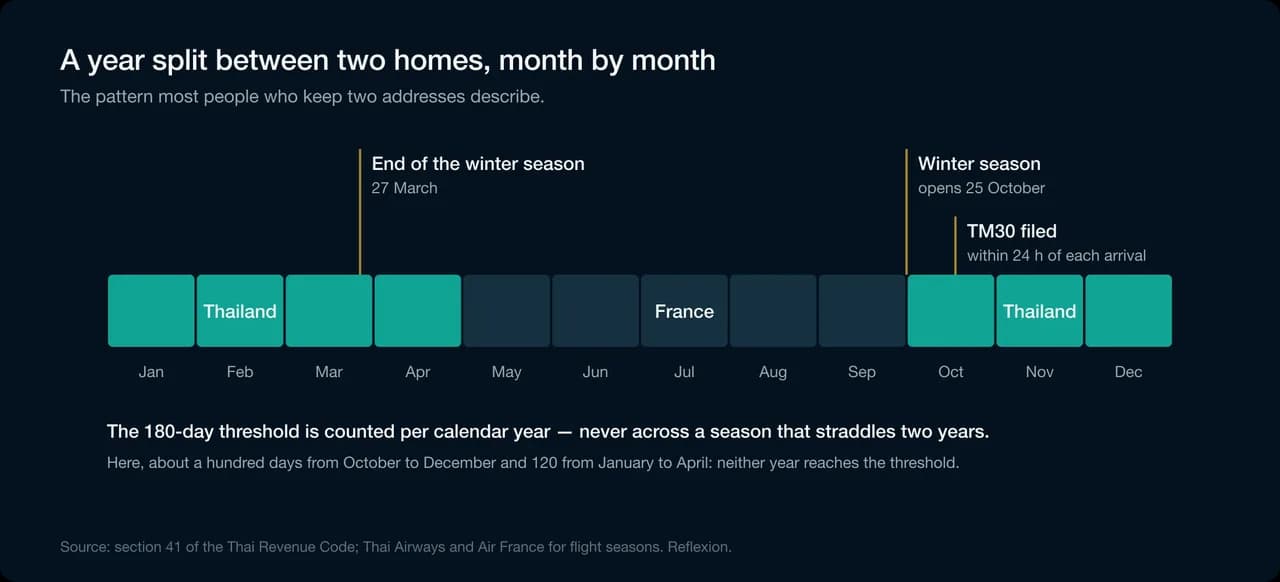
From these two overlapping calendars emerges a pattern found among most people who keep two addresses: arrive in the autumn, leave in the spring. It is not a rule, it is a convergence — and it has a precise consequence.
The 180 days, a dial you set
Thailand treats as a tax resident any person present on its soil for 180 days or more in a calendar year, cumulative rather than consecutive days — section 41 of the Thai Revenue Code, as stated on the Revenue Department's website. The threshold is neither a cap on stays nor a penalty: it is a tipping line, and whether you cross it depends on how you distribute your months.
What crossing it entails has changed recently. Since 1 January 2024, Revenue Department instruction Por. 161/2566 makes foreign-source income received by a Thai tax resident taxable in the year it is remitted to Thailand, whatever the year in which it was earned; instruction Por. 162/2566 protects savings accumulated before that date, provided they can be documented. On the French side, the France–Thailand tax treaty of 27 December 1974 eliminates double taxation on property income by exemption subject to the effective-rate rule, not by tax credit.
The rule, dated.
Thai tax residence from 180 cumulative days in the calendar year (section 41 of the Thai Revenue Code). Taxation of foreign income in the year of its remittance since 1 January 2024 (instruction Por. 161/2566). The "year of earning or following year" exemption remains a draft not published in the Royal Gazette as of 24 September 2026.
These mechanisms have their own article: we detail them, with figures and treaty articles, in our analysis of the French taxation of a Thai property. Let us retain just one thing here, which is enough to organise a year: the number of days is a variable you steer when booking your tickets, not a figure you discover in December. The choice of stay arrangement follows the same logic — thresholds and durations are covered in our article on residence and property.
Healthcare: what exists for a French national in Thailand
This is the most useful section, and the most specifically French. Two framing facts, from the "Healthcare costs" page of the French Embassy in Thailand, updated on 21 April 2026.
The first: the French State does not cover the healthcare costs of French nationals hospitalised or treated abroad. This information appears on page 32 of the passport. The second is structural for any planning: there is no social security agreement between France and Thailand. The page states that such agreements exist with certain countries; Thailand is not one of them. This is not a warning; it is an input: cover is built, it is not carried over.
What exists to build it, on the French side, is the Caisse des Français de l'Étranger (CFE), the health and social insurance fund for French nationals abroad. Its subsidised category requires cumulative conditions: French nationality, residence outside the European Economic Area and Switzerland, registration on the register of French nationals living abroad, and annual income below €24,030 for 2026, or about THB 922,100. The flat-rate contribution has been €228 per quarter since April 2025, or €912 over the year (about THB 35,000), for sickness-maternity, work-accident and pension cover. Above the income ceiling, this category is not open, and the rates of the other categories have not been collected here.
The rest of the market consists of international private insurers, which act as first-line or top-up cover, and — often forgotten — of cover already held: the embassy recommends checking what bank cards, mutual health insurance and home insurance contracts cover, as they sometimes include repatriation and hospitalisation for stays of less than 90 days. We compare no contracts and recommend no products: this is a matter for a broker, and the interplay between CFE reimbursement and international hospital billing should be clarified with the Caisse itself.
On the hospital side, the map is changing. Bangkok Hospital Phuket and Bangkok Hospital Chiang Mai are JCI-accredited — and healthcare provision is taking shape faster than the housing that connects to it, as we detailed in our analysis of longevity and wellness. And Bumrungrad, Thailand's leading private hospital group, is building its first campus outside Bangkok in Phuket: THB 4.3 billion (≈ €112 million), 16.5 rai less than ten minutes from the international airport, 120 beds in the first phase and 212 eventually. The piles were driven in February 2025; opening is announced for 2027.
School, when there are children
Two Thai schools are accredited by the AEFE, the French agency for education abroad, and their status is not the same. The Lycée français international de Bangkok is under agreement (conventionné) — bound to the AEFE by an agreement, with seconded staff — and accredited from nursery to the final year of secondary school for 1,057 pupils. BCIS Phuket, in Chalong, is a partner school: also accredited from nursery to the final year of secondary school, for 212 pupils, but with neither an agreement nor seconded staff. For a family, the difference concerns supervision and continuity of the curriculum; it deserves to be considered before choosing a city. These two entries come from the AEFE's official directory.
For families aiming for English-language schooling, Phuket concentrates the offer: British International School Phuket, whose 2026-2027 fees published on its own website range from THB 489,000 (≈ €12,700) in kindergarten to THB 982,700 (≈ €25,600) in secondary, with full boarding between THB 473,550 and THB 509,300 a year; UWC Thailand, in Thalang, a non-profit school that states it provides more than 6 million dollars in financial aid each year. And an announced opening: North London Collegiate School Phuket, in Cherng Talay, whose agreement with VLC Group was signed in May 2026 for an opening announced for the third quarter of 2028, with day and boarding places and a capacity of about 1,000 pupils rising to 1,500. The agreement is signed; no construction is documented to date.
Day-to-day paperwork: who declares what
Three obligations, often confused, and none of them complicated once assigned to the right person.
TM30 is a notification of residence, and it is the owner, landlord or possessor of the accommodation who files it — not the foreigner staying there. It is due within 24 hours of a foreigner moving in, and again after each of their returns from abroad, even to the same address. A French owner occupying their own condominium therefore declares their own arrival and each of their returns; if they let to a foreigner, they declare each time the tenant moves in.
The 90-day report (form TM47) is a separate obligation, which falls on the foreigner themselves and does not limit the length of the authorised stay: an O-A visa holder can stay twelve continuous months per entry while filing a report every 90 days. The filing window runs from 15 days before the due date to 7 days after, and any departure from the country resets the counter to zero — which, for a life shared between two countries, often means never having to file it.
Finally, the paper TM6 arrival card has been replaced by the Thailand Digital Arrival Card, mandatory since 1 May 2025, to be completed online before each arrival.
What a year at two addresses really costs
Here, honesty is worth more than an average. We do not publish an item-by-item cost-of-living comparison between France and Thailand, because no source with a published methodology provides one. The World Bank indicator dedicated to consumption (`PA.NUS.PPPC.RF`) has been withdrawn from its catalogue, and crowd-sourced aggregators have neither a sample nor controls.
What we do know is more useful than a national average, because it is local. According to the Trade Policy and Strategy Office of the Thai Ministry of Commerce, the consumer price index for April 2026 rose by +3.91% in the South — so in Phuket and Samui — against +2.89% nationally, +2.97% in the Centre (Pattaya, Hua Hin), +2.83% in the North (Chiang Mai) and +2.56% in Bangkok and its surroundings. These are price changes, not levels: they say where prices are rising fastest, not where life is most expensive. No cost-of-living level index by Thai city exists in an official source.
Cost can also be read in the property entry ticket. On condominium transfers to foreign buyers recorded in 2025, the calculated average ticket comes out at THB 5.12 million in Phuket (≈ €133,300) against THB 2.84 million in Chiang Mai (≈ €74,000), THB 2.78 million in Pattaya and THB 2.60 million in Koh Samui — these last three forming the bottom of the grid of our six destinations. The full reading of these series can be found in our analysis of the Thai property market.
The published amounts that structure a shared year, as of 24 September 2026:
| Item | Amount | Source and date |
|---|---|---|
| CFE, flat-rate contribution (subsidised category) | €228 / quarter (≈ THB 8,750) | French Embassy, page of 21/04/2026 |
| CFE, 2026 income ceiling (subsidised category) | €24,030 / year (≈ THB 922,100) | idem |
| BISP, annual fees, kindergarten | THB 489,000 (≈ €12,700) | BISP official website, 2026-27 |
| BISP, annual fees, secondary | THB 977,900 – 982,700 (≈ €25,500 – 25,600) | idem |
| BISP, full boarding | THB 473,550 – 509,300 (≈ €12,300 – 13,300) | idem |
| Average ticket, transfers to foreigners, Phuket 2025 | THB 5.12 m (≈ €133,300) | Calculation on REIC data, 2025 |
| Average ticket, transfers to foreigners, Chiang Mai 2025 | THB 2.84 m (≈ €74,000) | idem |
| Failure to file TM30, maximum fine (owner) | THB 2,000 (≈ €52) | Immigration Act, s. 38 |
What makes a second address work?
Five criteria separate a good project from an average one, and none of them concerns the price per m².
The real distance to an airport with direct flights. Not the advertised distance: the measured distance, in minutes, and to which airport. Direct links from Paris are seasonal — Air France's Phuket service is a winter route, and Thai Airways' doubling covers the high season from 25 October to 27 March. An eight-month presence a year cannot be built on a four-month route. In Koh Samui, the airport belongs to Bangkok Airways and operates under a regulatory cap of 73 flights a day.
Hospital facilities, in minutes of travel. A JCI-accredited hospital twenty minutes away is not the same asset as a JCI-accredited hospital an hour away in high season.
Schooling, if it is at stake. Two AEFE-accredited schools in the whole country, in Bangkok and in Phuket, and none identified in Chiang Mai: this rules out cities before the housing question even arises.
Managing the property while you are away. Six months of vacancy a year, in a tropical climate, require someone who opens up, airs the place and checks it — and, if the property is let, who files the TM30 within 24 hours.
Actual running costs relative to the season of presence. Condominium charges run for twelve months; presence does not. It is the simplest calculation and the one most often left out.
Across the 7,865 projects we track in six provinces, 80 districts and 308 sub-districts, we measure real distances to transport, beaches and amenities. This makes it possible to replace "close to the airport" with a number of minutes, and to compare two addresses at equal granularity rather than two cities.
The typical rhythm of a shared year, what is decided and when:
| Period | Where | Tax and reporting side | To anticipate |
|---|---|---|---|
| Late October – November | Arrival in Thailand | TDAC to complete before arrival; TM30 filed by the owner or landlord within 24 h | Winter flight season opens on 25 October; bookings for seasonal direct flights |
| December – January | Thailand | Count of days in the current calendar year, then reset to zero on 1 January | Tourist high season: prices and visitor numbers at their peak |
| February – April | Thailand, preferably outside the North | 90-day report if no departure from the country since arrival | Burning season in the North, peaking in March (IQAir) |
| Late March – April | Return to France | Departure from the country: 90-day counter reset to zero | End of the winter flight season on 27 March; new TM30 on the next return |
| May – September | France | Thai day count closed for the current calendar year | Monsoon on the Andaman side; management and upkeep of the property in your absence |
| October | France | Final decision: stay below 180 cumulative days or switch to Thai tax residence | Decision made before buying the tickets, not after |
When we model a year at two addresses
The situation. She is 43, a freelance consultant for European clients; their son is starting secondary school. They want to spend October to April in Thailand and the rest in France, and to buy rather than rent. Purchase budget: THB 7 million, or about €182,400.
What the figures impose. Schooling settles the geographical debate before the budget does: two AEFE-accredited schools exist in the country, in Bangkok and in Phuket, and none in Chiang Mai — which nonetheless showed, with an average ticket of THB 2.84 million against THB 5.12 million in Phuket, a markedly lower entry cost. For an English-language option in Phuket, BISP's secondary fees stand at THB 977,900 – 982,700 a year, or €25,500 to €25,600. The ticket gap between the two cities — THB 2.28 million — is a one-off cost; schooling is an annual cost: from the third year, its cumulative total exceeds that gap, and it keeps running afterwards. On the health side, her income puts her above the CFE subsidised category's ceiling of €24,030: she will need to look at the other categories and the private market with a broker.
The calendar. This is where the reasoning is done by hand, and where many get it wrong. From October to April, they are in Thailand for about seven months — but those seven months are spread over two calendar years: around a hundred days from October to December, a hundred and twenty from January to April. Counted this way, neither year reaches 180 days, and Thai tax residence is not triggered. It would be as soon as one calendar year totals 180 days or more — if a summer stay were added, or if the spring return slipped into June. The threshold is assessed calendar year by calendar year, never over a season straddling two years, and it is this count that a tax adviser familiar with both countries validates before the first long stay.
Their decision. They buy in Phuket, in the Chalong area, close to an accredited school and to Bangkok Hospital Phuket, and they set their calendar to stay below 180 days per calendar year, a count validated by a tax adviser familiar with both countries — knowing that a single additional summer stay would change their status. In return, they accept the highest inflation in the country — +3.91% in the South in April 2026 — and the seasonal nature of the direct Paris–Phuket flight, by routing their spring returns via Bangkok. Before signing, they ask for a comparison of sub-districts based on measured distances to the school, the hospital and the airport.
Modelled scenario. This profile is not a client; the parameters are working assumptions.
What you can do now
Start by setting out your calendar, not your budget. Write down the months you would really spend in Thailand, add them up, and see where the total falls relative to 180. This single number determines the stay arrangement to examine, the conversation to have with a tax adviser, and the type of address that makes sense — a six-month address and a three-month address are not the same property.
Explore neighbourhoods and sub-districts by real distance to the airport, the hospital and schools in the Reflexion explorer, or ask an adviser for a quantified comparison between two addresses based on your actual calendar of presence.
Frequently asked questions
Do you have to live in Thailand for six months to buy a property there?
No. Staying requires no purchase, and it is the length of presence that determines tax residence, from 180 cumulative days in a calendar year. Conversely, a purchase can open a stay: since Immigration Bureau order 238/2568, a condominium worth at least THB 3M (€78,178) allows a renewable one-year stay, with a certification letter from the Ministry of Tourism and Sports. The choice of stay arrangement is dealt with separately.
After how many days do you become a Thai tax resident?
The threshold is 180 days of presence in the same calendar year, consecutive or not — section 41 of the Thai Revenue Code. It is triggered on the 180th day, not the 181st, and the counter restarts at zero every 1 January: a season straddling two years does not add up. What crossing it entails falls under instruction Por. 161/2566, in force since 2024, and should be quantified by a tax adviser familiar with both countries.
Is there a social security agreement between France and Thailand?
No. That is what emerges from the page on healthcare costs of the French Embassy in Thailand, updated in April 2026: no bilateral agreement is mentioned there for this country, and the French State does not cover care received abroad. Practical consequence: cover is set up locally, through the Caisse des Français de l'Étranger or a private contract.
Is there an accredited French school outside Bangkok?
Yes, just one: BCIS Phuket, in Chalong, 212 pupils, accredited from nursery to the final year of secondary school with partner status. The Lycée français international de Bangkok, larger with 1,057 pupils, is for its part under agreement. Elsewhere, nothing — no accredited school has been identified in Chiang Mai, which rules the city out for a family attached to the French curriculum.
Who has to file the TM30: the owner or the tenant?
The owner, or the landlord — not the foreign occupant. The notification is due within 24 hours of their moving in, then on each of their returns from abroad, even to the same address. Not to be confused with the 90-day report, which is the foreigner's own responsibility, shortens no authorised length of stay, and restarts from zero on each departure from the country.
Is life cheaper in Phuket or in Chiang Mai?
Neither: the question has no measured answer. There is no official index of price levels by Thai city, only regional changes — in April 2026, +3.91% in the South against +2.83% in the North. What can really be compared is the property entry cost: an average ticket of THB 5.12 million in Phuket against THB 2.84 million in Chiang Mai on 2025 transfers.
Method and sources
Sources checked September 24, 2026
Exchange rate used: 1 EUR = 38.374 THB (24 September 2026).
- 1 EUR = 38.374 THB (24 September 2026). All conversions are indicative and rounded. The Caisse des Français de l'Étranger's amounts are natively denominated in euros: they are given in euros, with the baht equivalent in brackets.
- Calculations carried out by us: the average tickets by province are obtained by dividing the published value by the number of published units in the REIC series for 2025. The REIC does not publish this column, and it is not a price per m²: floor area is published only at national level.
- Statuses used: actual (measured, recorded, in service) / announced (dated public commitment by an identified player) / projected (study, forecast). The Air France Paris–Phuket link has been operating since November 2025; Thai Airways' doubling on Paris–Bangkok is announced; the opening of NLCS Phuket is announced, on a signed agreement, with no documented construction; the Bumrungrad campus in Phuket is under construction, with opening announced for 2027.
- French Embassy in Thailand, Prise en charge des frais de santé (healthcare costs), page updated on 21/04/2026 — https://th.diplomatie.gouv.fr/fr/social/prise-en-charge-des-frais-de-sante
- Thai Airways, doubling of the Paris–Bangkok service, via Le Petit Journal Thaïlande, 20-21/09/2026 — https://lepetitjournal.com/thailande/thai-double-vols-bangkok-paris-haute-saison-touristique-453955
- Air France, corporate press release of 16/04/2025 (Paris-CDG ↔ Phuket nonstop) — https://corporate.airfrance.com/en/news/winter-2025-2026-air-france-will-offer-new-nonstop-service-between-paris-charles-de-gaulle-and
- AEFE, official directory, Lycée français international de Bangkok and BCIS Phuket entries — https://aefe.gouv.fr/fr/etablissements/bcis-phuket
- British International School Phuket, 2026-2027 fee schedule — https://www.bisphuket.ac.th/admissions/school-fees/
- UWC Thailand, the school's official page
- NLCS International, press release of 14/05/2026 — https://www.nlcsinternational.co.uk/news/nlcs-phuket-launch/
- Bumrungrad International Hospital, press release of 11/12/2025 — https://www.bumrungrad.com/en/blog-news/announces-phuket-create-world-class-medical-and-wellness-hub
- Revenue Department (Thailand), tax residence rule — https://www.rd.go.th/english/6045.html
- HLB Thailand, instructions Por. 161/2566 and Por. 162/2566, update of 17/10/2025 — https://www.hlbthai.com/thailands-foreign-income-tax-changes-now-in-force/
- ThaiLawOnline, tracking of the status of the exemption on remitted income, update of 05/09/2026 — https://www.thailawonline.com/thailand-remittance-tax-exemption-status/
- BOFiP, France–Thailand tax treaty of 27/12/1974, BOI-INT-CVB-THA — https://bofip.impots.gouv.fr/bofip/490-PGP.html/identifiant=BOI-INT-CVB-THA-20120912
- DeeMED Consulting, TM30 and 90-day reporting, 01/08/2026 — https://www.deemedconsulting.com/insights/2026-08-01-tm30-90-day-reporting-compliance
- TAT, Thailand Digital Arrival Card — https://www.tourismthailand.org/Articles/tdac
- REIC (Real Estate Information Center, Government Housing Bank), condominium transfers to foreigners by province, full year 2025, via Prachachat Turakij, 02/03/2026 — https://www.prachachat.net/property/news-1971437
- Trade Policy and Strategy Office (Thai Ministry of Commerce), consumer price index by region, April 2026, via Nation Thailand, 31/05/2026 — https://www.nationthailand.com/business/economy/40066875
- C9 Hotelworks, Samui Hotel & Tourism Market Review 2025, via Hospitality Net — https://www.hospitalitynet.org/news/4127624.html
- Bangkok Airways via Kaohoon International, 01/12/2025 (cap of 73 flights/day in Samui) — https://www.kaohooninternational.com/markets/571273
- IQAir, World Air Quality Report 2025, via Nation Thailand — https://www.nationthailand.com/news/general/40064230
What we could not verify
- Item-by-item cost-of-living comparison France/Thailand (rent, food, restaurants, fuel): no source with a published methodology provides one. The World Bank's PA.NUS.PPPC.RF indicator, dedicated to consumption, has been withdrawn from its catalogue. We publish none.
- Cost-of-living level index by Thai city: none exists in an official source. Only regional price-index changes are published.
- Actual out-of-pocket costs for a CFE member in Thailand: the embassy page does not spell out the interplay between reimbursement on a French basis and international hospital billing. To be clarified with the Caisse.
- CFE rates outside the subsidised category: not collected. The €228 per quarter applies only to the subsidised category, under an income ceiling.
- Rates and cover of international private insurers, and the average cost of a hospital stay in Thailand: not published here. Comparison sites and brokers are paid on subscription and were not used as sources.
- Renewal of the Air France direct Paris–Phuket flight for winter 2026-2027, and Air France Paris–Bangkok frequency: not published. A seasonal route may not be renewed; schedules to be checked with the airline.
- Chiang Mai's 2026 pollution episodes. The daily values and administrative statements reported by the press could not be cross-checked against a primary government document: none is published here. Only the IQAir annual average and the February-April window are used.
- Current AEFE accreditation for schools in Pattaya, Koh Samui and Bangkok other than the LFIB: sources from 2019-2021, individual verification required. No AEFE-accredited school has been identified in Chiang Mai.
- Enrolment and tuition fees of UWC Thailand; enrolment of British International School Phuket: not published at a primary source. Only BISP's fees are.
- Fees, age range and campus size of NLCS Phuket: not published in the announcement press release.
- Treatment of French pensions under the 1974 tax treaty: not verified here. No statement is made on this point.
- Volume of DTV visa applications and any geographical breakdown of these visas by city: no source attributes these figures to a named Thai body. Not used.
This article is general information, not legal or tax advice. The rules cited are dated: check with a qualified professional that they are still in force before acting.