What March 2025 taught Bangkok's towers
Nearly 7,000 buildings inspected in Thailand after March 2025, 55 barred from use, only 2 of them in Bangkok. The six documents a buyer can ask for.
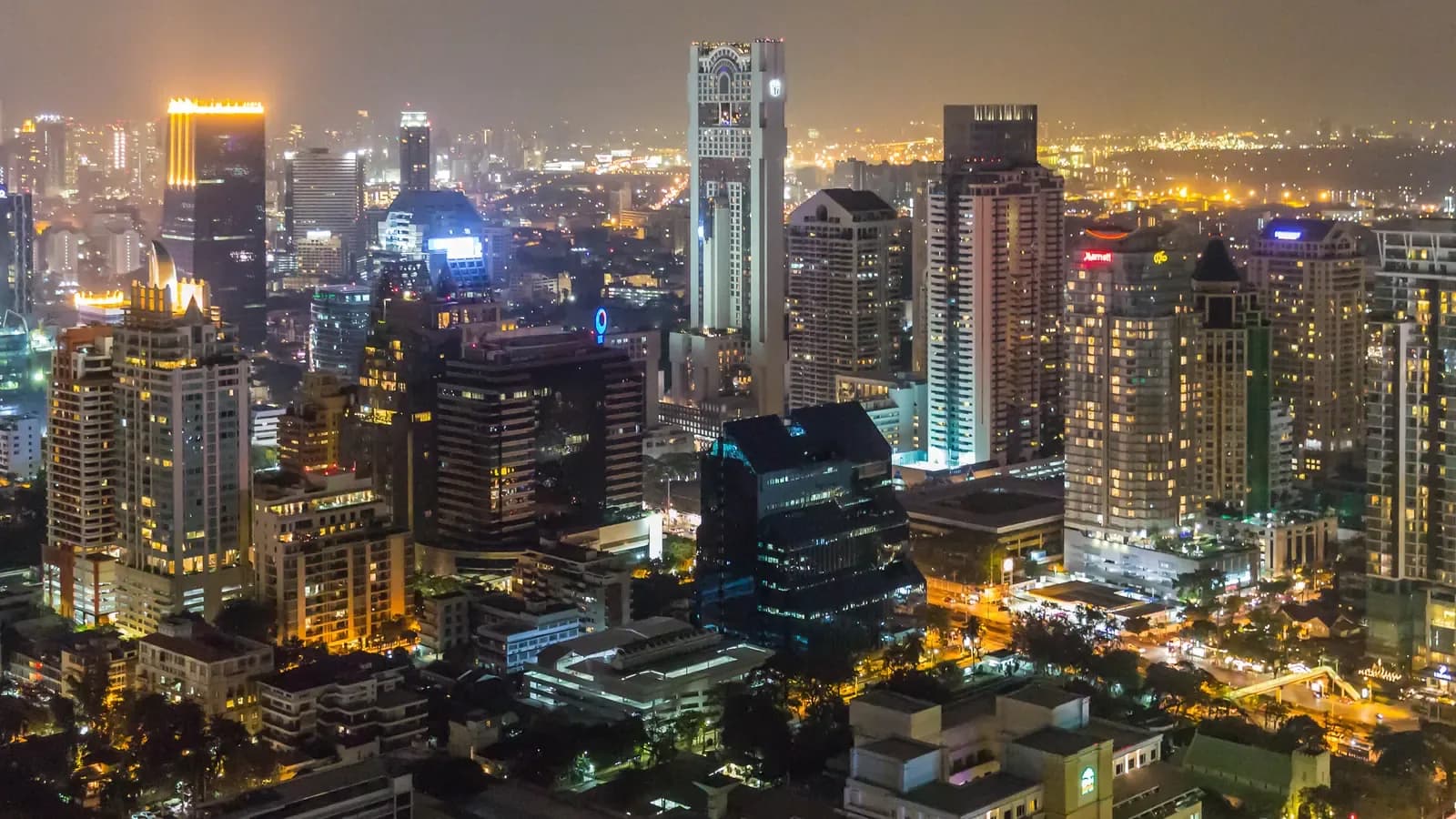
Several hundred towers, ten million inhabitants, and ground whose softness geologists know well: until 28 March 2025, no one had seen Bangkok put through a real earthquake. That day, the city was tested at full scale, and the instruments were in place. Accelerometers recorded, the Department of Public Works inspected nearly 7,000 buildings in ten days, and researchers compared the ground motion with the code's design spectra. What remains is a body of evidence about its building stock that few cities possess — and what it says about the Thai property market is more precise than what most people took away from it.
What the records say first
Across the whole metropolitan area, only one building collapsed completely: the State Audit Office tower in Chatuchak — a public office building still under construction, never handed over, never occupied. CBS News, as early as 31 March 2025, described it as the only tower in Bangkok to have given way entirely; a study published in 2025 in the Bulletin of Earthquake Engineering reaches the same conclusion. No occupied residential building collapsed.
The inspections give the measure of the rest. Of 6,903 buildings examined nationwide between 28 March and 6 April 2025, 55 were barred from use, only two of them in Bangkok; of 498 public buildings surveyed by the Earthquake Research Centre of Thailand, 91.2% were undamaged. Damage was widespread; structural failures remained the exception.
What the inspections found, March-April 2025:
| Scope | Buildings examined | Safe | Moderate damage | Barred from use |
|---|---|---|---|---|
| Thailand — DPT and BMA, 28 March to 6 April 2025 | 6,903 | 6,487 | 361 | 55 (2 of them in Bangkok) |
| Public buildings — DPT, 2 April 2025 | 3,375 | 3,130 | 211 | 34 severely damaged |
| Public sample — Earthquake Research Centre of Thailand, 5 April 2025 | 498 | 454 (91.2%) | 42 (8.4%) | 2 (0.4%) |
What happened, precisely
The earthquake occurred on the Sagaing Fault, in Myanmar, at a depth of 10 kilometres. The USGS gives a magnitude of Mw 7.7, a strike-slip mechanism and a supershear rupture of 460 to 500 kilometres, one of the longest ever observed. The epicentre lies about 1,000 kilometres from Bangkok; as the rupture propagated southwards, its closest point to the capital was about 600 kilometres away.
In Bangkok, peak ground acceleration measured at the PWSA station reached 0.019 g north-south and 0.023 g east-west: the strongest motion ever recorded in the capital, and a low acceleration in absolute terms. What mattered was not the violence of the shaking but its period and its duration.
The magnitude used is Mw 7.7.
It is the value published by the USGS and adopted by the scientific literature, and everything that follows rests on it — including the spectra against which the Thai code was tested.
Why does a city a thousand kilometres from the epicentre move?
Bangkok is built on a deep sedimentary basin: bedrock lies 500-2,000 metres below the surface, beneath 15 to 30 metres of soft clay with a very low shear-wave velocity. The mechanism, described by Ornthammarath and co-authors in Geoenvironmental Disasters in 2023, comes down to the contrast between these two media: the wave slows down as it enters the sediments, part of its energy becomes trapped there and is converted into surface waves, mainly Love waves. The motion is not only amplified; it lasts longer than at a nearby rock site. On 28 March 2025, amplification was measured relative to stations outside the basin — about 3 in acceleration, 4 to 5 in velocity — in two period bands: 1 to 3 seconds and 5 to 7 seconds.
These two bands are what matters to a buyer. A building resonates when its natural period of oscillation matches that of the ground. A low-rise house oscillates over a very short period: the basin does not affect it. A sixty-storey tower oscillates over about six seconds — exactly in the second amplified band. That is why, a thousand kilometres from an earthquake, it felt what a single-storey house did not. It is not an anomaly; it is physics, and Thai engineers know it.
Thailand did not discover seismic design in 2025
This is the decisive section for anyone comparing two buildings. Thailand's seismic regulations were not born of the earthquake: they have existed since 1997, have covered Bangkok since 2007, and were last tightened in 2021 — four years before.
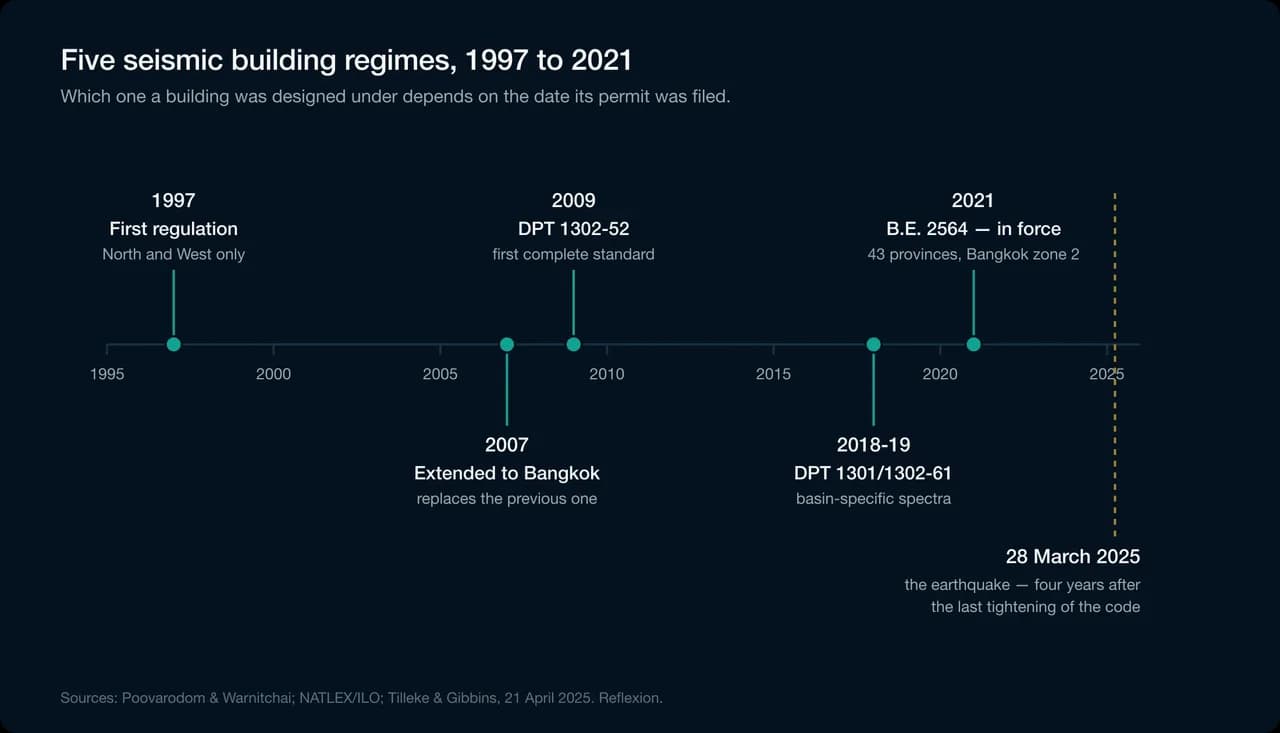
The five successive regimes, and the one under which a building was designed:
| Year | Text | What it introduced |
|---|---|---|
| 1997 | Ministerial Regulation No. 49 (B.E. 2540) | Thailand's first seismic regulation. Northern and western regions only. Equivalent static forces, based on the 1985 *Uniform Building Code* |
| 2007 | Ministerial Regulation B.E. 2550 | Extension to Bangkok. Replaces the previous one |
| 2009 | DPT 1302-52 | First complete technical standard, built on ASCE 7-2005. Modern analysis procedures and detailing provisions |
| 2018-2019 | DPT 1301/1302-61 | Design earthquake raised to the MCE with a 2,475-year return period. Spectra specific to the Bangkok basin, microzonation into 10 zones. Spectral acceleration at 1.0 s raised by about 25% |
| 2021 | Ministerial Regulation B.E. 2564 | Regulation in force. Published on 4 March 2021, applicable 180 days later. 43 provinces instead of 22, 3 zones, Bangkok in zone 2 (moderate hazard). From 18 to 30 building categories. Modified response spectrum analysis (MRSA) mandatory, with reference to DPT 1301/1302-61 |
The most telling fact fits in one sentence. According to a case study by the engineering firm Meinhardt on a 36-storey tower in Bangkok, the calculation method required in 2021 produces seismic forces at least three to four times higher than those required by the 2007 regulation.
The nuance comes from the same document and matters as much as the figure: this tower, designed under the old regulation and then reassessed during construction under the new one, met it without structural strengthening, with non-linear time-history analysis showing actual storey forces at about 70% of those predicted — a 30% margin.
What changes between 2007 and 2021 is not safety: it is the demonstration required, and its traceability.
The tightening of the code is real and measurable, but it does not make earlier buildings dangerous: the margins built into Thai practice mean that a building designed under the old regulation can meet the new one without works. Ministerial Regulation B.E. 2564, published on 4 March 2021, in force since late August 2021.
Did the code pass its first real test?
Over the range that concerns the vast majority of buildings, yes. The authors of the Bulletin of Earthquake Engineering study compared the ground motion of 28 March 2025 with the design spectra of the DPT 1301/1302-61 standard. Between 1 and 3 seconds — the range of ordinary high-rise buildings — the design spectra exceeded the actual demand. The code was on the right side. Beyond 5 seconds, however, the recorded accelerations exceeded the code values. This is the range of the most slender towers, and the researchers draw a recommendation from it: incorporate 2D and 3D basin amplification effects.
An open point, and it is better to say so.
No new text has been adopted since to act on it. Prof. Pennung Warnitchai, who heads the Earthquake Research Centre of Thailand, announced in April 2026 a pilot instrumented-monitoring project on twenty buildings, planned for 2027. It is an announced project, not an obligation.
What the investigation established about the Chatuchak tower
The State Audit Office tower had 33 storeys and stood 137 metres tall. The contract, awarded to a consortium of Italian-Thai Development and China Railway No.10 Engineering Group (Thailand) for THB 2.136 billion (€55.7 million), had started in 2020: the structural shell had just been completed, and the façade and building services were in progress — a building neither finished, nor handed over, nor certified for occupancy.
Ninety-five deaths had been confirmed when the search ended, on 13 May 2025; the consolidated toll after identifications stands at ninety-six. The victims were overwhelmingly construction workers on the site, many of them migrant workers. The State paid THB 129.86 million (€3.38 million) in preliminary aid and compensation.
The official State Audit Office report, published on 20 March 2026, identifies four causes:
- The collapse began at levels 1 to 4, through shear failure of the shear walls.
- The concrete cores taken from these walls had a strength below the specified threshold.
- The construction drawings did not comply with regulations, resulting in a structural strength below the legal minimum.
- The anchorage length of the reinforcement between coupling beams and shear walls was shorter than required.
All four causes are construction defects; none of them implicates Bangkok's seismicity. The question of the reinforcing steel led to divergent conclusions and is not among them.
The courts have been seized: on 7 August 2025, twenty-three individuals and entities were indicted before the Criminal Court on sixty-seven counts, including non-compliant construction causing death and offences under the Building Control Act. The proceedings are ongoing; no ruling on the merits had been handed down as of 24 September 2026.
What can be checked before buying?
At a round table of the Asia Real Estate Summit on 2 October 2025, Thai professionals summed up the change: "It is no longer just a question of location. It is a question of trust." Trust, here, is documented.
- The building permit, form Or.1 (อ.1), under section 21 of the Building Control Act: its filing date shows under which seismic regulation the project was designed.
- The certificate of occupancy, form Or.6 (อ.6), under section 32: it attests that the completed building has been inspected and may be occupied.
- The engineer's inspection certification, under section 32 bis, for buildings of 23 metres or more, or of more than 10,000 m².
- The EIA approval, mandatory before the permit. The threshold commonly cited is 80 units and/or 4,000 m², but two divergent formulations circulate: a Thai lawyer will settle it.
- The annual and five-yearly inspection reports, required by Ministerial Regulation B.E. 2548 of 2005 for buildings taller than 23 metres and condominiums of more than 2,000 m². The condominium's juristic person (building management) holds them, and failure to comply is punishable by a fine of up to THB 60,000 (€1,563), then THB 10,000 (€261) per day.
- The structural engineer's licence, with the Council of Engineers, which keeps the register of licensed engineers.
On structure, the standard system for Bangkok towers is documented: a central core of reinforced-concrete shear walls combined with perimeter frames, with performance-based design for slender buildings. A serious developer can say which one it chose, and under which regulation its permit was filed.
An honest clarification: in none of the legal sources consulted did we find a standardised "seismic compliance certificate" handed to the buyer. Compliance is carried by the permit and by the engineer's signature — so it is the permit you should ask for.
Warranty and insurance: what exists, what does not
The standard sale contract for a condominium unit must provide for a developer's warranty of five years for the structure and equipment, two years for other components — section 6/2 of the Condominium Act, mandatory public-order minimums. Under general law, section 600 of the Civil and Commercial Code makes the contractor liable for defects for five years from delivery, and section 601 requires action to be brought within one year of the defect appearing.
What the text guarantees, and what we could not establish.
The five-year warranty on the structure and two-year warranty on other components is a contractual obligation of the developer, of public order — Condominium Act B.E. 2522, section 6/2, in force since 4 July 2008. It is not insurance cover, and that is a difference in kind from the French ten-year builder's warranty (garantie décennale). On the other hand, we found no compulsory construction damage insurance of the French dommages-ouvrage type in Thai law, without being able to establish that none exists: the point needs to be confirmed by a Thai lawyer, and we do not publish it as a rule.
On the insurance side, earthquakes are covered by Thai fire policies — but with a sub-limit: THB 20,000 per year (€521) on a standard residential policy, with an optional extension available. In a condominium, the common areas fall under an Industrial All Risk policy taken out by the building management; the private unit falls under the owner's policy, and therefore under this sub-limit. The point to watch is not the cover; it is its ceiling. On 7 July 2025, the Thai General Insurance Association estimated claims at up to THB 50 billion (€1.30 billion) for around 150,000 claims filed.
What the market did next
In April 2025, Kasikorn Securities expected a 50% fall in high-rise condominium transfers over the year. The consolidated figures corrected it: according to the REIC, 2025 ended with 316,214 transfers, down 9.1%, for THB 864.913 billion (€22.54 billion). Above all, the fourth quarter marked a recovery, led by condominiums: up 8.6% in volume and 17% in value. The REIC expects 2026 to stabilise at 314,593 transfers.
The most telling point lies elsewhere: the analyses published in January and February 2026 — KKP Research, REIC, JLL, CBRE, Colliers — no longer attribute the market's weakness to the earthquake, but to household debt and credit restrictions. The market settled the question itself, in less than three quarters. This movement does not read the same way from one province to another, and we have detailed it destination by destination in our comparison of Thailand's six markets.
Who published what
Four listed developers published verifiable communications. AP Thailand inspected its 82 projects between 28 March and 3 April 2025, in two phases — in-house engineers, then four named external experts. Origin Property inspected 55 of its 83 delivered projects, Supalai its 90 projects nationwide, and Sansiri claims more than 200 projects declared safe. Eleven others reported inspections through the press.
These statements come from the developers themselves.
They attest to an inspection process and a willingness to be transparent, not to independent certification. None specifies the seismic regulation under which the projects concerned were designed — which remains, for the buyer, the most useful question. We publish no ranking of developers by safety: the data needed to establish one does not exist.
When we model a choice between two buildings
Laurent, 54, Lyon. Budget: THB 11 million (€286,600). Two apartments on the shortlist in Bangkok.
The first is 62 m² in a 2012 tower, seven minutes from a BTS station, noticeably cheaper per square metre than the second — 58 m² delivered in 2025, further out. Laurent asks for three documents.
The two Or.1 permits. The 2012 tower's was filed under regulation B.E. 2550; the 2025 project's under B.E. 2564 — the difference in method described above, measured at three to four times in one case study. Not an observed difference in safety: a difference in the demonstration required.
The Or.6 certificates of occupancy and the section 32 bis engineer's certifications, which both buildings produce, being taller than 23 metres.
The latest five-yearly inspection report, held by the building management. The 2012 tower's is dated, signed by an engineer whose licence Laurent has checked with the Council of Engineers, and records no structural defect after March 2025. The 2025 project, too recent, has no five-yearly history — only its original compliance.
Laurent buys the 62 m² unit from 2012: documented compliance and an inspection history, no defect after March 2025, and a price difference that pays for the earthquake insurance extension his policy caps at THB 20,000 (€521) a year. He has the file reviewed by a Thai lawyer and the reports read by a structural engineer before signing.
Modelled scenario. This profile is not a client; the parameters are working assumptions.
What you can do now
Placing a building against the successive versions of the code is an exercise in dating before it is a technical one. For 7,865 projects, our database indexes the year of completion, the number of storeys and the developer: these three fields are enough to know under which regime a project was most probably designed. It is a sorting method, not an engineer's opinion — the Or.1 permit alone settles it.
Whether you are comparing two Bangkok towers or branded residences, first place them in time with the project explorer and the developer leaderboard, then ask us for the list of documents to request from the seller. For structural analysis and legal review, we refer you to an engineer licensed by the Council of Engineers and to a Thai lawyer.
Frequently asked questions
Is Bangkok an earthquake-risk city?
Bangkok is classified in zone 2, moderate hazard, by Ministerial Regulation B.E. 2564 of 2021. It is far from active faults, but its clay subsoil amplifies long waves coming from far away: on 28 March 2025, measured amplification reached a factor of 3 in acceleration and 4 to 5 in velocity compared with sites outside the basin. It is this amplification, not local seismicity, that concerns towers.
How many buildings collapsed in Bangkok in March 2025?
One, and only one: a 33-storey public office tower in Chatuchak, which had been neither completed, nor handed over, nor occupied. CBS News established this as early as 31 March 2025 and a study in the Bulletin of Earthquake Engineering confirms it. The point that matters to a buyer is the other half of the finding: among occupied residential buildings, none gave way.
Should buildings built before 2021 be avoided?
The available sources do not justify it. The gap between the two calculation methods — three to four times on forces — comes from a single case study, Meinhardt's on a 36-storey tower, and it concerns the demonstration required, not observed safety: in that same case, the older building met the new standard without works. One case does not make a rule; it is the permit of the building under consideration that answers the question.
Which documents should I ask the seller or developer for?
Six, and they all exist: the building permit (Or.1), the certificate of occupancy (Or.6), the engineer's inspection certificate required above 23 metres, the environmental approval, the annual and five-yearly inspection reports held by the building management, and the engineer's registration with the Council of Engineers. The first is the most revealing: its filing date tells you under which seismic regime the building was designed.
Does my insurance cover an earthquake in Thailand?
Yes, but very little. The risk is included in Thai fire policies, with a ceiling of THB 20,000 per year (€521) on a standard residential contract — the order of magnitude of material damage, not of a structural loss. The extension has to be requested explicitly. The private unit and the common areas also fall under two separate contracts, the second taken out by the building management: both need to be checked separately.
Did the earthquake bring down the condominium market?
For less time than predicted. In April 2025, a brokerage house was expecting high-rise transfers to halve; the REIC ultimately measured −9.1% over the year, with a fourth quarter recovering on the back of condominiums. Above all, the analyses published in early 2026 no longer attribute the market's weakness to the earthquake, but to household debt and credit conditions.
Method and sources
Sources checked September 24, 2026
Exchange rate used: 1 EUR = 38.374 THB (24 September 2026).
- Sources verified on: 24 September 2026. 1 EUR = 38.374 THB (24 September 2026). All amounts are given in THB, with the euro conversion in brackets. Editorial regime: translation. The substance of this article does not depend on the reader's nationality.
- A value not to be confused. Higher initial magnitude estimates, released in the hours after the shaking, still circulate in the press and in company statements. They were not confirmed. The value used in this article is that of the USGS and the peer-reviewed literature: Mw 7.7.
- What we did. No fact was retained without a named, verifiable source. The physical measurements come from two peer-reviewed papers and a presentation by the Earthquake Research Centre of Thailand. The inspection figures come from the Department of Public Works and Town & Country Planning and the Bangkok Metropolitan Administration, reported by the Thai press. The causes of the collapse come from the official State Audit Office report of 20 March 2026. The regulatory framework was cross-checked between an academic publication, the International Labour Organization's NATLEX database and two law-firm notes. Market figures come from the REIC.
- Ornthammarath, Warnitchai, Maruyama, Pornsopin & Yamazaki (2025), Far-field ground motion characteristics of the Bangkok Basin, Thailand, in the 2025 Mw 7.7 Mandalay earthquake, Bulletin of Earthquake Engineering, 23:6577-6602 — https://link.springer.com/article/10.1007/s10518-025-02295-7
- Ornthammarath et al. (2023), Preliminary analysis of amplified ground motion in Bangkok basin using HVSR curves, Geoenvironmental Disasters, 10:28 — https://link.springer.com/article/10.1186/s40677-023-00259-0
- USGS, M 7.7 Mandalay, Burma (Myanmar) Earthquake — https://www.usgs.gov/news/featured-story/m77-mandalay-burma-myanmar-earthquake
- Pennung Warnitchai, The Bangkok Earthquake and What We Learned From It, BKNIX presentation, 22 May 2025 — https://peeringforum.bknix.co.th/wp-content/uploads/2025/05/1.0-Bangkok-EQ-BKNIK-PF-22May2025.pdf
- Poovarodom & Warnitchai, A New Earthquake Resistant Design Standard for Buildings in Thailand — https://www.academia.edu/96985759/A_New_Earthquake_Resistant_Design_Standard_for_Buildings_in_Thailand
- Tilleke & Gibbins, Essential Building Safety Standards and Legal Obligations in Thailand, 21 April 2025 — https://www.tilleke.com/insights/essential-building-safety-standards-and-legal-obligations-in-thailand/
- Meinhardt, Seismic Design of High-rise Building using Performance Based Design — https://www.meinhardt.net/news/seismic-design-of-high-rise-building-using-performance-based-design-pbd/
- Lorenz & Partners, Basic Conditions for Building Construction in Thailand — https://www.lorenz-partners.com/wp-content/uploads/2019/01/NL221E-Basic-Conditions-for-Building-Construction-in-Thailand-Jan19.pdf
- FRANK Legal & Tax, Liability for Construction Defects — https://franklegaltax.com/liability-construction-defects-2017/
- State Audit Office one-year report, 20 March 2026, via Nation Thailand — https://www.nationthailand.com/blogs/news/general/40064045
- Nation Thailand, special report of 27 December 2025 — https://www.nationthailand.com/blogs/the-nation-special-report/40058759
- The Thaiger, DPT/BMA inspections — https://thethaiger.com/news/bangkok/earthquake-leaves-55-buildings-unusable-inspections-continue
- REIC via Nation Thailand, 26 February 2026 — https://www.nationthailand.com/blogs/business/property/40063000
- CBS News, 31 March 2025 — https://www.cbsnews.com/news/thailand-earthquake-bangkok-building-collapse-investigation-china-italy-firms
- Bangkok Post, Insuring against earthquake risk — https://www.bangkokpost.com/business/general/2996269/insuring-against-earthquake-risk
- Reinsurance News, 7 July 2025 — https://www.reinsurancene.ws/thai-insurance-claims-from-march-earthquake-could-reach-1-53bn/
- Asia Real Estate Summit, 2 October 2025 — https://www.asiarealestatesummit.com/rethinking-bangkoks-skyline-with-safety-trust-and-resilient-design/
- Proprietary element. Our database indexes the year of completion, the number of storeys and the developer for 7,865 projects. No statistic derived from this database is published here: we describe what the method makes possible, not an aggregate result we have not calculated.
- Not advice. This article is a documentary synthesis. It constitutes neither structural engineering advice, nor legal advice, nor an investment recommendation. The structural assessment of a building is a matter for an engineer licensed by the Council of Engineers Thailand; the review of sale documents and warranties is a matter for a Thai lawyer.
What we could not verify
- The exact role of the reinforcing steel in the collapse of the State Audit Office tower. The sources contradict each other and the official report does not include it among the four causes.
- The progress rate of the works at the time of the collapse. The values circulating in the press are hard to reconcile with a structural shell completed in April 2024; none is used here.
- Any court ruling on the merits in the State Audit Office case. No verdict had been found as of 24 September 2026.
- Any amendment to the Building Control Act or any new seismic regulation adopted after March 2025. None was identified: the tightening of the code dates from 2021, and so predates the earthquake.
- Any new obligation for developers to publish their design calculations or seismic certificates, and any regulatory tightening of controls on public construction sites in force after March 2025.
- The existence of a standardised seismic compliance certificate handed to the buyer, and any obligation to provide the buyer with the soil investigation report.
- The exact starting point of the five-year and two-year warranty periods under section 6/2 of the Condominium Act.
- The existence of compulsory construction damage insurance (dommages-ouvrage type) in Thailand. It is documented nowhere, but absence of evidence is not evidence of absence.
- Any actually observed increase in earthquake insurance premiums or deductibles since March 2025. All available sources are expectations formulated in 2025.
- Any effect on condominium prices directly attributable to the earthquake, and any reservation cancellation rate.
- The use of seismic base isolation in Thai residential buildings. No instance was found: it is not a selection criterion available in this market.
- Colliers' second-quarter 2025 data (page inaccessible) and any Knight Frank publication quantifying the impact of the earthquake.
- The Bangkok Metropolitan Administration's public dashboard as a usable source: all its counters showed zero on 24 September 2026.
- How the public can access the Council of Engineers' licence verification service. The register certainly exists; its online accessibility does not.
This article is general information, not legal or tax advice. The rules cited are dated: check with a qualified professional that they are still in force before acting.