Bangkok property prices: the station and the width of the soi
A hundred metres closer is worth more than $200 per square metre in the centre, less than $80 on the outskirts. And on a road narrower than ten metres, no tower gets built.
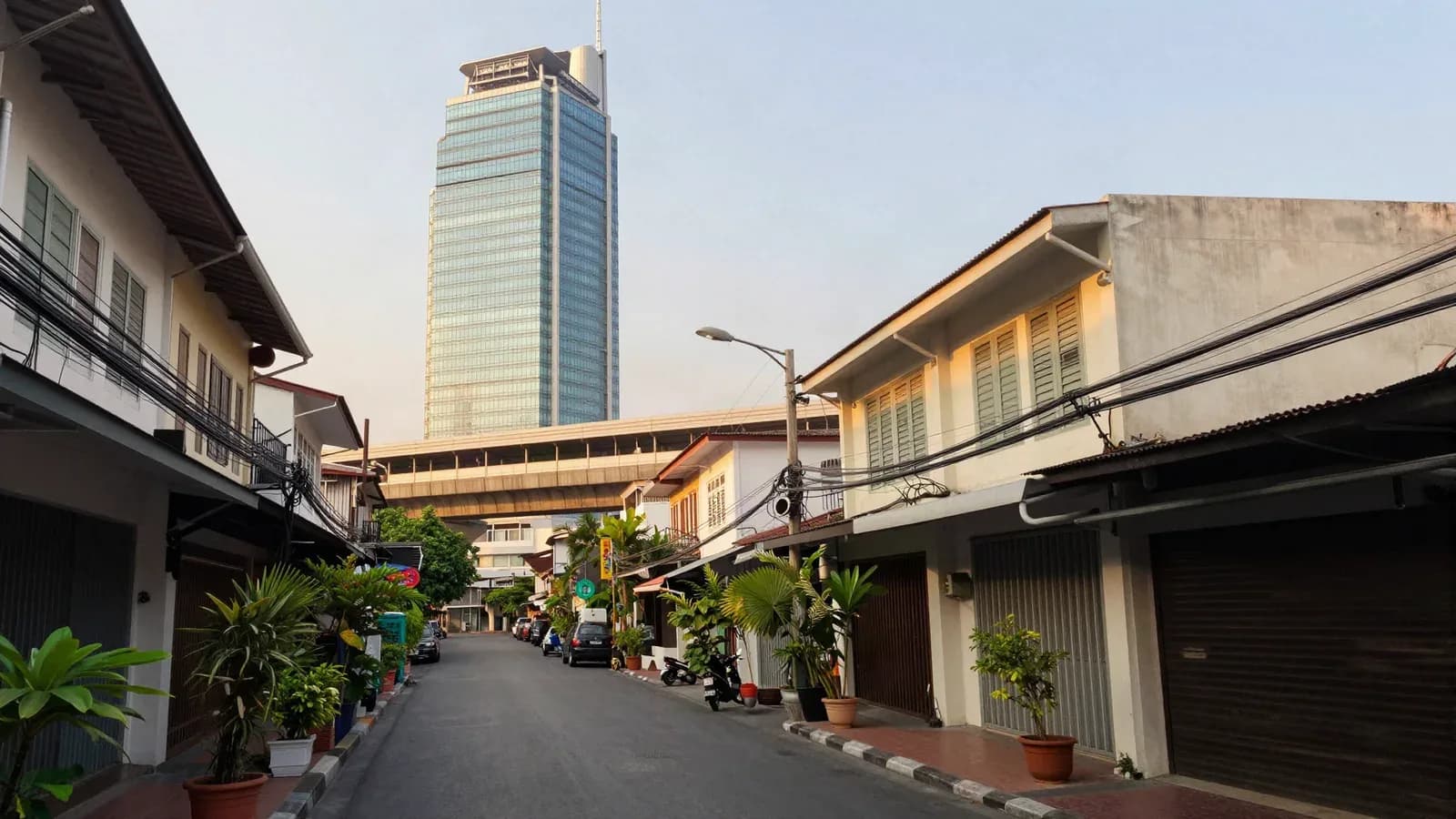
A hundred metres closer is worth more than $200 per square metre in the centre, less than $80 on the outskirts. And on a road narrower than ten metres, no tower gets built.
What is running today, and what is only a timetable
The first thing to establish when a listing promises a station is whether that station exists. Bangkok accounts for most of the country's new supply, whose cycle we follow in our reading of the Thai property market; but at the scale of a single address, the cycle matters less than the transport link. Bangkok's urban rail network today has around ten lines in service, and as many sections under construction or awaiting opening. The official count adopted by the Cabinet in July 2025 covers thirteen lines and branches, 279.84 kilometres and 194 stations; an academic study from the same period counts 166, excluding the Red Lines. Both figures are correct within their scope, and it is the scope that needs naming.
What is running in Bangkok as of 1 October 2026, and what is still only announced:
| Line or section | Status | Stations | Date marker |
|---|---|---|---|
| BTS Sukhumvit and Silom | in service | 47 and 14 | since 1999, northern extension in 2020 |
| MRT Blue | in service | 38 | loop completed in 2019 |
| MRT Purple | in service | 16 | 2016 |
| MRT Yellow and Pink, monorails | in service | 23 and 30 | commercial service 2023 and January 2024 |
| Red Lines, two branches | in service | 14 | 2021 |
| MRT Orange, eastern section | civil works complete, not open | 17 | completed in 2023, opening announced for end-2027 |
| MRT Orange, western section | under construction | 12 | opening announced for 2030 |
| MRT Purple, southern section | under construction | 17 | one section in 2027, the whole in 2030 |
| Red Line extensions, Thammasat and Salaya | contracts signed | 13 | signed in May 2026, opening announced for 2029 |
The eastern section of the Orange Line is worth pausing on, because it is the textbook case of what a timetable is worth. Its civil works were one hundred per cent complete by June 2023. Three years on, it has not opened, and opening is now announced for the end of 2027. A buyer who paid in 2022 for the promise of a working station will have waited five years longer than planned. The southern section of the Purple Line offers a variation on the same lesson: scheduled for 2028 as of June 2025, it was split two months later into one section for 2027 and the remainder for 2030.
A word on fares, because the question comes up in every conversation and the answer doing the rounds is out of date. A THB 20 flat fare did exist, from 16 October 2023 to 30 September 2025, but on two suburban lines only. Its extension to the whole network was approved by the Cabinet in July 2025, then reconsidered after the change of government in September, and it never came into force. Distance-based fares returned on 1 October 2025, and those on the Green Line extensions were raised on 1 November that year. What is committed today is something else: a common ticketing law published on 27 December 2025, and a cap of THB 17 on entry and THB 45 per journey approved on 23 June 2026 to take effect on 1 January 2027, whose implementing regulation had not been published at the time of writing.
What is a hundred metres closer worth?
The answer exists, it is quantified, and it is more interesting than the simple thesis.
The reference study is by Vichiensan and co-authors, published at the end of 2021. It covers 512 condominium buildings, or 1,374 aggregated units, within a three-kilometre radius of a station, and combines a classic hedonic regression with a multiscale geographically weighted regression. The central finding fits in one sentence: in the centre and along the main corridors, being a hundred metres closer is worth more than $200 per square metre; on the outskirts, less than $80. The effect does not decline evenly with distance; it varies by location. In other words, the gradient is not a law, it is a map.
An earlier study, from 2007, had already given the order of magnitude in another form: an elasticity of around minus nine hundredths, meaning a 0.09% fall in price for each 1% of extra distance. And a 2026 study based on a neural network, covering 235 vacant plots across the metropolitan area, ranks public transport second among thirty price drivers of land — without giving a distance coefficient, which is honest: the model says it matters a great deal, not by how much.
That leaves the counter-intuitive finding, and it is the one to know before buying on a promise. A 2024 study of 28 new developments within a kilometre of Orange Line stations — a line not yet open — finds a distance coefficient that is positive and highly significant: every additional metre goes with a higher price. Two readings hold up. A station that has not opened has no use value yet; and the plots immediately next to future stations line noisy, already built-up roads. Either way, the practical conclusion is the same: on a planned corridor, proximity does not command a premium yet, and may even come at a discount.
The pre-development land price index, by rail corridor, in the second quarter of 2026:
| Corridor | Year-on-year change |
|---|---|
| Green, Khu Khot to Lam Luk Ka | +17.6% |
| Pink, Khae Rai to Min Buri | +9.7% |
| Orange, Cultural Centre to Min Buri | +7.4% |
| BTS Sukhumvit and Airport Rail Link | +7.3% |
| Yellow, Lat Phrao to Samrong | +6.3% |
These gaps can also be read in absolute terms, and the range is considerable. Land on Ploenchit and Wireless Road traded at between THB 3.4 and 3.8 million per square wah in 2024, with compound annual growth of around six per cent since 2016. Rama IV is above three million, against just over one million in 2017. Silom and Sathorn are around 2.2 million, Udom Suk and Punnawithi around one million, and Krungthep Kreetha around seventy to eighty thousand. From one end of the same metropolis to the other, the ratio is one to forty.
Why does the width of the soi decide what gets built?
Because under Thai law the access road does not act as a ratio but as a threshold. It is the hardest fact in this article, and the one foreign buyers know least.
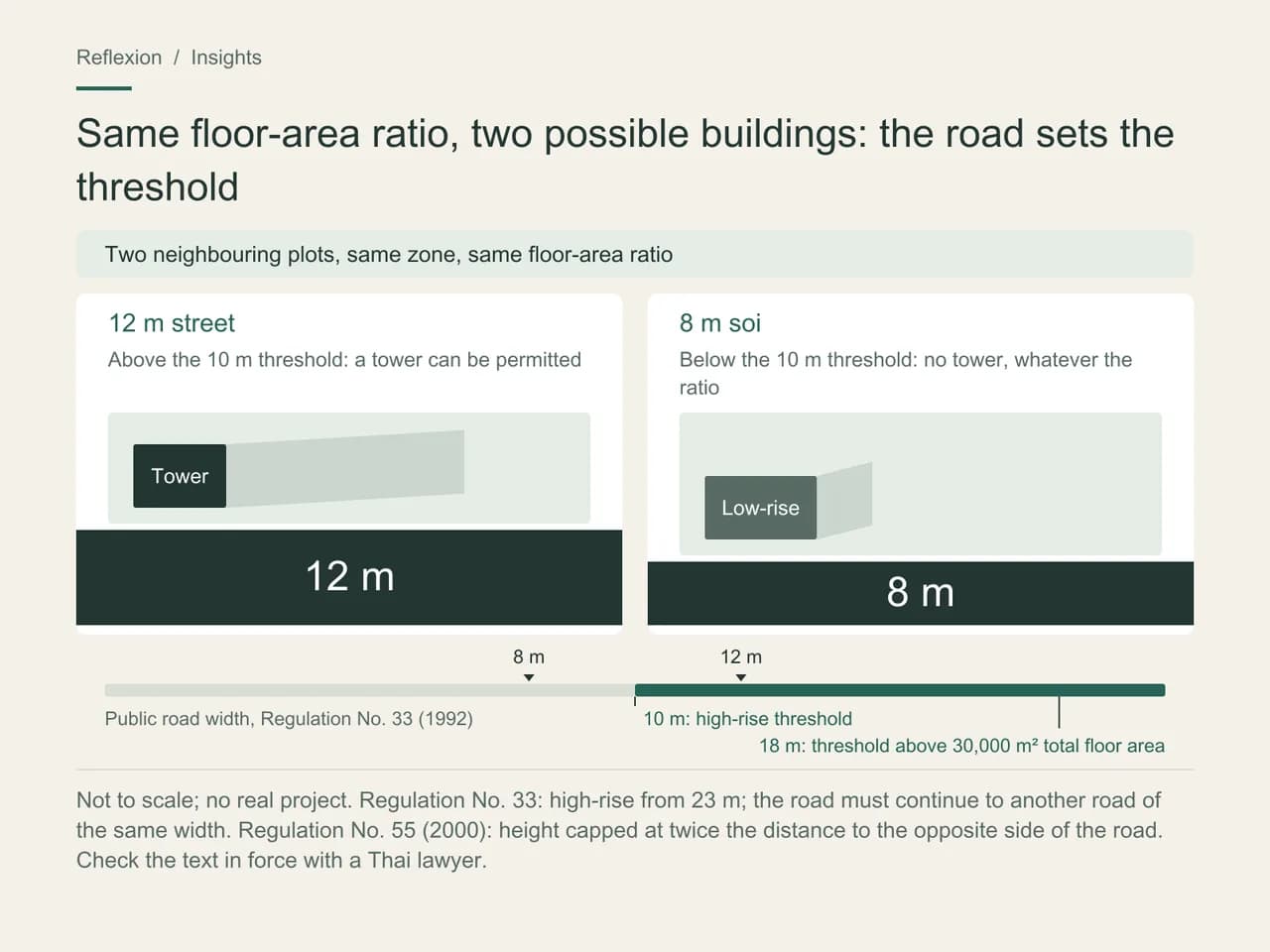
Ministerial Regulation No. 33 of 1992 sets three cumulative conditions for any high-rise or extra-large building. One side of the plot, at least twelve metres long, must front onto or have access to the public road. If the building's total floor area does not exceed thirty thousand square metres, the public road must be at least ten metres wide, continuing to another road of the same width. Above thirty thousand square metres, the threshold rises to eighteen metres. And the access strip up to the building must be kept clear over twelve metres for emergency vehicles.
The definitions that trigger this regime are precise in their own right: a high-rise building is one of at least twenty-three metres; a large building is one exceeding two thousand square metres of total floor area, or reaching fifteen metres with a floor area between one and two thousand; an extra-large building is one reaching ten thousand square metres. On top of this, Ministerial Regulation No. 55 of 2000 adds a building envelope that forbids exceeding twice the horizontal distance to the opposite side of the nearest road, a setback that varies with road width, and a setback of one eighth of the height for high-rise buildings. The mandatory open space is thirty per cent of the plot in residential use.
An eight-metre soi rules out a tower, whatever the zone's floor area ratio.
It is the reverse of the European intuition, where the plan leads and the roads follow. In Bangkok, a plot zoned for high density but served by an eight-metre road that does not run through will never take a high-rise: the floor area ratio stays theoretical. It is this threshold, not the zoning, that explains the price gap between two neighbouring plots. Article numbers have shifted with successive amendments: any investment decision should be checked against the text in force with a Thai adviser.
These rules combine with Bangkok's own soil and structural constraints, which we covered separately after the March 2025 earthquake — see what that episode taught the capital's towers — and with the provincial height and setback rules we read notification by notification in our review of where you can build in Thailand.
The plan that governs Bangkok dates from 2013
The comprehensive plan in force is the Bangkok Comprehensive Plan B.E. 2556, a ministerial regulation published in the Royal Gazette on 16 May 2013. It is the third revision. Its first clause provided for a five-year term, but plans in force in September 2015 stopped expiring and remain applicable until they are replaced. The city is therefore run on a document that predates the Pink, Yellow and Orange Lines.
One detail that the property press often presents as new deserves correcting: the floor-area bonus linked to proximity to a station already exists in the 2013 plan. It provides for five bonus conditions, each capped at twenty per cent of the base ratio, among them the creation of a public car park within five hundred metres of designated stations, valued at thirty square metres of building rights per space created. The number of stations concerned varies between professional sources, from seven to twenty-two; only the text settles it, and we have not read it on that specific point.
The fourth revision, for its part, is not a plan. It is a draft that cleared the provincial town planning committee on 9 April 2026 and is awaiting a ninety-day public display. The city itself announces promulgation for the end of 2027. What the draft would contain is substantial: thirty-one land-use categories instead of twenty-six, medium-density zones enlarged by nearly a quarter, a second business district along the Rama 9 corridor with a ratio of eight raised to 9.6 by bonuses, ten bonus conditions instead of five, and a high-density development regime within eight hundred metres of interchange stations. But the mechanism the press cited most — the transfer of development rights from heritage sites to areas within five hundred metres of a station — has been removed from the draft. None of these provisions is enforceable today.
When we model the case of Paul and Claire, two addresses ten minutes away
Paul, 52, and Claire, 48, are looking for a pied-à-terre, with a budget fixed at THB 9 million (€234,500). Two addresses fit that figure, both advertised as a ten-minute walk from a station. The first is on a line that has been running for twenty years, on a twelve-metre street. The second is on the Orange Line corridor, twenty per cent cheaper per square metre, on an eight-metre soi.
What the data allows us to tell them about the first: on this budget, they buy around seventy square metres on the city fringe, where the asking price is about one hundred and twenty-three thousand baht per square metre, against two hundred and thirty-seven thousand in the central business district. The proximity premium is already in the price there, and it will hold as long as the line keeps running.
What the data allows us to tell them about the second: the twenty per cent discount is not a bargain, it is a measure of risk. The station is announced for the end of 2027 on a section completed in 2023. The study available on this corridor finds that proximity is not yet capitalised there, and could even carry a discount. And the eight-metre soi means the plot next door will never take a tower: an advantage for the view, a handicap for liquidity, because the street will stay what it is.
What we do not tell them: that they will make a capital gain in either case. The new-build market has contracted, from 50,681 units launched in 2022 to 17,409 in 2025, and unsold stock is taking around thirty-nine months to clear. We give them the width of the road, the actual status of the line, and the price gap between the rings. We have compared Bangkok with the country's other markets in our review of six Thai destinations.
Modelled scenario. This profile is not a client; the parameters are working assumptions.
What our database can put in context
We index developments by sub-district, with their location and price per square metre. Cross-referencing that geography with station locations and access-road widths answers two questions no listing asks: how many minutes of actual walking separate this address from a station entrance, and what category of building the road allows on neighbouring plots. Public datasets give the stations, not their entrances, which can lie one to two hundred metres from the station's centre point; so we map the entrances ourselves. To place a specific address, start by setting it in its surroundings.
What you can do now
Three steps, before signing on the promise of a transport link. Check the actual status of the line, not the brochure: a section can have been finished for three years and still not be open. Measure the access road, in metres, and check that it runs unbroken to a road of the same width — that figure decides what will be built around you. And walk the route yourself, at the time of day you would make it, from the station entrance you would actually use: the distance to the station's centre and the distance to its entrance are not the same thing, and the difference is counted in minutes. None of these three steps appears in a listing.
Frequently asked questions
How far from a station does the premium stop?
There is no single cut-off. The available research works with continuous distance, and the effect depends on location: strong in the centre and along the main corridors, much weaker on the outskirts. The five- and ten-minute walking bands seen in listings are a sales convention, not a research finding.
Does an announced line push up prices around it?
That has not been properly measured in Bangkok: nobody has compared a corridor before and after a line was announced, against a control group. The only study available on a corridor not yet served finds the opposite of what you would expect, with proximity associated with lower prices. A timetable, in other words, is not an asset.
Why don't two neighbouring plots allow the same building?
Most often because of access. A high-rise needs a road at least ten metres wide, continuing unbroken to an artery just as wide, and eighteen metres once total floor area reaches thirty thousand square metres. A generous floor area ratio never makes up for a narrow access road: the plot can still be built on, but not upwards.
Is Bangkok's city plan going to change?
A draft fourth revision cleared the provincial committee in April 2026 and still has to go through a ninety-day public display. The city administration itself expects promulgation towards the end of 2027. Until then the 2013 plan applies, and none of the draft's provisions can be enforced against anyone.
Will public transport cost THB 20 per journey?
That fare applied from October 2023 to September 2025, on two suburban lines, and its extension, approved in 2025, was dropped after a change of government. The measure now committed is different: seventeen baht on entry and forty-five at most per journey, across all lines, announced for January 2027.
How many square metres does a given budget buy in Bangkok?
In the first quarter of 2026, the average asking price stood at around two hundred and thirty-seven thousand baht per square metre in the central business district, one hundred and twenty-three thousand on the city fringe and seventy-one thousand in the suburbs. The same budget therefore buys roughly three times as much space in the outer ring as in the centre.
Method and sources
Sources checked October 1, 2026
Exchange rate used: 1 EUR = 38.374 THB (1 October 2026)
- What this article draws on: the Cabinet decisions of 8 July 2025 and 23 June 2026 for the fare scope and the announced cap, the Common Ticketing Management Act published on 27 December 2025, and the operators' announcements for the 2025 and 2026 distance-based fare tables; the progress reports and contracts published for the sections under construction, including the Red Line extension contracts of 19 May 2026; for the proximity premium, Vichiensan and co-authors in Sustainability 14(1) 284, published at the end of 2021, Chalermpong in Transportation Research Record 2038 in 2007, Pongprasert and Benjaanunphong in the Hong Kong Journal of Social Sciences no. 64 in 2024, and Tochaiwat and Suwanchaisakul in Sustainability 18(9) 4595 in May 2026; Ministerial Regulation No. 33 of 1992 and Regulation No. 55 of 2000 in their consolidated Thai version, together with the 2001 Bangkok ordinance, for the road-width, building-envelope and setback thresholds; the Ministerial Regulation B.E. 2556 published in the Royal Gazette vol. 130 part 41 ก on 16 May 2013 for the comprehensive plan, and the city's statement of 15 May 2026 on the status of the fourth revision; the Real Estate Information Center's vacant-land index and unsold-stock figures for the second quarter of 2026, and asking-price surveys by an international consultancy for the three rings. The article numbers of the building regulations have been amended several times and must be confirmed against the text in force.
This article is general information, not legal or tax advice. The rules cited are dated: check with a qualified professional that they are still in force before acting.