Where you can build in Thailand, and how high
Sea view, hillside, beachfront: three sets of rules decide what gets built next to you. The strips, the altitudes, the slopes — straight from the Royal Gazette.
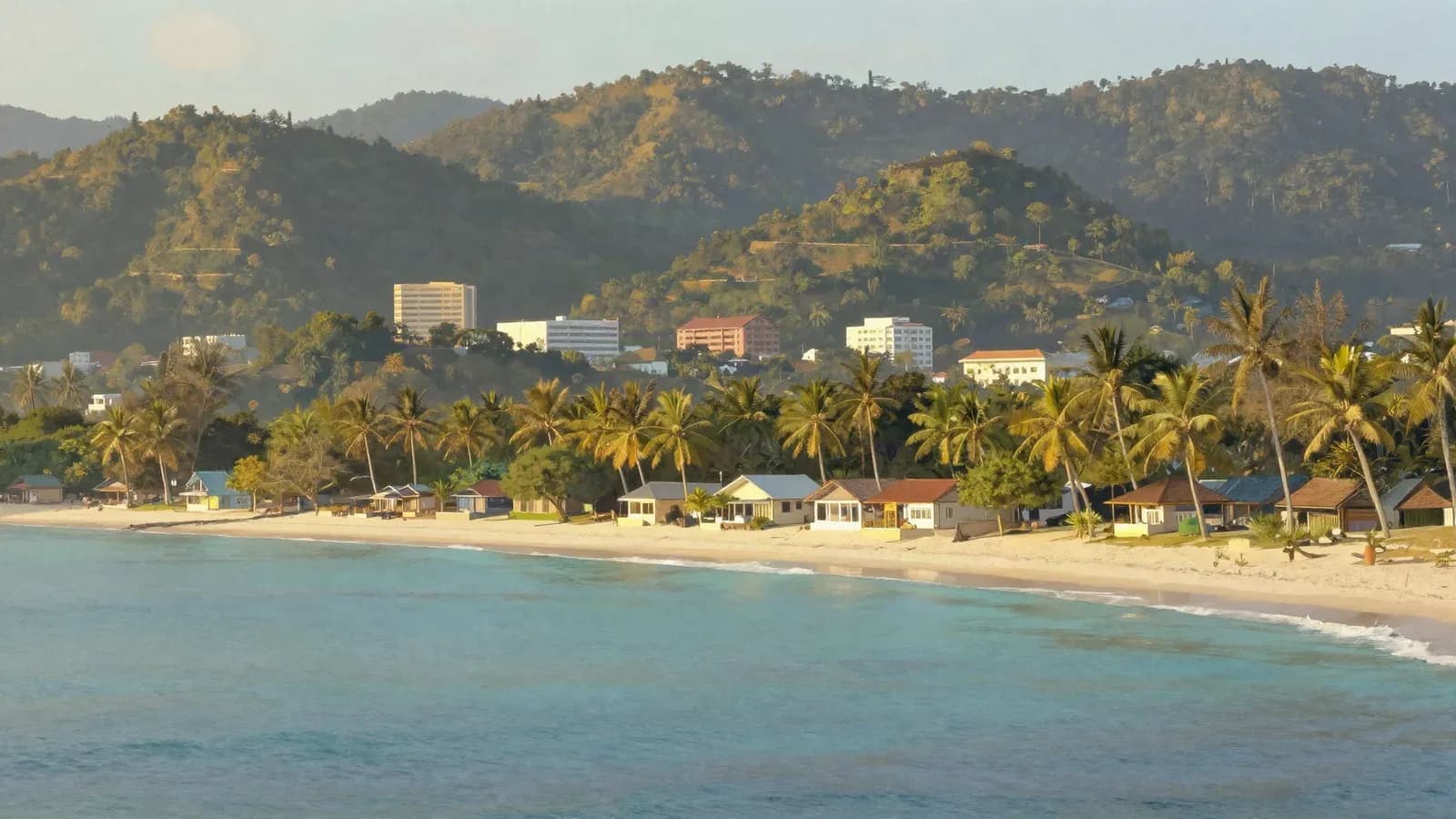
Sea view, hillside, beachfront: three sets of rules decide what gets built next to you. The strips, the altitudes, the slopes — straight from the Royal Gazette.
What decides how tall a building can be in Thailand?
Three bodies of rules, written by three different authorities, which do not replace one another: they stack.
The first is national. The Building Control Act B.E. 2522 (1979) and its ministerial regulations set minimum distances, setbacks from roads and watercourses, and a rule of proportion that governs everything else: at no point may a building exceed twice the horizontal distance separating it from the opposite edge of the public road. The narrower the street, the lower the ceiling. This is geometry, not politics, and it is not negotiable — any more than the way the property is held, which follows a different logic again.
The second is local: the comprehensive town plan, which divides the territory into colour-coded zones and assigns each one a floor area ratio. It is what allows a sixty-storey tower here and a two-storey house three hundred metres further on.
The third exists only in certain provinces, and it is the one buyers discover last: the environmental protection notification, issued under section 45 of the Enhancement and Conservation of National Environmental Quality Act B.E. 2535 (1992). Phuket, Samui and Phangan, Krabi, Phang Nga and the coastal districts of Chonburi each have one. It is a short text, published in the Royal Gazette, which redraws the province and imposes ceilings that nothing else imposes.
The rule that ties them together is spelt out in both notifications we have read: where another law provides protective measures that are no less stringent than those of the notification, those measures apply. In other words, of the three texts, the strictest prevails. A lawfully issued building permit is therefore not proof of compliance: it shows that one authority has checked the rules it is responsible for, not the other two.
How high can you build on the Phuket seafront?
The notification in force is that of 13 December 2024, which replaced the B.E. 2560 (2017) text and divides the island into eight zones. Three of them are strips running parallel to the shore, measured from a point worth keeping in mind: the line reached by the sea at its highest normal natural level. It is neither the boundary of your title deed nor the limit of the public foreshore. It is a physical line, and it moves.
What the notification prescribes in Phuket's four coastal strips:
| Distance from the high-water line | Maximum height | Other requirements |
|---|---|---|
| 0 to 20 m | no building | absolute setback |
| 20 to 50 m (zone 1) | 6 m | open space ≥ 75% of the plot |
| 50 to 200 m (zone 2) | 12 m | permeable surface ≥ 50% of the required open space; permanent greenery ≥ 50% of the permeable area |
| 200 to 400 m (zone 3) | 16 m | same requirements, unless a height is set by the local plan where one exists |
| beyond 400 m (zone 7) | 23 m | unless height and open space are set by the local plan |
Phuket town follows its own grid: 9 m within the old town conservation area, 45 m in the high-density zone with a floor area ratio of 6 and 35% open space, 60 m in the very-high-density zone with a ratio of 8 and 40% open space. Here too, the local town plan takes over on height wherever it sets one.
The costly detail is in the last two rows of the table. In zones 3 and 7, the environmental notification gives way to the town plan where one exists: the 16 or 23 m ceiling is therefore not an acquired right to build that high, but a ceiling that applies in the absence of a local rule. Depending on the municipality, the actual height may be lower.
A strip is measured on the ground, not on the title deed.
The reference line is the normal high-water mark, not the cadastral boundary. Two neighbouring plots, sold at the same price with the same “sea view”, may not take the same building. Have the line surveyed by a land surveyor before you sign — not read off a sales plan.
Altitude, and what changed in December 2024
Phuket is a mountain set in the sea, and altitude governs the second half of the problem. Between 40 and 80 metres above mean sea level, the ceiling drops to 8 m. Above 80 m, the notification flatly prohibits construction, extension and change of use.
The December 2024 notification opened a gap in that prohibition, and it has been widely discussed. It is real, and it is narrow. Between 80 and 140 m of altitude, on land whose owner can show it was lawfully held before 16 December 2017, it becomes possible again to build a detached house or building: 6 m high at most, a 90 m² footprint at most, 70% of the plot left open, and half of that open space planted with perennial trees. Above 140 m, the exception does not apply.
What this opening permits is a single-storey villa on land bought nearly nine years ago. It is not a development, it is not an apartment building, and it does not carry over to land acquired since. The gap between “hillside building is allowed again” and what the text actually says is considerable — and the first version is the one doing the rounds.
Why doesn't Koh Samui work like Phuket?
Because its notification — that of 21 May 2025, which replaced the B.E. 2557 (2014) text — does not work in distances from the shore. It sets out seven zones, and the second covers the whole of Koh Samui, Koh Taen and Koh Phangan from the shoreline up to 80 m of altitude. Within that zone, the notification imposes only two things: that no wall may block access to the sea or the beach, and that hotels and multi-unit residential buildings set aside at least half of their regulatory open space as green space planted with trees.
No height. No coastal setback. On Samui, those two rules come not from environmental law but from the municipal regulations and the town plan — which explains why the figures circulating on the island are so often attributed to the wrong text, and why they change when the municipal regulations change, without any environmental notification moving at all.
Above 80 m, on the other hand, the logic matches Phuket's. Construction is prohibited, except on lawfully held private land, and then only a detached house or building of 6 m, with 50% of the plot left open between 80 and 140 m, and 70% above 140 m. Samui adds a requirement Phuket does not have: a pitched roof in Thai, tropical or local style covering at least 80% of the built area, and natural colours — brick, terracotta, brown, grey, leaf green.
The 10-metre setback quoted everywhere in connection with Samui does exist in the notification, but it does not apply to Samui: it applies to the small islands — fifteen or so, each named — where a 6 m height limit and a 75 m² built area are added. On a second list of islands, all construction is prohibited.
What exactly does a 35% slope rule out?
It does not rule out building. It rules out building anything other than a house.
The two notifications converge. On land with a slope of 35% or more, only a single house or a detached building is allowed. In Phuket, the height limit is 6 m in the coastal strip and at altitude, and 12 m in the other zones. The footprint is capped at 90 m² where the plot measures 100 square wah or more — that is, 400 m² — and at 70 m² below that, with 70% and 50% permeable surface respectively. On Samui, the same figures apply, with two further requirements: reshaping the land may not exceed a slope of three to one, nor cut or fill of more than one metre relative to natural ground level, foundations and tanks excepted. And above a 50% slope, it becomes prohibited to damage the trunk or roots of any naturally growing tree measuring 50 cm in circumference at a height of 1.30 m.
One point deserves to be stated plainly, because it causes confusion. The highly publicised demolitions and inspections of 2024 and 2025 on the hillsides of Samui and Phuket were decided under the previous notifications, whose text we have not read. What we can establish is what today's notifications say, and they lay down no general ban on building beyond a slope threshold. The operational lesson of those cases stands in full: on both islands, completed buildings were sanctioned after the fact, which means that a building's existence proves nothing about its legality. That is as true in Phuket as anywhere else.
The 50-metre threshold, and why it matters more than a height
The environmental impact assessment is the mechanism that decides, in practice, whether a development goes ahead or not. Both notifications use the same architecture, and the number to remember is 50.
Within 50 m of the shore, a hotel, a multi-unit residential building or a condominium requires a full impact assessment, whatever its size. No room threshold, no floor-area threshold: proximity is enough. Beyond 50 m, the regime reverts to thresholds — a full assessment from 80 rooms or 4,000 m², a preliminary report between 50 and 79 rooms or between 2,500 and 4,000 m². And between 11 and 49 rooms, with no assessment required, the requirements annexed to the notification still apply.
This 50-metre rule is not national, and that is a real commercial nuance: the Krabi notification does not contain it. A beachfront hotel there falls under the ordinary thresholds — 80 rooms or 4,000 m² — whereas the same project, placed in Phuket or on Samui, would trigger a full assessment for a single room.
For a buyer, this translates into one question to ask before any off-plan reservation: does this development have an approved impact assessment, and which one? A beachfront development without one is not a development running late: it is a development that has no right to start.
Four provinces, four grids — and none is the one you will be quoted
Six provinces have a protection notification. We have read the text in force for four of them, in the Royal Gazette. They do not resemble one another, and that is the first lesson: no figure carries over from one province to the next.
What the four notifications set, as read in each of them:
| Province | Notification in force | Expires | Seafront | Altitude | Slope |
|---|---|---|---|---|---|
| Phuket | notification of 9 Dec 2024 | 13 Dec 2029 | 20 m no-build, then 6 / 12 / 16 m up to 400 m | 8 m from 40 to 80 m; prohibited above, except a 6 m house up to 140 m | ≥ 35%: detached house, 6 or 12 m |
| Koh Samui, Koh Phangan | notification of 24 Apr 2025 | 21 May 2030 | no height or setback in the notification | prohibited above 80 m, except a 6 m house | ≥ 35%: detached house of 6 m |
| Krabi | notification of 26 Mar 2025 | 31 Mar 2030 | no strip; 6 m within 100 m of a registered site | 6 m above 40 m, 9 m with a gable roof | > 35%: land cannot be built on |
| Chonburi (Bang Lamung, Sattahip) | notification of 16 Jul 2020, extended on 11 Apr 2025 | 24 Jul 2027 | 20 m no-build, then 14 m over 100 m | — | > 35%: construction prohibited |
The weightiest divergence concerns slope, and it splits the provinces into two camps. In Phuket and on Samui, a 35% slope restricts: you can build a detached house there, not a development. In Krabi, the notification requires land to have a natural slope of no more than 35% for anything to be built on it at all, and prohibits any construction or alteration of the ground beyond that. In Chonburi it takes one line: above a 35% slope, no construction and no alteration of buildings. The same percentage, two opposite legal regimes, six hundred kilometres apart.
Krabi deserves two further details, because they exist nowhere else. Above 40 metres of altitude, the ceiling drops to 6 metres — raised to 9 metres for a building with a gable roof, provided the wall of the top storey does not exceed 6 metres. And within 100 metres of a site on the register of historic monuments, no building may exceed 6 metres. Koh Phi Phi Don and Koh Lanta Yai have yet another grid of their own, at 8 and 9 metres, with 60 to 70% of the plot left open.
Chonburi, finally, has a rule the other three lack: nothing may be built within 6 metres of the natural bank of a public river, canal or body of water.
And in Bangkok, where there is no shoreline?
There, the ceiling is not a height but a ratio. The B.E. 2556 (2013) comprehensive plan, still in force, assigns each colour-coded zone a floor area ratio — from 1 in low-density residential to 10 in central commercial — and an open space ratio. That ratio is calculated against the built floor area, not against the plot: 5% therefore does not mean that 5% of the land stays open.
The constraint that actually kills projects in Bangkok lies elsewhere, and it gets far less attention than it deserves: a high-rise or large building must have a frontage of at least 12 m on a public road at least 10 m wide — 18 m beyond 30,000 m² of floor area — along its full length to a road at least as wide. It was on this ground that a permit was revoked in 2021, and again on appeal in 2023, for a fifty-storey tower already completed — the same generation of towers as those whose structure the March 2025 earthquake put to the test — because its access road came from land expropriated for another purpose. An off-plan buyer is therefore protected neither by the age of the permit nor by how far construction has progressed.
The fourth revision of the Bangkok plan was approved by the province's town planning committee on 9 April 2026 and is entering its ninety-day public display period. The city is aiming for promulgation at the end of 2027. It has been neither adopted nor published to date, so we do not treat it as law: the specialist press reports higher floor area ratios in some twenty areas along transport corridors, and wider bonuses granted in exchange for public amenities. Those figures describe a draft submitted to the Ministry of Interior, not an enforceable rule. Anyone buying today is buying under the B.E. 2556 plan.
When we model the case of Gillian and Richard, on a hillside in Kamala
Gillian, 57, and Richard, 61, viewed two plots in Kamala, on Phuket's west coast, a fortnight apart. The first is 180 metres from the shore, at 30 m of altitude, on a gentle slope. The second is higher up, at 95 m, with a view the first lacks, and it costs 15% more per square metre.
The first plot is in zone 2: they can build up to 12 m, that is three storeys, subject to the permeable-surface and green-space requirements. The architect's scheme they were shown fits within that envelope.
The second is above 80 m. Construction there is prohibited unless they can show that the seller held the land lawfully before 16 December 2017: this can be read on the back of the title, where the land office records the registration date of each transfer, on a Chanote as on a Nor Sor 3 Kor — and even then the opening is limited to a detached house 6 m high with a 90 m² footprint and 70% of the plot left open. The scheme presented to them covers 240 m² over two storeys. It cannot be built, and the price difference is not explained by the view: it is explained by a building potential the seller assumes and no document grants.
We recommend neither plot to them. What we establish is that the first question to put to the second seller is the date the land was acquired, with documentary proof — and that the answer determines whether the price makes any sense.
Modelled scenario. This profile is not a client; the parameters are working assumptions.
What our database lets you check before a sale agreement
We track developments across six Thai provinces, indexed by sub-district, with the location of each. Overlaying that location on the coastal strips, the 40, 80 and 140-metre contour lines and the slope of the land answers, project by project, a question no brochure addresses: does what is being promised fit within the envelope the notification allows at that spot? It is a consistency check, not legal advice — and it is the natural extension of our reading of six Thai destinations, three of which fall under a protection notification and three of which do not. To place a specific development in its surroundings, start by checking what can be built at its address: the location is shown before the price.
What you can do now
Three documents, before any reservation, and in this order. A survey of the high-water line by a land surveyor, and your plot's distance from that line — not the advertised distance. The altitude of the highest and lowest points of the plot, and its average slope, measured rather than estimated. And, for any beachfront development or any project of more than fifty rooms, the reference of the approved impact assessment, with its date. Have the whole file reviewed by a Thai lawyer before signing: these three figures decide what you are buying, and none of them appears on a reservation agreement.
A fourth reflex, if you are shown a permit: look at the expiry date it bears. The Building Control Act sets none — its section 35 provides that a permit is valid for the period specified in it, which is set by the local authority. The “one-year permit” commonly quoted is a frequent municipal practice, not a national rule. A permit whose validity has lapsed no longer covers the works it authorised.
Frequently asked questions
How close to the beach can you build in Thailand?
There is no national answer: it depends on the province, and only six provinces have a protection notification. In Phuket, nothing may be built in the first twenty metres inland from the natural high-water line. On Koh Samui itself the notification sets no setback at all — the ten-metre figure often quoted there applies only to the small outlying islands. Everywhere else, municipal regulations decide.
Can you build a hillside villa in Phuket?
Above eighty metres of altitude, no — with one exception: land lawfully held before 16 December 2017, up to one hundred and forty metres, and then only for a detached house six metres high with a ninety-square-metre footprint. Beyond one hundred and forty metres there is no exception. Between forty and eighty metres you can build, but no higher than eight metres.
Does a building permit guarantee that a building is compliant?
No, and it is the most expensive misunderstanding in the market. Three regimes overlap — building control, town planning and environmental protection — and each is handled by a separate authority. The strictest text applies. Completed buildings, on Samui as in Bangkok, have been sanctioned years after their permits were issued.
What triggers an environmental impact assessment?
Two things. Size: eighty rooms or four thousand square metres. And proximity to the shore: at fifty metres or less, a hotel or a condominium is subject to one whatever its size. Between the two sits a lighter preliminary report, for projects of fifty to seventy-nine rooms.
How can I find out what may be built on the plot next to mine?
By overlaying three pieces of information: the coastal strip or altitude band the plot falls into, the comprehensive-plan zone that covers it, and the width of the road that serves it. The third is often the tightest: in Bangkok, a tower requires a public road ten metres wide, eighteen beyond thirty thousand square metres of floor area, along its entire length.
Can these rules change after I buy?
Yes, and that is their very nature. Protection notifications are issued for five years and renegotiated at each expiry: Phuket changed regime in 1997, 2003, 2010, 2017 and 2024. Phuket's notification runs until 13 December 2029, Samui's until 21 May 2030. What protects a buyer's view today may no longer protect it in five years — and the reverse is also true.
Method and sources
Sources checked September 30, 2026
Exchange rate used: 1 EUR = 38.374 THB (30 September 2026)
- Primary sources, read in the Royal Thai Government Gazette: Notification of the Ministry of Natural Resources and Environment on the environmental protection area of Phuket province, signed on 9 December 2024, published in vol. 141, special part 342 ง, on 13 December 2024, in force from 14 December 2024 for five years; Notification of the same ministry on the protection area of the municipalities of Koh Samui and Koh Phangan, Surat Thani province, signed on 24 April 2025, published in vol. 142, special part 199 ง, on 21 May 2025, in force from 22 May 2025 for five years. Both texts are issued under section 45 of the Enhancement and Conservation of National Environmental Quality Act B.E. 2535. Professional sources for the national framework: consolidated texts of the Building Control Act B.E. 2522 and of Ministerial Regulations No. 33 and No. 55 circulated by the Association of Siamese Architects; the English translation of the Town Planning Act B.E. 2562 published by the Office of the Council of State; the Bangkok Metropolitan Administration's statement of 15 May 2026 on the progress of the fourth revision of the comprehensive plan.
What we could not verify
- What we were unable to verify and therefore do not publish: the figures in the Phang Nga notification, which we know dates from B.E. 2568 and covers seven districts, including Ko Yao, but whose text we have not read; the technical definition of slope to which the Phuket notification refers, which falls under a standard of the Department of Public Works and Town & Country Planning; and the ratios in the fourth revision of the Bangkok plan, which has not been published.
This article is general information, not legal or tax advice. The rules cited are dated: check with a qualified professional that they are still in force before acting.