Moving to Thailand long term: water, health, schools, fibre
Living in Thailand all year round comes down to a string of ordinary moments: turning on the tap, seeing a doctor, dropping a child at school, joining a video call. The national spatial plan published on 5 October 2026 gives each of them targets and lists of cities up to 2037: mains water extended first to nineteen cities, 557 new sewage systems, one doctor per 1,000 people from 2027, fibre in the central district of every province. Read together, they map out the cities where daily life is set to improve fastest.
What makes an address work all year round?
An ordinary day in Chiang Mai, Pattaya or Phuket depends on simple things: the water pressure in the shower, the morning run to school, the specialist appointment, the late-afternoon video call with Europe. These, more than the view, decide whether an address works all year round. The national spatial plan published in the Royal Gazette on 5 October 2026 treats them as infrastructure in their own right: water, health, education and digital networks each have a chapter, numerical targets for 2027, 2032 and 2037, and lists of cities.
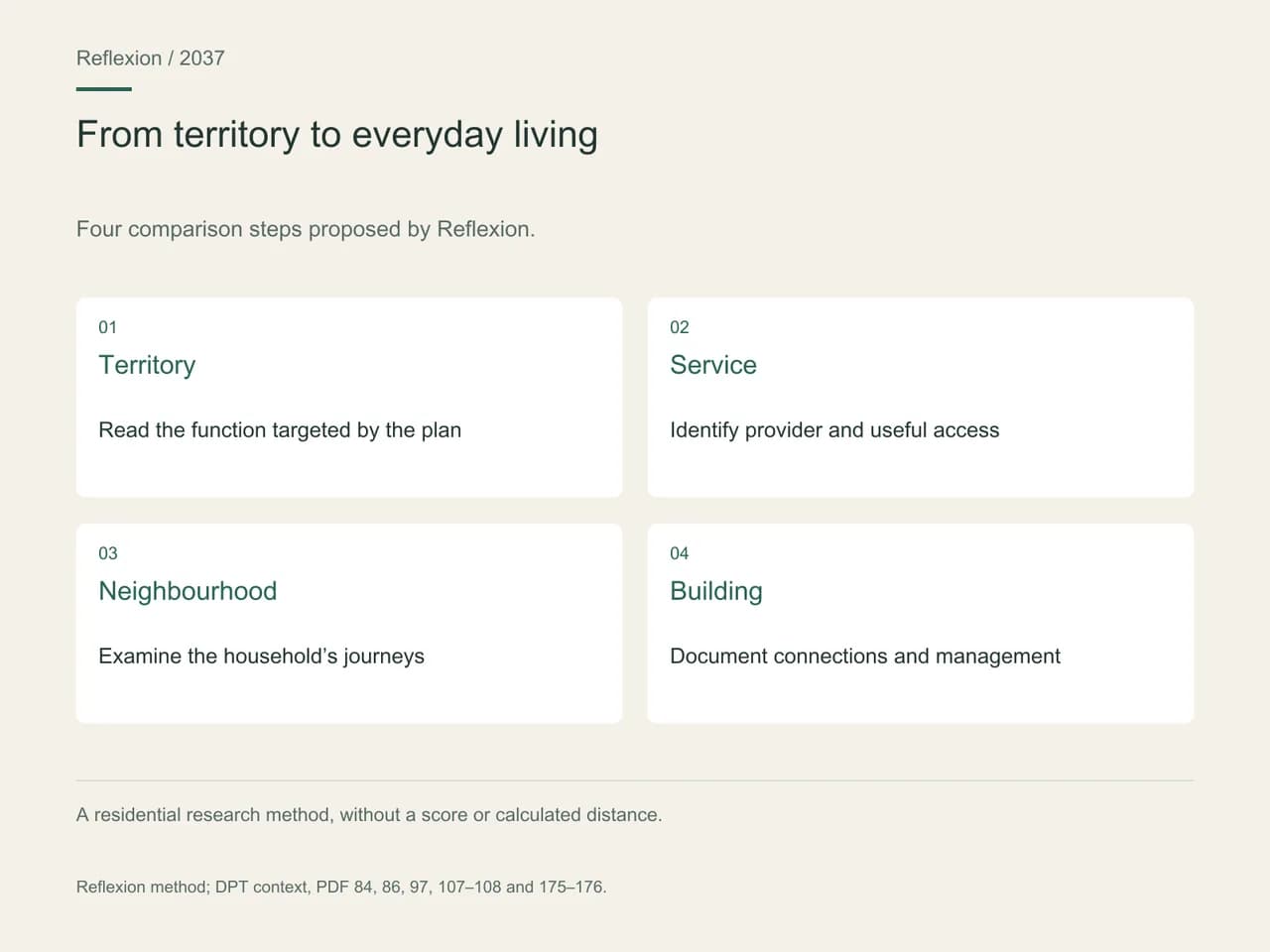
The starting point is the home itself. According to the Department of Public Works and Town and Country Planning (DPT), housing policy should bring residential developments closer to jobs, schools and public transport, following the principle of Transit-Oriented Development (TOD), so as to cut journey times (printed page 75). The same passage provides for renovating older urban neighbourhoods with public space, greenery and modern networks, and for building public housing near transport for older people and low-income households.
For a buyer, this principle changes the way you view a property. An apartment is no longer judged only on its layout and outlook, but on what it lets you reach every day and on the networks that serve it. We focus here on four families of services – water, health, education and digital – because they are what makes a year-round move hold together, and because the plan quantifies them precisely. Our article on six Thai destinations and six ways of living helps you choose the city; this one helps you choose the address.
Where are water, health and networks set to improve?
Running water first. The water chapter pursues four distinct objectives: drinking water, water for farming and industry, flood protection and the reduction of wastewater (printed page 76). It provides for upgrading drinking-water networks in all 76 provinces and Bangkok, cutting pipe losses and increasing production capacity in sixteen areas, among them Chiang Mai, Chon Buri, Songkhla, Surat Thani and Phuket (printed pages 77 and 80).
Distribution, for its part, is to be extended first in nineteen cities: Bangkok, eight regional centres (Chiang Mai, Nonthaburi, Khon Kaen, Hat Yai, Nakhon Ratchasima, Pattaya, Phuket and Phitsanulok) and ten cities in the border special economic zones (printed page 81). Sanitation is moving the same way. The plan schedules 557 new municipal wastewater collection and treatment systems – 8 by 2027, 150 by 2032 and all of them by 2037 – from Ranong to Trang and from Phuket to Chiang Mai, along with extensions to existing networks in Bangkok and the same eight regional centres (printed pages 80 and 86).
Against flooding, the plan schedules 370 drainage and urban protection systems by 2037, 65 of them in fourteen southern provinces including Phuket, Krabi and Ranong (printed page 83), as well as nine sponge cities, from Bangkok to Phuket, designed to slow down and store rainwater. We look at this in detail in our article on reading the landscape before the address.
Health is the most detailed chapter. It opens with a named inventory of what already exists: 35 level-A public hospitals, the highest tier, 55 level-S general hospitals, and 59 facilities accredited by Joint Commission International in 2022 (printed pages 89 to 91). It then sets targets: going from one doctor per 1,959 people in 2023 to one per 1,000 in 2027, giving every province emergency medicine units that meet the standard, and keeping at least 59 JCI-accredited facilities (printed page 97). Telemedicine, meanwhile, is to reach every hospital in the country (printed page 98).
Education is planned around skills and trades. The plan counts 876 vocational institutions and 260 universities, 123 and 32 of them respectively in the South (printed page 104). It wants vocational training centres in the special economic zones, including the six provinces of the Andaman Wellness corridor, nine regional teacher-training centres, among them Phuket, Chiang Mai, Chon Buri and Songkhla, and universities organised into five groups according to their mission, from frontier research to local development (printed pages 105 and 106). For a family, this is a clue to a city's skills base and its student life.
Digital, finally, is treated as basic infrastructure. The plan wants to make Thailand ASEAN's digital hub and to upgrade 5G in Bangkok and its surroundings, in the EEC, in seventeen provinces including Chiang Mai, Phuket, Surat Thani and Songkhla, and in the central district of every province (printed page 173). Fibre is to reach the central district of all provinces, and high-performance 5G is to extend to provinces such as Ranong, Trang and Satun (printed page 174). The speed targets are explicit: fixed-line speeds of up to 300 Mbps in 2027 and 500 Mbps in 2032, against 285 Mbps in 2021; mobile speeds of up to 150 Mbps by 2037, against 47.86 Mbps; and 70% of the population covered by wireless broadband in 2037, against 44.06% (printed page 176).
Put side by side, these chapters trace a geography – and this is our own cross-reading. Bangkok and eight major regional cities (Chiang Mai, Nonthaburi, Khon Kaen, Nakhon Ratchasima, Phitsanulok, Phuket, Pattaya and Hat Yai) recur in every list: extended drinking water, extended sanitation, sponge cities, teacher-training centres, 5G upgrades and, at provincial level, complex care. For anyone who wants all four services to improve at once, this is the first circle to look at. For health, teacher training and 5G, Pattaya and Hat Yai appear through their provinces, Chon Buri and Songkhla.
What should you check at the address before signing?
A city named in one of the plan's lists signals a public priority; whether a building is actually connected is checked at the address. This rule separates a good purchase from an average one, and it starts with water. Is the building on the public network, or does it rely on a borehole, a storage tank or deliveries? What is the pressure on the top floors, how much reserve does the development keep, and what happens at the end of the dry season? These questions go to the building manager first, then to the neighbours.
The same reflexes apply to wastewater and flooding. A development connected to the public sewer is not run like one that treats its own wastewater: the latter has a plant to maintain, and service charges to match. The level of the street in heavy rain, the neighbourhood's flood history and the plot's position within its catchment are all checked on site, ideally in the rainy season.
For health, the function comes before the map. An area designated for promoting rehabilitation is not an open clinic. The plan's inventory helps at this stage, since it names, region by region, the level-A and level-S hospitals and the accredited facilities. Anyone with a specific need starts from that list, identifies the facility that meets it and its current accreditations, then makes the journey, including at night.
For schools, the plan is not enough: none of its lists covers international schools. The choice is prepared school by school, comparing curriculum, language of instruction, admission requirements and available places, then repeating the morning school run from each candidate home, at the time lessons actually start.
For connectivity, a test beats a map. Ask which operators bring fibre into the building and whether the connection reaches the apartment itself, then test the speed in the room you will work in, at the time you will be working. National targets show where networks are improving; the test shows what you will have on Monday morning.
Which health areas does the plan map out?
The health chapter designates promotion areas for three functions: complex care, for patients with several conditions or complicated chronic diseases; rehabilitation for patients and older people; and holistic care, which combines modern medicine, traditional Thai medicine, alternative medicine and psychiatry (printed page 94). These lists overlap: they show where the state wants to develop each function, not facilities to be added up.
Three healthcare functions and their promotion areas in the plan:
| Function | Published scope | What the figure represents | Proposed residential reading |
|---|---|---|---|
| Complex care | 9 areas | Bangkok and eight named provinces | Identify the medical function sought |
| Rehabilitation for patients and older people | 26 areas | Bangkok and named provinces | Examine services useful over time |
| Holistic Care | 35 areas | Bangkok and named provinces | Distinguish each service type and its institution |
The nine complex-care areas (Bangkok, Chiang Mai, Phitsanulok, Khon Kaen, Nakhon Ratchasima, Nonthaburi, Chon Buri, Phuket and Songkhla) also appear on the other two lists: these are the places where the plan intends to bring the whole chain of care together. The Andaman coast has a place of its own. The plan adds an 'Andaman provinces group' that writes Krabi, Phang Nga, Ranong, Trang and Satun into the rehabilitation and holistic-care lists, as we explain in our article on the Andaman Wellness Corridor.
For a retiree or a family, this reading works at city level: it shows where the state intends to concentrate its healthcare effort until 2037. It does not say which hospital can be reached from a given address, or with which specialities; that is for the visit to establish.
When we model a year-round move to Phuket
Imagine a fictional family moving to Phuket for the school year: two parents, one of whom works remotely for a European company, a ten-year-old child, and a grandmother who will join them every winter. They are torn between two properties on a similar budget: an apartment in town and a villa in the hills, larger and quieter. The case is built by Reflexion: it represents no client and attributes no prices to the market.
They put both addresses through the four-service test. The apartment is connected to the town's water supply and sewerage; the villa depends on a borehole and a treatment plant that has to be maintained. Fibre reaches the apartment building, and the test in the future study is conclusive; at the villa, the operator will not commit to a connection date. The chosen school has confirmed a place, the school run has been timed at rush hour, and the nearest hospital appears in the plan's inventory.
They sign for the apartment. Not because the town is more beautiful than the hills, but because every service the family depends on can be checked there today, at the address. The villa stays on their list: if public networks and fibre reach it one day, they can come back to it.
Modelled scenario. This profile is not a client; the parameters are working assumptions.
Which milestones should you watch in 2027, 2032 and 2037?
The plan's targets add up to a readable timetable. In 2027: one doctor per 1,000 people, the first eight urban communities with new sewage systems, 100 cities equipped against flooding, fixed-line speeds of up to 300 Mbps and half the population covered by wireless broadband. In 2032: 150 communities with sanitation, 235 protected cities, 500 Mbps fixed and 100 Mbps mobile. In 2037: 557 new sewage systems, 370 protected cities and 70% of the population covered.
These are public-policy horizons, not connection dates. They help you judge the trajectory of a city you already like, and tell you when to revisit an address you set aside once its networks have caught up. On a map, they belong in a layer of targets kept separate from the layer of existing facilities, so that the map never promises more than the text.
What you can do now
Before your next viewings, prepare four questions for each address: where does the water come from, where does the wastewater go, how far away are the hospital and the school in practice, and what speed do you get in the room you will work in. Note the answers, their source and their date, then compare properties on that basis rather than on the view alone. Our map guides extend this approach to the scale of cities and neighbourhoods.
Frequently asked questions
Which Thai cities does the plan want to supply better with drinking water?
Nineteen, as a priority. Besides Bangkok, the text names Phuket, Pattaya, Chiang Mai, Hat Yai, Khon Kaen, Nakhon Ratchasima, Nonthaburi and Phitsanulok, followed by ten border cities such as Chiang Rai, Tak and Nong Khai. Other provinces are not forgotten: their networks are covered by a general upgrade. For a specific home, only the building manager can confirm the connection and its quality.
Does a health area in the plan guarantee a hospital nearby?
No. These areas are provinces where the state wants to develop a care function, such as rehabilitation or the treatment of complex conditions; they overlap and cannot be counted as facilities. Separately, the plan publishes a named inventory of existing hospitals, useful for finding the nearest level-A or JCI-accredited facility. It is that hospital which matters for an address.
Does the national plan help in finding an international school?
Not directly. Its education chapter covers vocational training, universities and teacher training, and it tells you about a city's educational environment rather than the places on offer. For a family, the approach remains the same: contact schools, compare curriculum, language and admissions, then measure the journey from each home under consideration.
Can you work remotely from any Thai city?
That is the direction the plan sets, with dated milestones. Fibre is to reach the provincial seat of every province, and high-speed wireless coverage is to rise from 44% of the population in 2021 to 70% in 2037, with 500 Mbps targeted for fixed lines from 2032. For a given home, only a test in your workspace, during working hours, is conclusive.
What should you ask a seller about a building's services?
Four answers, in writing if possible: where the water comes from, public mains or borehole; how wastewater is treated; which operators bring fibre into the building; and the history of outages and flooding. Add your own journeys to the hospital and the school. This dated information carries more weight than a mention of the city in a national policy, which sets a direction without describing the building.
Method and sources
Sources checked October 13, 2026
Exchange rate used: 1 EUR = 38.374 THB (28 September 2026)
- What this article draws on: the DPT's 2026–2037 national spatial plan, published in the Royal Gazette on 5 October 2026, read in its original Thai version and checked on 13 October 2026, for its chapters on housing, water, health, education and information technology. Translations from Thai are editorial; the choice of four service families, the viewing questions and the family in the scenario are Reflexion constructions. The plan's lists and targets describe public priorities: whether a building is connected or a service is available is checked at the address.
- DPT, housing, TOD and neighbourhood renewal, printed page 75 / PDF 78.
- DPT, drinking water: objectives, production and extended distribution, printed pages 76–81 / PDF 79–84.
- DPT, flooding, sponge cities and sanitation: targets and areas, printed pages 80, 83 and 86 / PDF 83, 86 and 89.
- DPT, health: hospital inventory, targets and promotion areas, printed pages 89–98 / PDF 92–101.
- DPT, education: institutions counted, vocational training and teacher training, printed pages 104–106 / PDF 107–109.
- DPT, information technology: 5G, fibre and speed targets, printed pages 172–176 / PDF 175–179.
- Reflexion reference rate: 1 EUR = 38.374 THB; no monetary amount is converted here.
This article is general information, not legal or tax advice. The rules cited are dated: check with a qualified professional that they are still in force before acting.