Andaman Wellness Corridor: living and healthcare in Thailand
On the Andaman coast, Thailand is no longer betting on the sea alone: it wants to make this shoreline one of the world's great health regions. The national spatial plan published on 5 October 2026 groups Phuket, Phang Nga, Krabi, Ranong, Trang and Satun into the Andaman Wellness Economic Corridor, with the aim of turning it into a global centre for medicine and wellbeing by 2037. Top-tier hospitals, rehabilitation centres, expanded airports: for anyone thinking of living here all year, the question is no longer just which beach, but which stretch of coast, and which hospital within reach.
Why is the Andaman coast becoming a health hub?
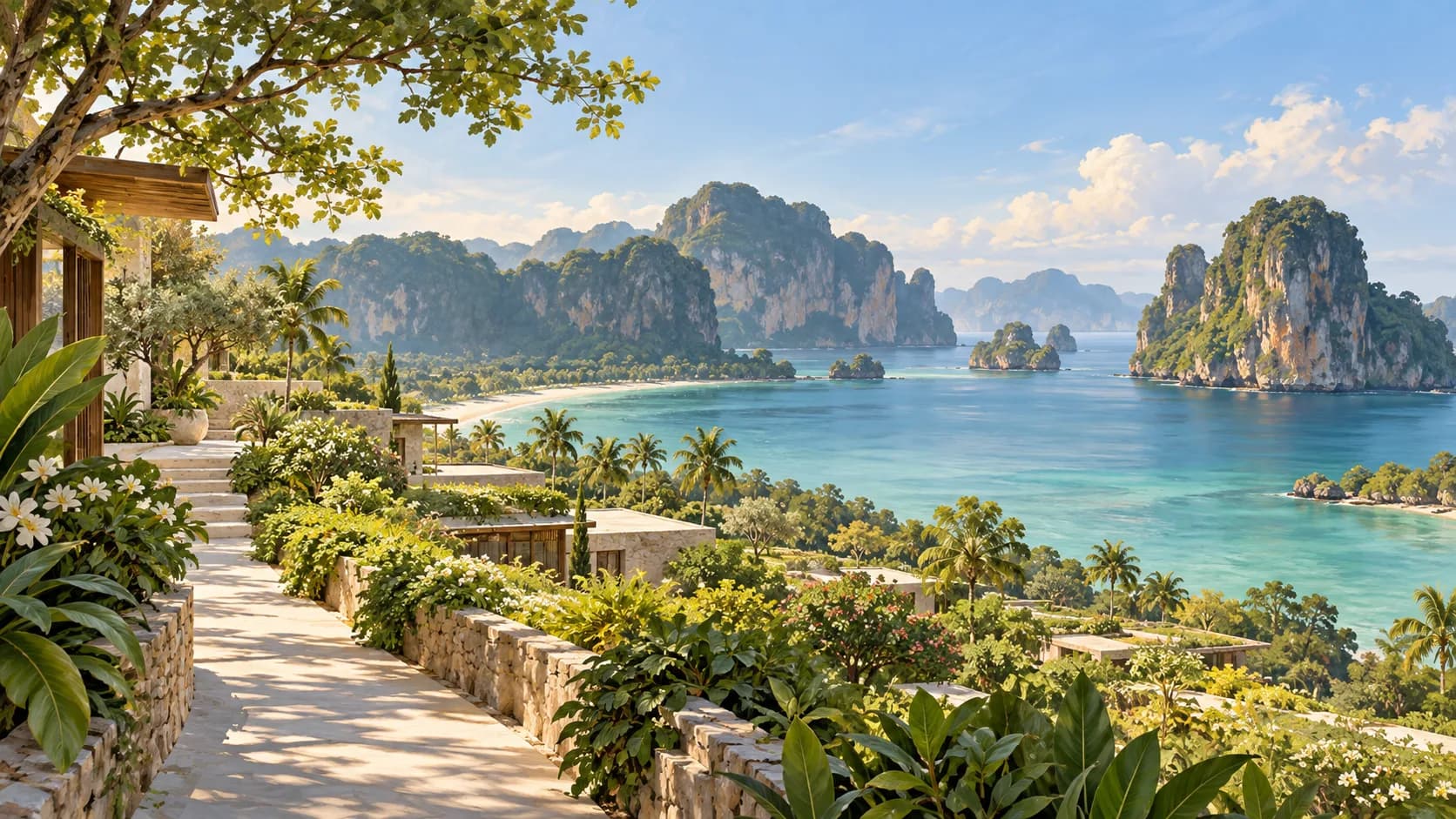
Limestone islands in Phang Nga Bay, evening light on the beaches of Krabi, the hot springs of Ranong, the islands off Trang and Satun: the Andaman coast first made its name through its landscapes. The national spatial plan published in the Royal Gazette on 5 October 2026 gives it a different ambition. Of the four policies the text devotes to the country's special development zones, one sets out to turn six provinces – Phuket, Phang Nga, Krabi, Ranong, Trang and Satun – into a global hub for medicine and health (printed page 182).
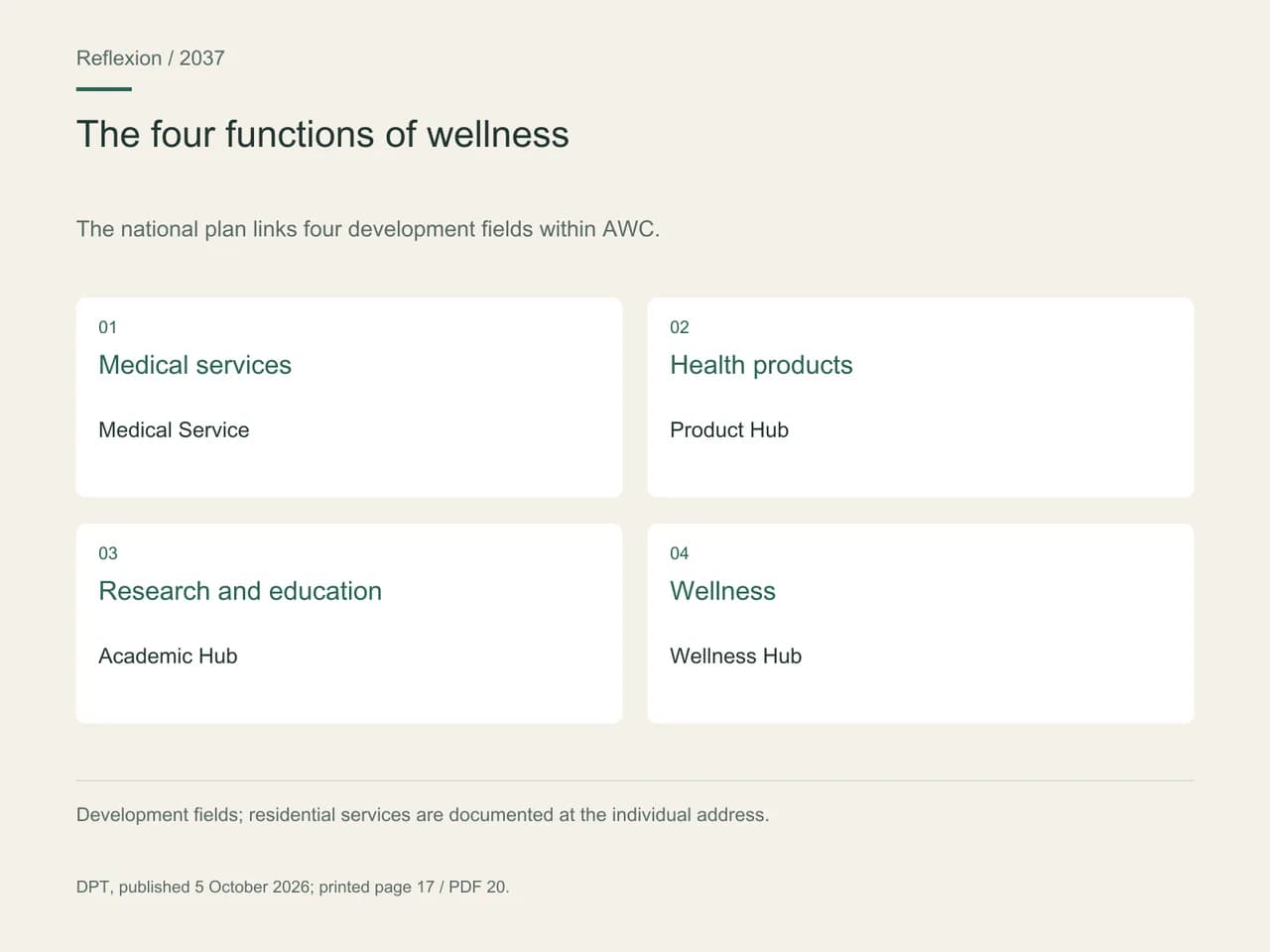
The hub has a name: the Andaman Wellness Economic Corridor, or AWC. The Department of Public Works and Town and Country Planning (DPT), which drew up the plan, describes what it contains on printed page 17 and fixes its boundaries at the same six provinces on printed page 29. The Medical Service strand provides for public and private hospitals to be developed for high-end Thai and international patients, and names specific fields: oncology, cardiology, alternative medicine, aesthetic medicine, anti-ageing retreats and telemedicine. The Product Hub covers health products, medicinal plants and medical devices; the Academic Hub, medical research and training; the Wellness Hub, the emergence of whole towns built around wellbeing.
The idea predates the plan. The corridor was approved on 11 April 2022 by the committee charged with making Thailand an international medical hub, and it sits within the Thirteenth National Economic and Social Development Plan (2023–2027), which aims for high-value medicine and health (printed page 183). The 2026 plan ties it to a measurable goal for the whole country: to climb from 15th place in the Global Wellness Institute ranking, where Thailand stood in 2020, to 6th in 2027, 5th in 2032 and 4th in 2037 (printed page 185).
The means are set out in the table of measures. The Ministry of Interior and the Ministry of Public Health are to draw up a master plan for the six provinces, covering transport, logistics and digital networks, designed as the framework for a medical and health-tourism hub city. The Ministry of Transport is tasked with expanding Phuket and Krabi international airports; the Board of Investment with offering tax incentives for the manufacture of medicines and medical devices and for research centres (printed page 192). Phuket's second airport, planned in Phang Nga, is following its own administrative path, which we trace in our article on the Lanna and Andaman airports.
For anyone deciding where to live, the implications are concrete. The plan notes that tourism on the Andaman coast generates more value than anywhere else in the country (printed page 44). It draws a conclusion from this: on this coast, health stops being one service among many and becomes the axis around which the state says it will organise its roads, airports, networks and investment until 2037. Buyers who once compared beaches now compare healthcare catchments as well.
Phuket, Krabi or Trang: which Andaman suits which life?
The six provinces are not moving at the same pace, and that is what makes the coast easy to read. In the tourism chapter, Phuket, Phang Nga and Krabi are among the 22 international tourism hubs – Bangkok plus 21 provinces – that the plan wants to bring up to world standards (printed page 137). Ranong, Trang and Satun join the 55 provinces in the complementary destination category, formerly known as secondary cities: places where tourism still earns little and where the plan wants to build on distinctive local experiences and short stays from neighbouring provinces (printed page 138).
At the centre of the coast, the Phuket–Phang Nga–Krabi triangle already holds most of the infrastructure. Phuket plays several roles at once: a UNESCO Creative City (printed page 17), a destination for conferences, medical tourism and cultural tourism (printed page 138), and a cruise and yachting hub together with Krabi and Phang Nga (printed page 139). The plan's hospital inventory ranks Vachira Phuket Hospital among the 35 level-A public hospitals, the highest tier in the system, and lists facilities accredited by Joint Commission International in Phuket, Krabi and Ao Nang (printed pages 89 to 91). Our portrait of Phuket, the island where people settle describes what this density means from day to day.
North and south of the triangle, a different Andaman begins. A notice from the Public Relations Department dated 24 January 2024 already presented Ranong and its hot springs as one of the pillars of Andaman wellness, alongside Phuket, Krabi and Phang Nga. Trang, with Trang Hospital, has the corridor's second level-A hospital; the province is listed among the areas for creative and cultural tourism and among the cities Thailand wants recognised by UNESCO by 2037 (printed pages 17, 89 and 138). Ranong, Phang Nga, Krabi and Satun each have a level-S general hospital (printed page 90), and Ranong, Trang and Satun are among the provinces where the plan wants to extend high-performance 5G (printed page 174).
It is in the health chapter that the six provinces really come together. The DPT creates a category of its own there, the 'Andaman provinces group', and adds it to almost every one of its promotion lists (printed pages 93 and 94). All six provinces, Ranong, Trang and Satun included, appear among the 26 areas for rehabilitation centres for patients and older people, the 35 areas for holistic care, the 34 areas for specialist centres in cardiology, oncology, advanced surgery or physiotherapy, the 26 areas where the plan wants more JCI- or A-HA-accredited facilities, and the 37 areas for emergency medicine units. With seven other provinces, they also make up the 13 sites of a future Health Trade Complex, a free zone that would bring together care, medical training and trade.
For a couple who have wintered in Phuket for a few years and are thinking of staying all year, or for a retiree torn between Krabi and Trang, this detail weighs more than any tourism ranking: rehabilitation, specialist follow-up and emergency care are written into the roadmap for the whole coast, not just the island. Phuket keeps its lead for the heaviest care: it is the only one of the six provinces selected among the nine areas for treating complex diseases (printed page 94).
What separates a good choice from an average one?
The first criterion is reading the lists correctly. Of the twelve national Medical and Wellness Tourism territories (printed page 138), only Phuket and Krabi are on the Andaman coast. That list is about welcoming visitors who come for treatment; the health lists cited above are about equipping provinces for the people who live there. Phang Nga, Ranong, Trang and Satun are missing from the first and present in the second – and for a resident, it is the second that counts.
The second criterion is the hospital you can actually reach from the address. A promotion area expresses an intention; an open hospital, with its level, specialities and accreditations, is a fact. The plan itself offers a good starting point, since its inventory names, region by region, the level-A and level-S public hospitals and the accredited facilities. A well-advised buyer starts from that list, identifies the facility that meets their needs, makes the journey in person, at night and in the rainy season, and checks that the accreditation cited is still current on the day of the visit.
The six AWC provinces compared with two DPT lists:
| Province | Within AWC | DPT tourism category | Within the 12 Medical and Wellness Tourism territories |
|---|---|---|---|
| Phuket | Yes | International centre to develop | Yes |
| Krabi | Yes | International centre to develop | Yes |
| Phang Nga | Yes | International centre to develop | Not named in this list |
| Ranong | Yes | Complementary destination | Not named in this list |
| Trang | Yes | Complementary destination | Not named in this list |
| Satun | Yes | Complementary destination | Not named in this list |
The third criterion is the shoreline. The plan identifies stretches of severe erosion along parts of the coasts of Ranong, Phang Nga, Krabi, Trang and Satun, and moderate erosion as far as Phuket (printed page 202). These references do not single out any particular beach. They are reason enough, for a plot or a villa by the sea, to ask for the history of the shoreline, the protective structures already in place and the setback rules that apply to the parcel.
The last criterion is what 'wellness' actually means. In the plan, the word describes a territorial strategy: attracting investment, training people, building facilities, bringing in visitors. It says nothing about the effectiveness of a treatment or the quality of a residence. A development that calls itself wellness because it sits inside the corridor gains no guarantee from that; what counts is what it really offers and what it costs to live with, as we discuss in our analysis of branded wellness residences.
How can you track the corridor up to 2037?
Three signals will show whether the corridor is taking shape. The first is publication of the six-province master plan entrusted to the Ministries of Interior and Public Health: it will show where roads, networks and facilities are to go. The second is progress on works at Phuket and Krabi airports, and on the Andaman airport project in Phang Nga. The third is the actual opening – not the announcement – of rehabilitation centres, specialist care or emergency units in Ranong, Trang or Satun. At national level, the Global Wellness Institute ranking will provide an outside benchmark: the target for 2027 is 6th place.
The rest of daily life follows the same timetable. Phuket is one of eight regional centres where the plan wants to extend drinking water, sewerage networks and sponge-city schemes together; municipalities in Ranong, Phang Nga, Trang and Satun are among those due to receive new wastewater treatment systems by 2037 (printed pages 77 and 86). All six provinces are also to host vocational training centres linked to the corridor (printed page 105), a signal for anyone thinking about local jobs as well as healthcare.
One rule is enough to read these announcements: tell apart what the plan sets as a direction, what an authority has decided and what is actually running. The plan sets horizons – 2027, 2032 and 2037 – not opening dates. An address is chosen on what exists; the corridor shows where the state has chosen to concentrate its efforts, and therefore where existing services deserve close watching.
When we model a life between Phuket and Trang
Imagine a fictional couple in their early sixties who have spent the winter in Phuket for several seasons and now want to live on the coast all year round. One of them needs regular medical follow-up; the other cares less about the beach than about a garden and a town where you do your shopping at the market. The case is built by Reflexion: it represents no client and attributes no prices to the market.
They compare two options. In Phuket, an apartment close to town, within reach of the public and private hospitals listed in the plan. In Trang, a house in a quiet neighbourhood, with the level-A provincial hospital in town and a coastline that is among the erosion segments identified by the DPT. They drive to the hospitals at the hours they would need them, ask both facilities about the follow-up they require and test the connection in the room where one of them still works remotely.
They make up their minds after two stays: they settle in Trang, in a house set back from the shore and close to the provincial hospital, and keep their specialist follow-up in Phuket. What decided it was not the corridor label but three facts checked on the ground: a level-A hospital in town, a journey they had made themselves and a house away from the exposed stretches of coast.
Modelled scenario. This profile is not a client; the parameters are working assumptions.
What you can do now
Pick two provinces, one on each side of the corridor: Krabi and Trang, or Phang Nga and Ranong. For each, note the hospital closest to the address you have in mind, its level in the plan's inventory and its current accreditations, then make the journey. Add the shoreline question for any property by the sea, and the connectivity question if you work remotely. The Reflexion guide catalogue carries this approach across the map, from the coastline down to the neighbourhood.
Frequently asked questions
Which provinces make up the Andaman Wellness Corridor?
Six provinces on Thailand's west coast: Phuket, Phang Nga, Krabi, Ranong, Trang and Satun. Approved in April 2022 by Thailand's Medical Hub committee, the corridor was carried into the national spatial plan published on 5 October 2026, which aims to make it an international reference for care and wellbeing by 2037. Each province keeps its own character: busier with tourism in the centre, quieter to the north and south.
Is Phuket the only Andaman province with top-tier hospitals?
No. The inventory published by the DPT also places Trang Hospital in level A, the highest tier of the public network, alongside Vachira Phuket. Krabi has JCI-accredited facilities, while Phang Nga, Ranong and Satun each have a level-S general hospital. The difference lies in the most demanding treatment: for complex diseases, Phuket is the only one of the six that the plan selects.
Why is Phang Nga not on the medical tourism list?
The list of twelve Medical and Wellness Tourism territories names Phuket and Krabi on this coast, and the plan does not explain its choices province by province. Phang Nga is not sidelined for all that: it features in the lists for rehabilitation, holistic care and specialist centres, and the future Andaman international airport is due to be built on its territory.
Will the corridor push up property prices?
The plan does not say: it publishes no prices, rents or yields. It announces public investment – airports, networks, care centres – whose effect on a neighbourhood will depend on whether it is delivered and exactly where. Judging a property takes comparable transactions and recent local data; the corridor mainly tells you where to look.
Does the corridor change anything for a foreign resident?
Yes for the healthcare on offer, no for the legal framework. Its medical strand explicitly targets high-end Thai and international patients, which shapes how hospitals along the coast are equipped. The plan does not, however, deal with foreign ownership, visas or tax: those questions are governed by other legislation and call for specialist advice.
Method and sources
Sources checked October 13, 2026
Exchange rate used: 1 EUR = 38.374 THB (28 September 2026)
- What this article draws on: the DPT's 2026–2037 national spatial plan, published in the Royal Gazette on 5 October 2026, read in its original Thai version and checked on 13 October 2026, together with a Public Relations Department notice of 24 January 2024. Translations from Thai are editorial; the couple in the scenario is fictional. Reference rate: 1 EUR = 38.374 THB; no amount is converted here. The plan's lists designate promotion areas and do not, on their own, describe the services available at a given address.
- DPT, Andaman Wellness Economic Corridor: strands, boundaries, background, Global Wellness Institute target and measures, printed pages 17, 29, 182–185 and 192 / PDF 20, 32, 185–188 and 195.
- DPT, the coast's weight in tourism, tourism categories and the twelve Medical and Wellness Tourism territories, printed pages 44 and 137–139 / PDF 47 and 140–142.
- DPT, hospital inventory and health promotion areas, water and sanitation, vocational training, mobile networks and coastal erosion, printed pages 77, 86, 89–94, 105, 174 and 202 / PDF 80, 89, 92–97, 108, 177 and 205.
- Public Relations Department, notice of 24 January 2024: Ranong and its hot springs, within a four-province wellness angle distinct from the six-province scope adopted by the DPT.
This article is general information, not legal or tax advice. The rules cited are dated: check with a qualified professional that they are still in force before acting.