Longevity: in Thailand, property is catching up with care
Thailand's wellness tourism jumped 36.4% in 2024 to USD 14 billion. What is being built in Bangkok and Phuket, and how to check that an offer is real.
Thailand's wellness tourism grew by 36.4% in 2024 to reach USD 14 billion, roughly three times the global pace, according to data published by the Global Wellness Institute on 26 February 2026. In less than two months, from 10 to 13 November 2026, the Global Wellness Summit will hold its twentieth edition at the Angsana Laguna, in Phuket — the first in Thailand, and the occasion for the GWI to publish its country data there. In the meantime, two projects are changing the nature of the offer: a health campus of more than THB 29 billion facing Lumphini Park in Bangkok, and the first South-East Asian location of a Swiss longevity clinic in the north of Phuket. In Thailand, care has pulled ahead of housing. Property is starting to connect to it.
What care already weighs in Thailand
Three figures, published by the same institute, describe three different realities — and it is by telling them apart that the subject becomes readable.
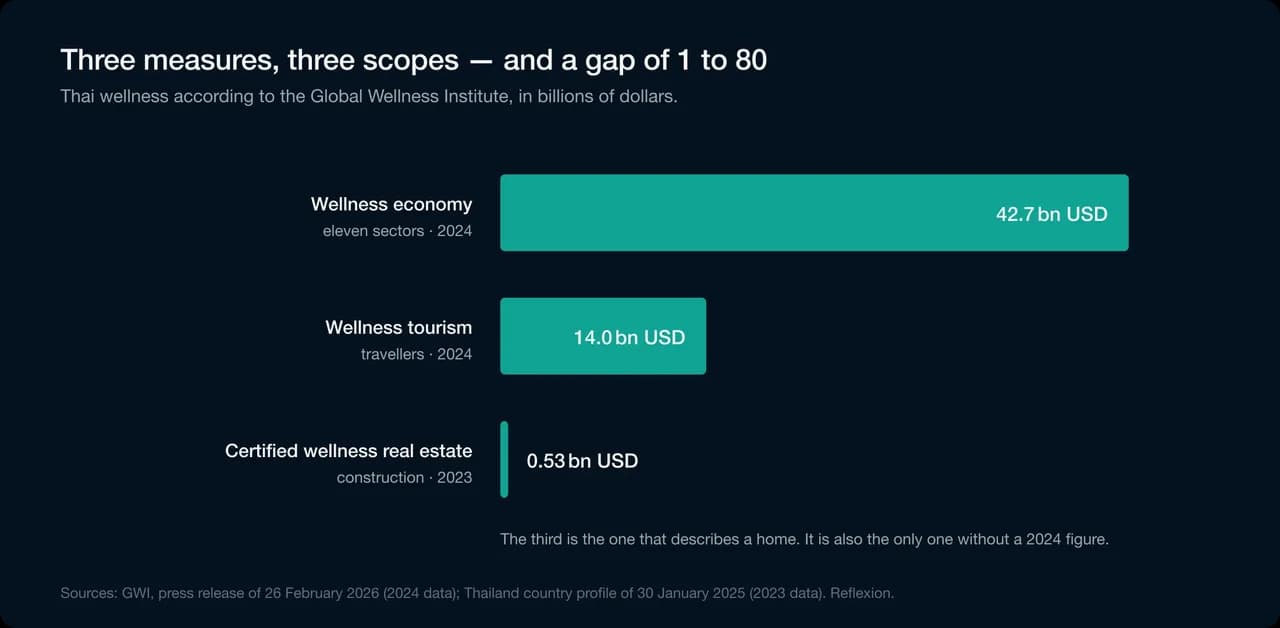
The first is the broadest. The Thai wellness economy, as measured by the Global Wellness Institute across eleven sectors — from spas to nutrition, from traditional medicine to preventive health — was worth USD 42.7 billion in 2024, up 10.1% year on year. Thailand ranks 24th in the world and 9th in Asia-Pacific.
The second is the most dynamic. Wellness tourism alone — the spending of travellers who come to be treated, to rest, to get back in shape — amounts to USD 14 billion in 2024, up 36.4% year on year. The GWI describes this pace as one of the fastest in the world: about three times the global average. Thailand is 15th in the world ranking for the sector and 7th for growth among the top twenty-five markets.
The third is the most modest, and it is the one that matters to a buyer. Thai wellness real estate — residential construction incorporating certified wellness standards — was worth USD 0.53 billion in 2023, 33rd in the world, according to the country profile published by the GWI on 30 January 2025. The GWI projects growth of 22.9% a year for this sector, but does not publish a 2024 value for Thailand: the latest available measurement remains that of 2023.
Around these figures, there is a care ecosystem that has been working for a long time. According to the Tourism Authority of Thailand, quoted by Nation Thailand on 18 October 2025, medical tourism generated revenue of about THB 125 billion (about €3.26 billion) in 2025 from nearly 580,000 foreign patients, or 1.74% of international arrivals. The same source cites costs 30 to 70% below Western rates and more than 500 hospitals and clinics equipped to receive international patients. One reading note, which applies to the whole file: the solid figure is the 2025 actual — the target announced for 2026 repeats exactly the same amount, THB 125 billion. It is a target of holding steady, not of growth.
What is being built, and where
Two projects are enough to describe the movement, because they are documented by their own operators.
WellEra, in Bangkok. On 19 June 2026, BDMS Wellness Clinic announced a development of more than THB 29 billion (about €756 million, or USD 865 million) on Sarasin Road, at the corner of Langsuan, facing Lumphini Park. The site exceeds 200,000 m² and brings together four components: the BDMS Wellness clinic, a 168-room, 20-storey stay hotel, a retail component, and Capella Residences — 262 units over 45 storeys, designed by the New York firm Kohn Pedersen Fox. The residential operator is Capella Hotel Group, in what the developer presents as its first branded residence integrated with a wellness offer. Opening is announced for 2030.
Tri Vananda × Clinique La Prairie, in Phuket. The Swiss operator announces on its own destination page an opening in November 2026 within the Tri Vananda estate, in the north of the island: 40 private pool villas, in three formats — Royal of about 400 m², Grand of about 160 m², Signature of about 120 m² — and three named programmes, Essence of Vitality, Master Detox and Life Reset. It is Clinique La Prairie's first location in South-East Asia. A discrepancy in timing deserves to be flagged rather than smoothed over: a specialist trade outlet announces 2027. We retain the operator's date, the most authoritative source, without going further.
These two developments arrive in a residential market already structured by brands. According to C9 Hotelworks (Asia Branded Residences Market Review 2026, June 2026), Thailand has 13,124 branded residence units launched across 63 properties, worth THB 205.3 billion (about €5.35 billion) — 26% of launched supply in Asia, the largest share on the continent. Bangkok accounts for 5,031 units, Phuket for 3,465 — a depth we put into context in our overview of the Thai market.
This is where the heart of the subject lies: first in Asia for branded residences, Thailand is only 33rd in the world for wellness real estate. It is not a contradiction; it is a difference of definition. C9 measures homes backed by a hotel brand; the GWI measures homes built to certified wellness standards. A branded residence is not a certified wellness home. The gap between the two measures is exactly the space in which the Thai offer is being built.
One detail confirms it. The country's longest-established longevity operators — Chiva-Som in Hua Hin, opened in 1995, or RAKxa near Bangkok — are stay-based establishments, and no associated residential property programme could be confirmed for either of them. The care ecosystem has been there for thirty years; the property that connects to it is new.
Certified, targeted, self-declared: where does WellEra stand?
We have published elsewhere the grid for reading a wellness property promise — certified, targeted, self-declared. It comes down to one distinction, and here it applies to a concrete case.
WellEra's press kit mentions three certifications: LEED Gold, Fitwel three stars and WELL Platinum. As of 24 September 2026, these are targeted certifications, not obtained ones — the developer says so itself. This is perfectly normal for a building whose opening is announced for 2030: you do not certify a building that does not exist. The practical consequence is simple — a buyer signing today would be buying an intention to certify, verifiable on delivery, four years later.
This is not a criticism of the project. It is the way to read any "wellness" line on a sales plan: ask whether the certification has been obtained, on what date, and at what level.
What does the air say, territory by territory?
Air is the most concrete wellness data point, because it can be measured, dated and compared — and because it depends on no brochure.
According to IQAir's World Air Quality Report 2025, published on 25 March 2026, Thailand's annual PM2.5 average stands at 17.8 µg/m³ in 2025, against 19.8 in 2024: the country is improving. It remains 3.6 times the World Health Organization guideline of 5 µg/m³. Chiang Mai shows 18.2 µg/m³ in the same series, above the national average.
For the two territories that carry the wellness offer — Phuket and Koh Samui — the series stops there. IQAir publishes no 2025 annual average for Phuket, for Surat Thani province or for Bangkok. The "least polluted cities" rankings in circulation come from commercial aggregators that name neither their primary source nor their number of stations: we use none of them. It is a useful limit to know before buying a promise of clean air — on the islands, institutional measurement does not yet exist, and an operator who quotes you one should be able to say where it comes from.
That leaves seasonality, which is the most useful parameter day to day. The agricultural burning window runs from February to April, peaking in March (IQAir); in 2026, Chiang Mai entered the world's top 10 most polluted cities on 4 March, 27 March and 16 April. This is not a permanent flaw of the country: it is a calendar parameter, and it is managed as such — through the choice of territory, and of the weeks one spends there.
What separates a longevity offer from a brochure argument?
Four checks, all feasible before signing, and all independent of the vocabulary the seller uses.
Is the clinical partnership named, and enforceable? A clinic brand cited in a press release is not a contract. The most solid projects name their medical operator — BDMS for WellEra, Clinique La Prairie for Tri Vananda — and write it into their contractual documentation. The questions to ask concern the length of the commitment and what happens if the operator withdraws.
Is the certification obtained, dated and of a known level? This is the grid from the previous section. A project delivered two years ago that can produce neither a certificate nor a date is a self-declared project.
Does the service exist when the owner is away? A residence sold to a buyer who spends eight weeks a year there lives the other forty-four without them. What keeps running out of season — the medical team, maintenance, catering, security — can be read in the service-charge budget, not in the brochure.
How far away, really, is the hospital's technical platform? It is the least glamorous question and the most decisive. In Phuket — whose schools and medical infrastructure we have detailed elsewhere — Bangkok Hospital Phuket is JCI-accredited; Bumrungrad is building its first campus outside Bangkok there — THB 4.3 billion (about €112 million), 16.5 rai less than ten minutes from the international airport, 120 beds in the first phase and 212 eventually, with its VitalLife preventive medicine centre. The piles were driven in February 2025, and opening is announced for 2027 (press release of 11 December 2025). The distance that counts is not the one on the map; it is the one travelled on a Tuesday morning.
Three figures, three scopes: the table that avoids confusion
The Global Wellness Institute's three measures of Thai wellness, and what each one covers:
| Scope | Value | Year | World rank | What the measure covers |
|---|---|---|---|---|
| Thai wellness economy | USD 42.7 bn | 2024 | 24th | Eleven sectors: spas, nutrition, beauty, traditional medicine, physical activity, mental health, preventive health, workplace wellness, thermal springs, tourism, real estate |
| Thai wellness tourism | USD 14 bn | 2024 | 15th | Spending by travellers, international and domestic, whose trip has a wellness motivation |
| Thai wellness real estate | USD 0.53 bn | 2023 | 33rd | Residential construction incorporating certified wellness standards — not branded residences |
| *Benchmark: global wellness real estate* | *USD 876 bn* | *2025* | *—* | *Same definition, global scope* |
a single amount, well above USD 14 billion, presented as "Thai wellness tourism in 2024" and attributed to the Global Wellness Institute. The phrase circulates in the international luxury press.
the GWI press release these reports refer to is dated 30 January 2024 and covers 2022 data. The amount they quote refers to the entire Thai wellness economy, all eleven sectors combined — not wellness tourism alone, which was more than six times smaller that year. Both the scope and the year are therefore wrong, and the amount itself has since been revised downwards by the GWI in its February 2025 edition. The only three values in force as of 28 September 2026 are those in the table above, each for its own scope.
When we model a choice between two cities
Hélène, 63, and Bernard, 66, have just sold their house in the western Paris suburbs. They want to spend six to eight months a year in Thailand and have a purchase budget of THB 12 million (about €312,700), excluding costs. Bernard needs two consultations a year and a reliable hospital platform. Hélène spent two winters coughing in a large Asian city and does not want to do it again.
The Bangkok option. Medical density there is the highest in the country: Bumrungrad, Bangkok Hospital, BNH and Samitivej are JCI-accredited and located in the central districts. We do not publish an average journey time — no source measures it, and it can triple depending on the time of day. In 2025, a foreigner buying a condominium in Bangkok spent on average THB 5.03 million (€131,200) — a value ÷ units calculation on the transfers recorded by the REIC: their budget therefore sits well above the capital's average ticket. Inflation there is the most moderate in the country, +2.56% in April 2026 against +2.89% nationally (Ministry of Commerce). The blind spot is the air: no 2025 annual average is published for Bangkok, and we will not invent one.
The Phuket option. On air, they have no institutional measurement: IQAir publishes no 2025 annual average for the island. It is something Hélène will have to observe for herself, on site, in the seasons when they plan to be there. The average ticket for a condominium transferred to a foreigner there was THB 5.12 million (€133,300) in 2025, the highest in the country. In May 2025, C9 Hotelworks measured a median of THB 144,000/m² across all segments on the island (about €3,750/m²): at that price, their budget corresponds to about 83 m². Backed by a hotel brand, the median rises to THB 181,000/m² (€4,720/m²), or about 66 m². On the other hand, in April 2026 the South showed the strongest price increase in the country, +3.91%.
The tipping point. It is not about property; it is medical. The island already has a JCI-accredited facility, and Bumrungrad is opening a campus there announced for 2027, less than ten minutes from the airport. The couple therefore does not have to choose between air and care, but between care that is at its maximum immediately and care that is sufficient today and better tomorrow.
Their decision. They buy in Phuket, with three rules. Only visit addresses less than twenty minutes from Bangkok Hospital Phuket, timed on a Tuesday at 8 a.m. and not estimated on a map. Budget for two return trips a year to Bangkok for Bernard's check-ups, until the Bumrungrad campus has opened. Rule out any project whose "longevity" argument rests neither on a named medical operator nor on an obtained, dated certification. They will sign after the GWI's country data is published in November.
Modelled scenario. This profile is not a client; the parameters are working assumptions.
What our database makes it possible to check
Reflexion indexes, project by project, amenities, facilities and the developer — across the 7,865 projects and 1,567 developers we track. Here this granularity serves one purpose, and one only: separating what is certified from what is declared. An indexed gym is a gym; a "longevity centre" without a named operator remains a brochure line. The method does not produce market statistics on wellness — we will not publish any until we have calculated them. It produces a check that no one can carry out from a brochure.
What you can do now
The Global Wellness Institute will publish its full country data at the Global Wellness Summit in Phuket, from 10 to 13 November 2026 — in less than two months, and for the first time in Thailand. Until then, two useful steps: for any project presented as "wellness", ask for the name of the medical operator and the exact status of its certifications — obtained, on what date, at what level; and measure for yourself the journey to the nearest hospital platform, at the times you would actually go.
You can explore the projects we index, or talk to a Reflexion adviser about how a longevity project can be checked before buying.
Frequently asked questions
How big is wellness tourism in Thailand?
Fourteen billion dollars in 2024 for wellness tourism alone — the spending of travellers who come to be treated or to rest. Growth reached 36.4% year on year, about three times the global pace, placing the country fifteenth (Global Wellness Institute, February 2026). Watch the scope: the Thai wellness economy as a whole, across eleven sectors, is three times larger.
Why is Thailand first in Asia for branded residences but only 33rd in the world for wellness real estate?
Because the two rankings count different things. One counts homes backed by a hotel brand, and the country holds a quarter of the launched supply in Asia. The other counts homes built to certified wellness standards, and on that scope Thailand weighs half a billion dollars. An apartment branded by a hotelier is not a certified home: that is the whole difference.
What is WellEra in Bangkok?
A health campus announced on 19 June 2026 by BDMS Wellness Clinic, facing Lumphini Park: more than 200,000 m² for just over THB 29 billion (€756 million). It will include a clinic, a stay hotel, retail and a residence operated by Capella — 262 homes over 45 storeys. Opening is announced for 2030, making it an off-plan purchase four years out.
Are a project's WELL or LEED certifications a guarantee?
Obtained, yes; announced, no. For a building due to open in 2030, the labels cited can only be targets — you do not certify a building that does not yet exist, and that is normal. What is not normal is a project delivered two years ago that cannot produce a certificate. Three questions are enough: obtained? on what date? at what level?
What is known about air quality in Thailand?
Not much, and that is a fact in itself. IQAir measures a national PM2.5 average of 17.8 µg/m³ for 2025, an improvement on 2024, and 18.2 µg/m³ in Chiang Mai. For Phuket, Koh Samui and Bangkok, the institute publishes nothing: no comparable value therefore exists for the beach destinations, and the aggregator rankings in circulation do not name their source. What is solid, on the other hand, is the calendar — February to April, peaking in March.
When is the Global Wellness Summit being held in Thailand?
From 10 to 13 November 2026, at the Angsana Laguna Phuket. It is the summit's twentieth edition and the first held in Thailand. The Global Wellness Institute will publish its full country data there, which should notably update the value of Thai wellness real estate, whose latest public measurement covers 2023.
Method and sources
Sources checked September 24, 2026
Exchange rate used: 1 EUR = 38.374 THB (24 September 2026).
- Global Wellness Institute, GWI Releases New Data on Thailand's Fast-Growing Wellness Market, press release of 26 February 2026 (2024 data) — https://globalwellnessinstitute.org/press-room/press-releases/gwi-releases-new-data-on-thailands-fast-growing-wellness-market/
- Global Wellness Institute, country profile Thailand — Wellness Economy, 30 January 2025 (2019-2023 data, including wellness real estate) — https://globalwellnessinstitute.org/wp-content/uploads/2025/02/GWI-WE-Thailand-2025_013025_final.pdf
- Global Wellness Institute, Global Wellness Economy: Country Rankings, press release of 30 January 2024 (2022 data) — https://globalwellnessinstitute.org/press-room/press-releases/gwi-country-rankings-jan2024/
- Global Wellness Institute, Wellness Real Estate Market Reaches $876 Billion, press release of 12 May 2026 — https://globalwellnessinstitute.org/press-room/press-releases/wellness-real-estate-market-reaches-876-billion-forecast-to-hit-1-8-trillion-by-2030/
- Global Wellness Summit, official page for the 2026 edition (Angsana Laguna Phuket, 10-13 November 2026) — https://www.globalwellnesssummit.com/2026-global-wellness-summit/
- BDMS Wellness Clinic, WellEra launch press release, 19 June 2026 — https://www.bdmswellness.com/en/article/news/wellera-launch
- Clinique La Prairie, Phuket destination page (Tri Vananda) — https://cliniquelaprairie.com/destinations/thailand-phuket/
- Bumrungrad International Hospital, press release of 11 December 2025 (Phuket campus) — https://www.bumrungrad.com/en/blog-news/announces-phuket-create-world-class-medical-and-wellness-hub
- Tourism Authority of Thailand (TAT), via Nation Thailand, 18 October 2025 (medical tourism) — https://www.nationthailand.com/news/tourism/40056950
- C9 Hotelworks, Asia Branded Residences Market Review 2026, June 2026 (via Hospitality Net, 16 June 2026) — https://www.hospitalitynet.org/news/4133005/
- C9 Hotelworks, Phuket Property Market Update, May 2025 (median prices per m²) — https://c9hotelworks.com/wp-content/uploads/2025/05/Phuket-Property-Market-Update-Report-May-2025.pdf
- IQAir, World Air Quality Report 2025, published on 25 March 2026, reported by Nation Thailand — https://www.nationthailand.com/news/general/40064230
- IQAir Newsroom, Chiang Mai burning episodes of 4 March, 27 March and 16 April 2026
- REIC (Real Estate Information Center, Government Housing Bank), 2025 annual report on condominium transfers to foreigners, via Prachachat Turakij, 2 March 2026 — https://www.prachachat.net/property/news-1971437
- Trade Policy and Strategy Office (Ministry of Commerce), regional consumer price indices, April 2026, via Nation Thailand, 31 May 2026 — https://www.nationthailand.com/business/economy/40066875
What we could not verify
- The 2024 value of Thai wellness real estate. The GWI publishes sector growth of 22.9% a year but no 2024 value for Thailand. The latest published value remains USD 0.53 billion in 2023. We have not applied the growth rate to this value to derive a 2024 figure.
- The number of JCI-accredited facilities in Thailand. Joint Commission International's official directory cannot be consulted (403 error). The totals in circulation come from commercial aggregators without a primary source; none is used. No number is given here; only facilities identifiable by name on their own website are cited.
- The annual PM2.5 averages for Phuket, Surat Thani province and Bangkok. Absent from the IQAir publications consulted. The values in circulation come from commercial aggregators that name neither their primary source nor their number of stations; our blocklist ranks them at the lowest level of evidence and the application refuses to serve them. None is published here.
- The tenure of WellEra's units. BDMS's press release does not mention tenure. An agency listing mentions a lease; we do not use it. It is legally weighty information for a French buyer: to be confirmed with the developer.
- Tri Vananda villa prices. The ranges in circulation come from an agency listing, not from the developer. No price is quoted.
- The exact opening date of Clinique La Prairie Phuket. The operator announces November 2026; a specialist outlet announces 2027. The operator's date is retained, and the discrepancy is flagged.
- Sales rates and yield premiums for Thai branded residences. No public source publishes a project-by-project price premium or an actually paid rental yield. These figures are therefore not quoted.
- Chiang Mai's pollution episodes from January to April 2026 beyond the IQAir readings. The extreme values and administrative statements reported by tertiary sources have not been re-verified at a primary source and are not used.
- RAKxa and Chiva-Som are stay-based operators. No associated residential property programme has been confirmed for either of them; they are not presented as such.
This article is general information, not legal or tax advice. The rules cited are dated: check with a qualified professional that they are still in force before acting.