Thailand filming locations: the set and the address
One series filmed on two Thai coastlines, a 30% public rebate, a measured effect of 12%. What the setting changes about an address, and at what price.
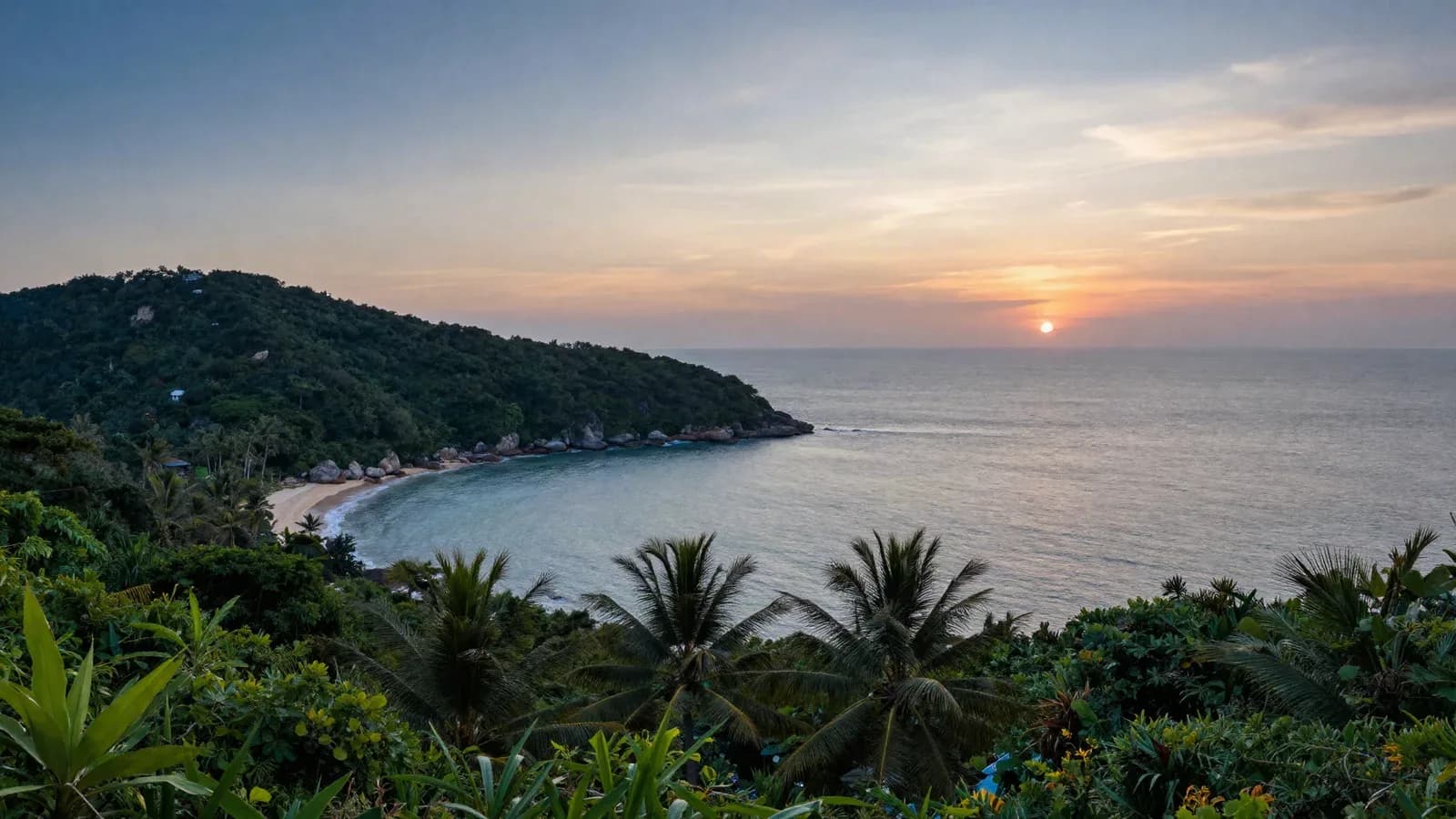
One series filmed on two Thai coastlines, a 30% public rebate, a measured effect of 12%. What the setting changes about an address, and at what price.
What does the state pay to bring a shoot to Thailand?
Thailand introduced a cash rebate for foreign productions in 2017, administered by the Thailand Film Office of the Department of Tourism, under the Ministry of Tourism and Sports. It is the instrument that brought the cameras in; what decides what may be built where they set up is another matter entirely, and we have covered it in our reading of the building regulations. The scheme has changed scale three times. At the outset, a rebate capped at twenty per cent for local spending of at least fifty million baht, with a ceiling of a hundred and fifty million per project. The ceiling doubled in March 2023. Then, on 27 December 2024, the relevant committee approved an increase that took effect on 1 January 2025: up to thirty per cent, and no monetary cap per production at all.
What the published schedule actually says is worth setting out, because the version in circulation is often wrong. Local spending must exceed fifty million baht, come from foreign sources, and be paid to entities registered in Thailand. Feature films, series, documentaries and music videos are eligible; television commercials are not. Post-production counts. The base rate depends on the spending band, and four cumulative bonuses are added to it: five points for key Thai personnel, five for showcasing the country in the version broadcast, three if at least a quarter of the shooting days take place in designated secondary provinces, three if fifteen per cent of local spending goes to post-production in the country.
The rebate schedule, as published by the Film Office in March 2025:
| Qualifying local spend | Base rate | Maximum total with bonuses |
|---|---|---|
| 50 to 100 million baht | 15% | 25% |
| 100 to 150 million baht | 20% | 30% |
| over 150 million baht | 25% | 30% |
One limit of the scheme goes unnoticed, yet it changes everything for a production that is planning ahead: removing the per-project cap does not remove the annual budget constraint. Rebates are paid within the limits of the fiscal year’s allocation. In fiscal year 2024, 509 million baht was paid out to fifteen films, and the Film Office asked for eight hundred million for 2025, against three hundred and thirty-seven million the year before. Set against the revenue the scheme is meant to generate, the instrument weighs a few per cent: it is a lever, not a mass subsidy.
Revenue, then. It is rising, and it is published: 466 foreign productions and 6.6 billion baht in 2023, 491 and 6.58 billion in 2024, 546 and 7.717 billion in 2025. In the first eight months of 2026, 383 productions and 6.52 billion. The geographical spread is revealing for anyone looking at property: in 2023, Bangkok accounted for 282 shoots, Chon Buri for 77, Samut Prakan for 60. The southern coastlines the public associates with postcard settings are not, by volume, where the filming happens.
Has the effect on visitor numbers been measured?
In part, and the results are more sober than the headlines. The most cleanly established measure comes from a booking platform, which reported on 18 February 2025 — two days after the first episode aired — a rise of twelve per cent in accommodation searches for Koh Samui, with the US market up sixty-five per cent on the previous month’s average. These are searches, not bookings, over two days.
Two other sets of figures exist, and where they come from needs saying. A hotel data provider recorded a sixty-five per cent rise in foreign tourist bookings on Koh Samui for Songkran week 2025, with the average stay lengthening to 3.8 nights — but the link with the series was added by those who relayed the figure, not established by the provider, and the 2024 and 2025 holiday calendars do not line up. The hotel group that owns three of the properties filmed reported, for its part, forty-one per cent more direct online bookings and doubled web traffic: proprietary data, unpublished method.
The most widely cited figures are the ones we do not repeat. A rise of three hundred per cent in travel bookings and eighty-eight per cent in searches for the country was announced by a public agency in May 2026, with no reference period, no data provider and no method. And the ‘plus three hundred per cent’ that circulates most widely actually comes from a travel platform measuring Hawaii and Sicily for the series’ first two seasons: a transfer of destination and season, not a Thai measurement.
That leaves the only flow genuinely observable at island level: traffic at Koh Samui airport, 1,127,832 passengers from January to April 2025, up nine per cent year on year. Nine per cent over four months that include the broadcast. And the most data-rich market report published on the island after the broadcast, in June 2025, does not mention the series once — neither the one on hospitality nor the one on residential property.
The countervailing fact belongs right alongside it, because it reframes everything. In 2025, the year the series aired, international arrivals in Thailand fell by 7.23%, to 32.9 million, and tourism receipts by 4.7%, to around 1,530 billion baht. A local, short-term screen effect can perfectly well coexist with a national market that is contracting. Both are true at the same time.
Maya Bay, the precedent never quoted in full
The most instructive story in Thai film tourism dates from 1999, and it is almost always only half told. For a film released in February 2000, a studio physically altered a beach on the island of Phi Phi Leh, inside a national park in Krabi province: earthworks, widening, the felling of coconut palms. In 2006, the Supreme Court ruled that the shoot had harmed the environment.
What came next is the part people forget. The site received up to five thousand visitors a day on a beach two hundred and fifty metres long, with around two hundred boats anchoring daily in spring 2018, and eighty per cent of the surrounding coral destroyed. It was closed in June 2018, then closed indefinitely in October of the same year, after surveys revealed more extensive damage than expected. It reopened on 1 January 2022 under a strict regime: boats banned from the bay, landing via a pontoon at the back, three hundred visitors per one-hour rotation, no swimming.
And since 1 October 2024, the permitted capacity has been 4,125 visitors a day, in eleven rotations of three hundred and seventy-five people, from seven in the morning to six in the evening, with an annual closure from 1 August to 30 September. In other words, less than three years after reopening, a return to more than four-fifths of the visitor level that destroyed the site. Only swimming and anchoring remain prohibited. It is the same state that funds the shoots and sets the cap: this is not a contradiction but a trade-off, and it is useful to know which way it leans.
The two coastlines, as the regulations see them
Now to what matters for a buyer. The third season of this series was filmed mainly on two coastlines, and the locations confirmed by the establishments’ own press releases are few: a resort on the north-western tip of Koh Samui, in Ang Thong sub-district; two addresses in Bophut and Chaweng, on the north-east coast of the same island; and a property in Mai Khao, in Thalang district, in north-west Phuket. Other locations have been reported by the trade press without confirmation from the broadcaster or the hotelier, in Patong, in Bangkok and on Koh Phangan; we leave them aside.
These three micro-locations have one thing in common: they are among the most tightly regulated in Thailand. We have read the notifications that govern them page by page, and this is what they say.
What the regulations allow where the scenes were filmed:
| Location | Strip or altitude | What is allowed |
|---|---|---|
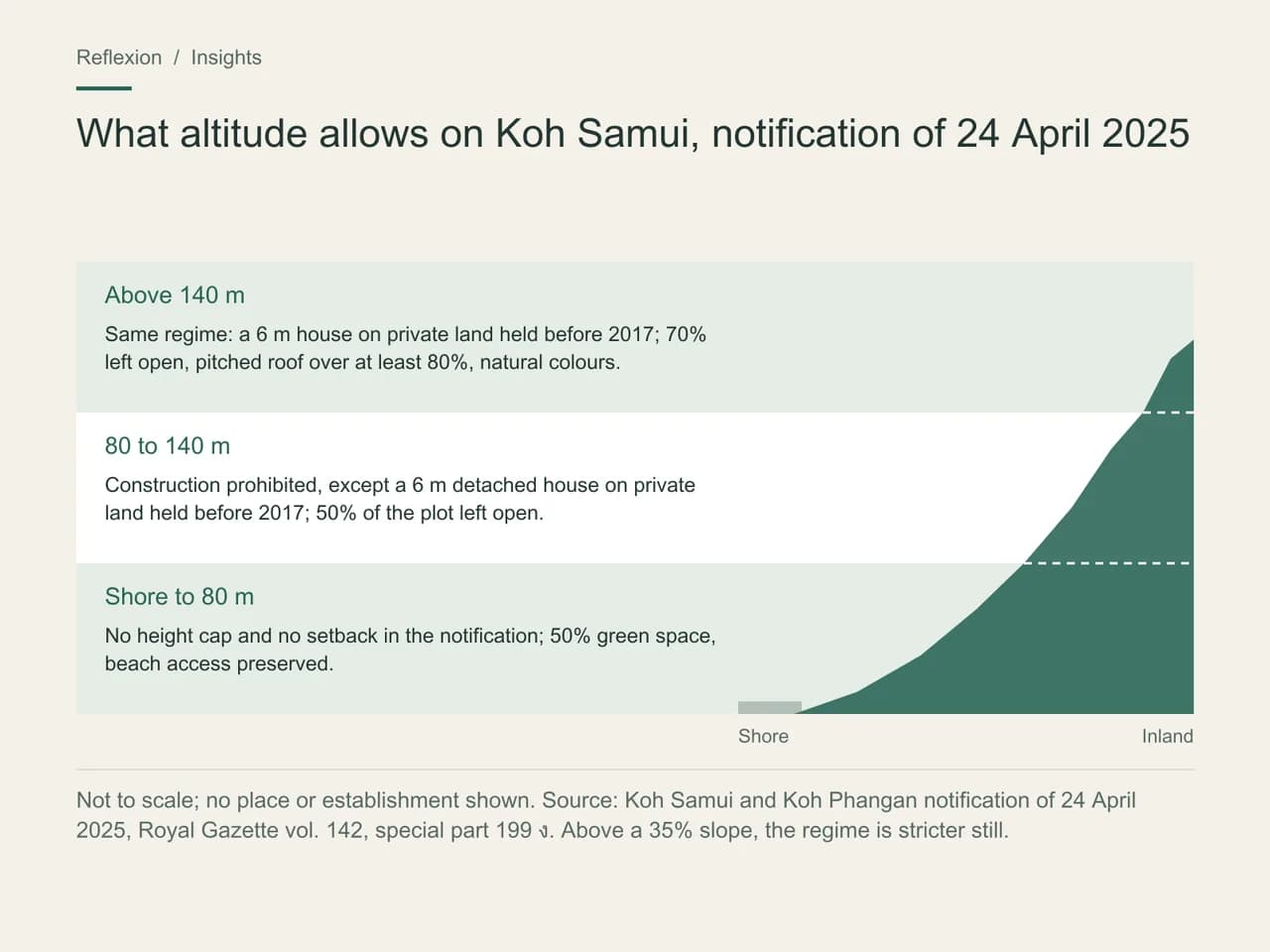
| Koh Samui, from Ang Thong to Bophut | from the shoreline up to 80 m altitude | no height cap or setback imposed by the notification; 50% green space and beach access preserved |
| Koh Samui | from 80 to 140 m altitude | building prohibited, except on private land: single house of 6 m, 50% of the plot left open |
| Koh Samui | above 140 m | same regime, 70% open, pitched roof over at least 80%, natural colours |
| Mai Khao, Phuket | first 50 m from the shoreline | 6 m height, 75% open, and full impact assessment for any hotel or apartment building, whatever its size |
| Mai Khao, Phuket | from 50 to 200 m from the shoreline | 12 m, then 16 m in the next strip |
Two surprises emerge from this table. The first: on Koh Samui, the strip running from the shoreline up to eighty metres of altitude — in other words, almost everything inhabited and everything filmed — has neither a maximum height nor a setback from the shoreline under the notification. The ten-metre setback that is often quoted applies to the neighbouring islets, not to Samui. The second: above eighty metres, precisely where the view the series made so desirable is to be found, building is prohibited in principle, and the only exception is a six-metre single house on private land held before 2017.
In Mai Khao, the constraint is of a different kind. Within the first fifty metres from the shoreline, the Phuket notification requires a full environmental impact assessment for any hotel or apartment building, with no size threshold — whereas the general law only triggers one at eighty rooms or four thousand square metres. It is the kind of provision you will not read in a sales brochure, and yet it decides a project’s timetable. We have treated the island in its own right in our reading of Phuket as a main home, and compared the markets with one another in our review of Thailand’s six destinations.
No study links filming to property prices in an area
Not in Thailand, and not anywhere else in a tourist setting. The closest work concerns the opening of permanent studios in a US metropolis, with an effect of four per cent within a one-mile radius — but the mechanism there is proximity to jobs, not screen-induced demand, and the transposition does not hold. Add to that a data limitation: Thai tourism statistics stop at provincial level. Visitor numbers in the sub-district of a filming location are therefore not observable. Anyone selling a ‘series effect’ on prices is selling an inference.
When we model the case of Claire and Simon, between Bophut and Mai Khao
Claire, 49, and Simon, 53, have watched the series and want a villa with a view. Their budget is set at 15 million baht (€390,900). Two options are put to them: a three-bedroom villa in the hills above Bophut, and a building plot higher up the same hill, cheaper, with a distinctly better view.
What we tell them about the first: at this budget, it is consistent with the island’s market, where a three-bedroom villa averages around fifteen million baht, with a median price for a house with land of close to sixty thousand baht per square metre. It exists, it is finished, and its price is no anomaly.
What we tell them about the second: before looking at the price, the plot’s altitude needs to be measured. Below eighty metres, the notification leaves wide latitude. Above that, the only thing that can be built is a house six metres high on land held before 2017 — so the question to put to the seller is not ‘can we build?’ but ‘since when has this land been held, and by whom?’. If the answer is after 2017, the view comes at a price with nothing buildable in return. And if the slope exceeds thirty-five per cent, the regime tightens further still.
What we do not tell them: that the series will push up the value of their property. No one has measured that, and the island was already on an upward trajectory before the broadcast. We give them the altitude, the date of acquisition, the slope and the market. The rest is a matter of taste, and taste does not need to be justified by a return.
Modelled scenario. This profile is not a client; the parameters are working assumptions.
What our database allows us to put in context
We index developments across six provinces down to sub-district level, with their location, their altitude and their price per square metre. That combination is what makes it possible to answer the only useful question when faced with a view: at this precise altitude and on this slope, what can legally be built? For projects operated under a brand — and the properties filmed are among them — we have looked elsewhere at what the brand really adds to the price. To place an address, start by seeing it in its surroundings.
What you can do now
Three steps before buying a view you have seen on screen. Measure the altitude of the land by GPS and compare it with the thresholds in the local notification: it is the only figure that governs what can be built. Ask for the date on which the current holder, and the previous one, acquired the land, because several exemption regimes attach to ownership before a given date, not to the plot. And go and see the place outside the broadcast season: a setting is best visited when it is out of fashion; that is when you see what it is worth to live with. None of these three steps appears in a listing.
Frequently asked questions
What is the actual rate of the rebate for foreign productions?
It depends on how much is spent in Thailand. Fifteen per cent at the bottom of the scale, twenty-five above a hundred and fifty million baht, and up to thirty in total once bonuses are added. The per-project monetary cap went at the start of 2025, but payments are still limited by the relevant office’s annual budget.
How much did the series actually cost the Thai state?
The figure has not been published. A foreign producer put forward US$4.4 million, which the tourism authority declined to confirm, and the source contains an inconsistent conversion. A public agency cited US$36.5 million of local spending, with no breakdown. The named beneficiaries for fiscal year 2024 do not include the series.
Can you build a villa with a view in the hills of Koh Samui?
Above the eighty-metre contour, the April 2025 notification closes off building, with one exception: a single dwelling capped at six metres, on a private plot acquired before 2017, half of which must stay unbuilt. Higher still, a pitched roof and prescribed colours are added. So it is the altitude measured by GPS that settles the answer, not the neighbourhood.
Why does a project in Mai Khao take longer than elsewhere?
Because within the first fifty metres of the shoreline, the local notification triggers the heavy environmental procedure for any collective accommodation project, whatever its size. Further back from the shore, the same review only applies from fifty rooms in its lighter form, and from eighty in its full form. A project’s timetable feels the effect before its budget does.
Has film tourism already damaged a site in Thailand?
Yes. The case of the bay made famous by a 2000 film is documented by a 2006 court ruling and by the surveys that justified its closure from 2018 to 2022. The site has been open again under a quota since January 2022, and in October 2024 that quota was raised to a level close to the one before the closure.
Should you buy near a filming location?
There is no answer in figures, since the link between filming and house prices has never been studied in a tourist setting. What can be checked, address by address, is the altitude, the slope, the coastal strip and the date the land was acquired. Those four factors decide the rest.
Method and sources
Sources checked October 1, 2026
Exchange rate used: 1 EUR = 38.374 THB (1 October 2026)
- What this article draws on: the schedule published by the Thailand Film Office in March 2025 for the rebate scheme, its conditions and its bonuses, and the same office’s announcement dated 27 December 2024 of the approval of the increase; the production and revenue series published by the Department of Tourism and reported by the Thai business press for 2023 to 2026; press releases from the hotel groups and the broadcaster, for confirmed filming locations only; the booking platform’s press release of 18 February 2025 for the search measure, and the June 2025 market reports for airport traffic and Koh Samui prices; Ministry of Tourism and Sports statistics for 2025 arrivals; the leading international press and Department of National Parks press releases for the Maya Bay timeline and the visiting regime in force since 1 October 2024; the two planning notifications, read in the version published in the Royal Gazette. We publish no images from the series and no production stills, and we suggest no commercial link with the establishments mentioned or with the production.
This article is general information, not legal or tax advice. The rules cited are dated: check with a qualified professional that they are still in force before acting.