Talat Noi, Charoen Krung: guide to Bangkok’s creative riverside
From Talat Noi to the Mandarin Oriental, discover galleries, dining and riverside life. Vijit Chao Phraya is scheduled from 13 November to 13 December 2026.
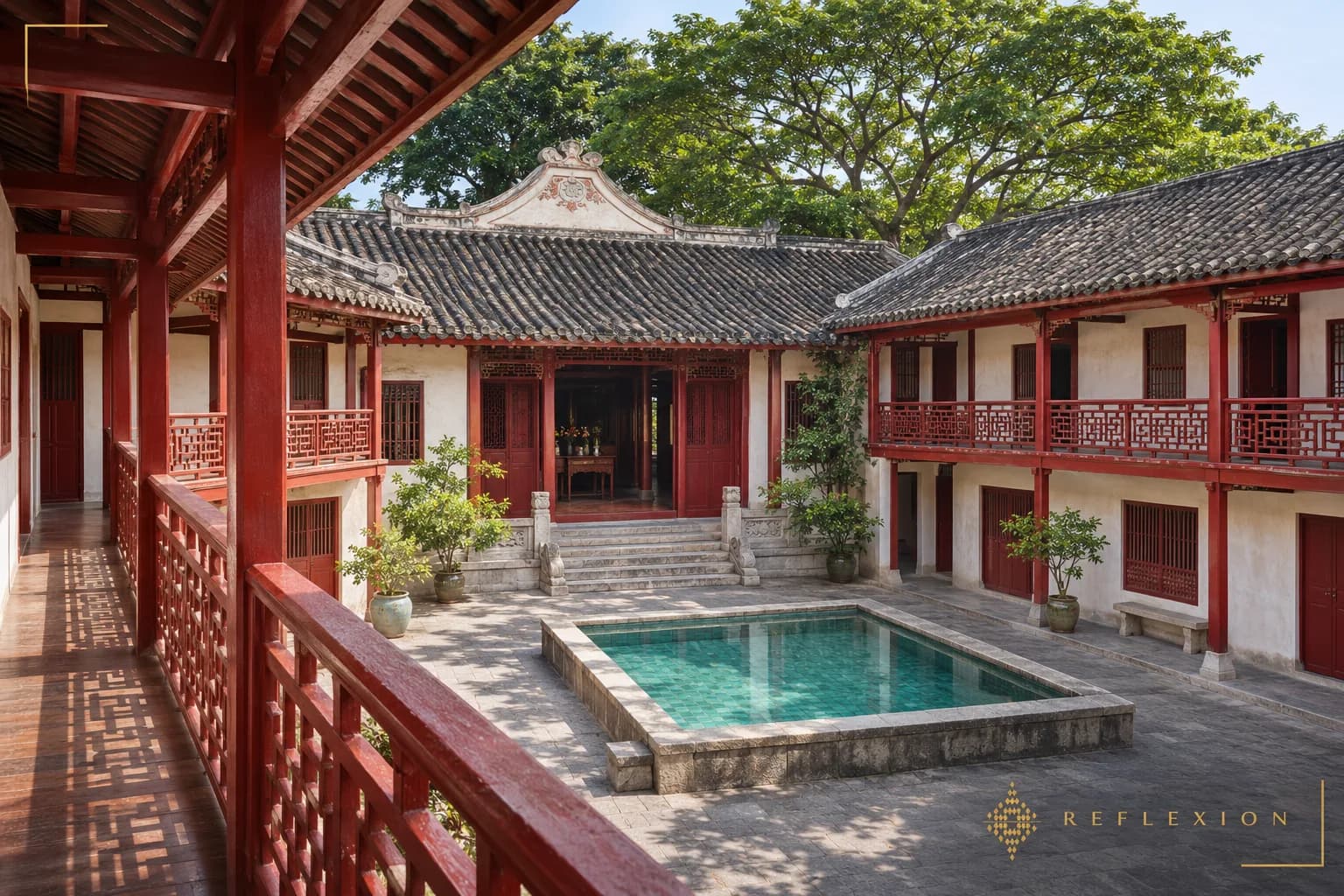
In the morning, in the lane of Trok San Chao Rong Kueak, in Talat Noi, mechanics work at pavement level among cylinder heads and engine parts; upstairs in the same shophouse, Mother Roaster brews its filter coffees, and incense from the Rong Kueak shrine mingles with the smell of metal. A few steps away, the neo-Gothic spire of Holy Rosary Church rises above the Chao Phraya. Here begins the Charoen Krung riverside, which runs down towards Bang Rak, its galleries and its grand hotels, and which we already counted among Bangkok’s prime neighbourhoods. Here is the neighbourhood from morning to evening: its history, its addresses, the people who live there, and what it is like to call it home.
Why has Talat Noi become the address Bangkok is talking about?
On 17 September 2026, Time Out published its annual ranking of the world’s 40 ‘coolest’ neighbourhoods. Talat Noi came 14th, between São Bento in Lisbon and Slakthusområdet in Stockholm. It is Bangkok’s best result ever on the list, after Song Wat, 39th in 2023, and Ekkamai, 27th in 2024. The magazine sums up the neighbourhood in a line its residents like to repeat: nobody had to leave; people simply started sharing the address.
The cool-season calendar gives one more reason to go now. From 13 November to 13 December 2026, Vijit Chao Phraya, organised by the Tourism Authority of Thailand (TAT), lights up thirteen sites between the Rama III and Rama VIII bridges, including the riverside of Talat Noi and Bang Rak. The Bangkok Art Biennale runs until 28 February 2027, and Bangkok Design Week, from 18 to 28 February 2027, is due to open the neighbourhood’s shophouses, old rice warehouses and lanes to installations and pop-up galleries, according to Time Out.
Morning in Talat Noi: a port, a church and engines
Talat Noi, the ‘little market’, began as an extension of Sampheng, the great Chinese market of the early Rattanakosin era; the Chinese called it Talak Kia, notes the journal Silpa Watthanatham. The first to arrive were Portuguese Catholics, who settled here in 1769 after the fall of Ayutthaya, according to the Bangkok Post. Their church, today’s Holy Rosary Church, which all of Bangkok calls Wat Kalawar, was founded in 1787; the neo-Gothic building seen today was built from 1891 to 1897. The Portuguese gradually left, and Chinese families have since formed the heart of the parish. Every year, on the evening of Good Friday, a statue of the dead Christ is carried in procession from the church; the faithful bring it garlands of flowers, which they then take home.
The Chinese communities left their shrines on every lane corner. According to Silpa Watthanatham, the Hokkien were the first to settle; the Chao Sue Kong shrine, dedicated to a monk from Fujian, is among the oldest Hokkien shrines in the city. The Daily News reports the tradition that King Taksin welcomed Teochew from the district of Theng Hai (Chenghai), near Shantou, known as seafarers, who settled along the river, repairing boats and working metal. The Hakka built the Rong Kueak shrine, known as the ‘shoemakers’ shrine’. In the nineteenth century, the port of Pho Seng, owned by the merchant Phraya Aphaiwanit, made the neighbourhood’s fortune, until steam sealed the fate of the junks.
The So Heng Tai mansion tells of this prosperity. Built around a courtyard in the Hokkien style, it belongs to the Sou family, one of whose eighth-generation descendants still lives there, according to the Bangkok Post. To fund its upkeep, he dug a pool in the courtyard, where diving lessons are now given.
Then came metal. Talat Noi became a hub of the motor trade in the late 1930s, and demand for spare parts grew during the Second World War, according to Cathay Pacific’s magazine. In everyday speech, ‘Siang Kong’ still means the second-hand parts trade, with which Talat Noi remains closely associated. For breakfast, the Daily News recommends chive kuichai and sticky-rice bacang, two Teochew specialities of the neighbourhood; the Hiap Tiang family bakery is the other morning stop.
Midday on Charoen Krung: what remains of Siam’s first road?
Heading east, you reach Charoen Krung. The road was born of a request from the Western consuls, who wanted a carriageway for their horse-drawn vehicles. King Mongkut (Rama IV) ordered its construction, carried out from 1862 to 1864 by Somdet Chao Phraya Maha Suriyawong and the British diplomat Henry Alabaster, according to the Siam Society. Some 8.6 kilometres long, it runs from Saphan Lek to Bang Kho Laem, following the river. Westerners called it New Road; it was the King himself who gave it its name, Charoen Krung, ‘prosperity of the city’. The Bangkok Post points out that an older road, Thanon Trong, today’s Rama IV, had preceded it by a few years: Charoen Krung is Siam’s first Western-style road, not the capital’s first thoroughfare. The city’s first tramway later ran along it, and Chinese shophouses lined both sides.
Along the road, Bang Rak bears the traces of all the communities that have crossed paths here. At Soi 36, the Haroon Mosque traces its origins to a teak mosque built in 1828 by merchants from Indonesia; it was moved under Rama V to make way for the customs house. At Soi 40, the Assumption Cathedral dominates the grounds of Assumption College. At Soi 43, the Bangkokian Museum, a former family home that became a municipal museum, shows the daily life of a Bangkok household from 1937 to 1957 in three wooden houses, according to the Bangkok Post.
For lunch, the riverside covers every register, from the chicken rice at Sui Heng, which Thai Airways’ magazine placed further south in 2022, opposite the Capella, to the grand hotel dining rooms. Where the addresses distinguished by the red guide are concentrated, and what that concentration says about the river, we measured in our article on the MICHELIN Guide and neighbourhoods.
Afternoon, from the galleries to the TCDC: where can you see art right now?
The afternoon belongs to the creative venues. The Thailand Creative & Design Center (TCDC), founded in 2004, moved in May 2017 into the Grand Postal Building, the former central post office with its massive lines. Its design library, more than 70,000 volumes in 2018, its workshops and its roof terrace are open to the public, with a day pass for non-members. The Creative Economy Agency, which houses it, organises Bangkok Design Week.
The creative district grew out of local initiative. Businesses in Bang Rak and Khlong San formed the Creative District Foundation together with universities, hotels, developers and artists; the TCDC, for its part, led the ‘Co-create Charoen Krung’ project with residents and the district. The Bangkok Post reported at the time that around one commercial unit in five stood empty on Charoen Krung in 2013. Since then, the architect Duangrit Bunnag has turned a row of 1940s warehouses, around 2016, into Warehouse 30, with shops, cafés and event spaces; the ATT19 gallery occupies a century-old former Chinese school; and River City Bangkok brings together, on four floors, galleries and antique dealers, among them Ingon Gallery and its Asian bronzes.
The fifth Bangkok Art Biennale, ‘Angels & Mara’, brings together 72 artists of 29 nationalities and more than 200 works until 28 February 2027. Its eleven main venues range from Wat Arun and Wat Pho to the Bangkok Art and Culture Centre and One Bangkok; Wat Prayoon lies across the river. The BAB Plus and BAB Fringe programmes extend the biennale to galleries and independent spaces; their calendar lets you pick an exhibition to round off this walk.
Evening by the river, from the Mandarin Oriental to ICONSIAM
Evening brings you back to the river. The Mandarin Oriental opened in 1876 as the Oriental Hotel, and celebrates its 150th anniversary in 2026. People come for the Bamboo Bar, or for Le Normandie, where Anne-Sophie Pic presides. Further south on Charoen Krung, the Chao Phraya Estate, developed by Country Group Development, covers 5.75 hectares: the Four Seasons Hotel Bangkok at Chao Phraya River opened there in December 2020 with 299 rooms, next to the Capella and its 101 rooms.
Opposite, on the Khlong San bank, ICONSIAM opened in November 2018. Further upstream, the old warehouses of Lhong 1919 bear witness to Sino-Thai trade; Asset World Corporation has announced a hotel conversion project there. From 13 November to 13 December 2026, Vijit Chao Phraya extends the evening on the river: thirteen illuminated sites, among them Memorial Bridge and Krung Thep Bridge.
Landmark addresses, from Talat Noi to the Mandarin Oriental
Twelve addresses from Talat Noi to Bang Rak and on the Khlong San bank, with their reference date:
| Place | What it is | Since | Source |
|---|---|---|---|
| Holy Rosary Church (Wat Kalawar) | Catholic church, a parish of Portuguese then Chinese origin | 1787; current building 1891-1897 | Bangkok Post |
| Chao Sue Kong shrine | Hokkien shrine, among the oldest in the city | founding not dated by the sources | Silpa Watthanatham; Thai PBS World |
| So Heng Tai mansion | Hokkien mansion of the Sou family, diving lessons | eight generations | Bangkok Post; Time Out, 2026 |
| Mother Roaster | café above a mechanic’s workshop | 2018 | Cathay Pacific; Time Out, 2026 |
| Haroon Mosque | mosque of the community of Indonesian origin | 1828 (first mosque) | Bangkok Post |
| TCDC, Grand Postal Building | creative and design centre, library | May 2017 | Going Places |
| Warehouse 30 | converted 1940s warehouses | around 2016 | National Geographic |
| River City Bangkok | art galleries and antique dealers on four floors | operating in 2024 | Cathay Pacific |
| Mandarin Oriental | hotel, Bamboo Bar, Le Normandie | 1876 | Mandarin Oriental |
| Four Seasons Hotel Bangkok | 299-room hotel, Chao Phraya Estate | December 2020 | Country Group Development |
| ICONSIAM (Khlong San) | retail and residential complex | November 2018 | TAT |
| Lhong 1919 (Khlong San) | heritage complex of former warehouses; hotel project announced | launched under the AWC brand in January 2022 | Asset World Corporation |
Living there: what is daily life like by the river in Bangkok?
Living on the Charoen Krung riverside means, first of all, days set by the river. BTS Saphan Taksin, on the Silom line, and Sathorn pier link the riverbank to the rest of the city: it is via them that Shrewsbury International School, at 1922 Charoen Krung Road, directs visitors to its Riverside campus, which takes nearly 2,000 pupils aged 3 to 18. To the north, Hua Lamphong station marks the edge of Talat Noi and Chinatown. The morning market, the shrines and the church, the corner café and the evening walk along the water make for real neighbourhood life.
Residential supply is scarce. According to Knight Frank, condominiums on the banks of the Chao Phraya accounted for 2.3% of Bangkok’s supply at the end of 2023. Three forms of housing sit side by side. Branded residences first: the Four Seasons Private Residences, at the Chao Phraya Estate, which their developer presents as the brand’s largest in the world, and, opposite, the Residences at Mandarin Oriental at ICONSIAM. The Four Seasons Private Residences are sold leasehold: the remaining term and the renewal conditions are set out in the contract for each unit. Next come the older towers along the river, then the shophouses of Talat Noi and Bang Rak, which families and creatives are restoring; what such a renovation involves is detailed in our article on renovating an older condo in Bangkok.
What sets a good address on the riverbank apart comes down to three criteria. Walking distance to the BTS or the pier, first, since riverside life runs to the rhythm of the boat and the train. Tenure, next, freehold within the foreign quota or leasehold, which is checked building by building. The immediate neighbours, finally: a workshop that starts its engines at dawn is part of Talat Noi’s charm for some, and a short night for others. Our river guide shows these buildings bank by bank.
The case of Oliver, between Sathorn and Charoen Krung
Oliver, 46, a manager at a British bank who has lived in Bangkok for three years, rents in Sathorn, ten minutes’ walk from his office. He wants to buy for the next ten years. Two options remain open: a recent apartment in Sathorn, near BTS Chong Nonsi, on a street he knows by heart; or an apartment on the Charoen Krung riverside, between Bang Rak and Talat Noi, where he already spends his Saturdays, from morning coffee to afternoon galleries.
He compares his days rather than his square metres. From the riverside, BTS Saphan Taksin takes him to Sathorn on the same Silom line; the boat opens up the old city and Thonburi. Sathorn gives him proximity; Charoen Krung, the neighbourhood he in fact already lives in. He visits at two times of day, in the morning, when the workshops open, and in the evening, when the riverbank lights up, and asks, for each building, about its tenure and the share of the foreign quota already used.
What he decides: to buy on the Charoen Krung riverside, in a building within walking distance of BTS Saphan Taksin, freehold within the foreign quota, once he has the manager’s written statement, and to rule out units that look directly onto a lane of workshops.
Modelled scenario. This profile is not a client; the parameters are working assumptions.
What our map lets you place
Our records place each riverside development in its district and sub-district, from Samphanthawong to Bang Rak and Khlong San, with its distance to the nearest station, its stated tenure and, where published, its asking price. To compare two buildings on the river beyond their brochures, place them on the map.
What you can do now
Do the day before you buy. Arrive early in Talat Noi, then follow Charoen Krung towards Bang Rak and the TCDC, and finish by the water; from 13 November to 13 December 2026, Vijit Chao Phraya lights up the evening. Or come back for Bangkok Design Week, from 18 to 28 February 2027. Then note the buildings that caught your eye, and ask, for each one, about its tenure and the state of its foreign quota.
Frequently asked questions
How do you get to Talat Noi and Charoen Krung?
To start in Talat Noi, MRT Hua Lamphong gives you a way in from the north; to reach Bang Rak by the river, take BTS Saphan Taksin and Sathorn pier instead. The station, on the Silom line, sets you down south of Bang Rak, and the pier gives access to the express boat. Once there, walking remains the best way to get around the lanes.
When should you visit Talat Noi?
From November to February, during the cool season. The Vijit Chao Phraya illuminations are announced for 13 November to 13 December 2026, the art biennale stays open until the end of February 2027, and design week takes over the neighbourhood for the last ten days of that same month. Come early to see the garages open, then stay until sunset for the cafés and galleries.
Is Charoen Krung really Bangkok’s first road?
It is Siam’s first Western-style road, opened in 1864 after two years of works ordered by King Mongkut. The Bangkok Post, however, points to an older route, Thanon Trong, which became Rama IV Road. Foreign consuls were then pressing for a paved road for their horse-drawn carriages, and the new thoroughfare moved the city’s life from the canal to the street.
Does the Bangkok Art Biennale come to Charoen Krung?
Not among its eleven main venues, which range from the temples of the old city to the shopping centres of Pathum Wan. Wat Prayoon lies on the other side of the river. The associated strands, BAB Plus and BAB Fringe, do however open the programme to independent galleries and venues; the organisers publish their up-to-date list.
Can you live in Talat Noi or on Charoen Krung?
Yes, in several forms. There are branded residences at the Chao Phraya Estate, older towers on the water and shophouses that their owners are restoring. Leasehold dominates in some residences, freehold within the foreign quota in others: each building has to be checked on its own, before any viewing.
Method and sources
39 sources · checked November 8, 2026
Sources checked November 8, 2026
Exchange rate used: 1 GBP = 44.54 THB (ECB euro reference rates, cross rate, 1 October 2026)
- Sources checked on 8 November 2026, reference rate 1 GBP = 44.54 THB (1 October 2026); no amount is converted in this article.
- What this article draws on:
- Time Out Bangkok, Talat Noi ranked 14th among the world’s ‘coolest’ neighbourhoods, 17 September 2026.
- The Nation, the same ranking, 17 September 2026.
- Tourism Authority of Thailand (TAT), Bangkok Art Biennale 2026, 16 September 2026.
- Tourism Authority of Thailand (TAT), opening reception of the Bangkok Art Biennale 2026, 28 October 2026.
- Time Out Bangkok, 72 artists at the Bangkok Art Biennale, 28 October 2026.
- The Nation, Vijit Chao Phraya 2026, 23 October 2026.
- Silpa Watthanatham, Nipaporn Ratchatapatthanakun, the beginnings of Talat Noi, February 2003, published online on 10 November 2017.
- Silpa Watthanatham, ‘Talat Noi, the trendy neighbourhood that was once home to “Siang Kong”’.
- Talat Noi Treasury Museum (Treasury Department), introduction to the Yan Chiang Kong neighbourhood.
- Bangkok Post, ‘Talat Noi explores its catholic roots’, Holy Rosary Church.
- Bangkok Post, ‘Grace and grandeur’, Holy Rosary Church.
- Bangkok Post, ‘A beautiful family history’, So Heng Tai mansion.
- Thai PBS World, Talat Noi, 20 September 2024.
- Daily News, Talat Noi and its Teochew cuisine, 25 June 2026.
- Daily News, ‘Charoen Krung, the dawn of Siam’, 18 December 2025.
- Bangkok Biz News, the ‘Maha Charoen’ walk, 29 June 2026.
- Tourism Authority of Thailand (TAT), a day in Talat Noi, 30 January 2025.
- Cathay Pacific, Philipp Meier, the revival of Talad Noi, 8 June 2024.
- The Siam Society, multicultural Bang Rak, 17 January 2020.
- Bangkok Post, ‘Discovering how Bangkok blossomed’.
- Bangkok Post, ‘Bring yourself to Bang Rak’.
- Bangkok Post, ‘Is this Bangkok’s chance to do renewal right?’.
- Tourism Authority of Thailand (TAT), Bangrak Museum (Bangkokian Museum).
- Thai Enquirer, 157th anniversary of Charoen Krung.
- Going Places (Malaysia Airlines), Eris Choo, 11 April 2018.
- Creative Economy Agency, Bangkok Design Week 2026 programme: TCDC (Grand Postal Building) and ATT19.
- National Geographic, Rachna Sachasinh, 11 March 2022.
- Sawasdee (Thai Airways), Tara Sering, 30 December 2022.
- Mandarin Oriental Bangkok, 150th anniversary.
- Country Group Development, Four Seasons Hotel Bangkok and Chao Phraya Estate, August 2022.
- Asset World Corporation, official timeline, launch of Lhong 1919, 14 January 2022.
- Asset World Corporation, annual report 2024, Lhong 1919 hotel project.
- TAT, opening of ICONSIAM, November 2018.
- Knight Frank, Waterfront Living in Thailand, 2023.
- Country Group Development, annual report 2024.
- Shrewsbury International School, Riverside campus.
- Bangkok Design Week, Creative Economy Agency.
This article is general information, not legal or tax advice. The rules cited are dated: check with a qualified professional that they are still in force before acting.