Loy Krathong: origins, dates and places of the water festival
Loy Krathong falls on Tuesday 24 November 2026. What the festival asks, where it comes from, where to join it in Bangkok or Sukhothai, and how Yi Peng differs.
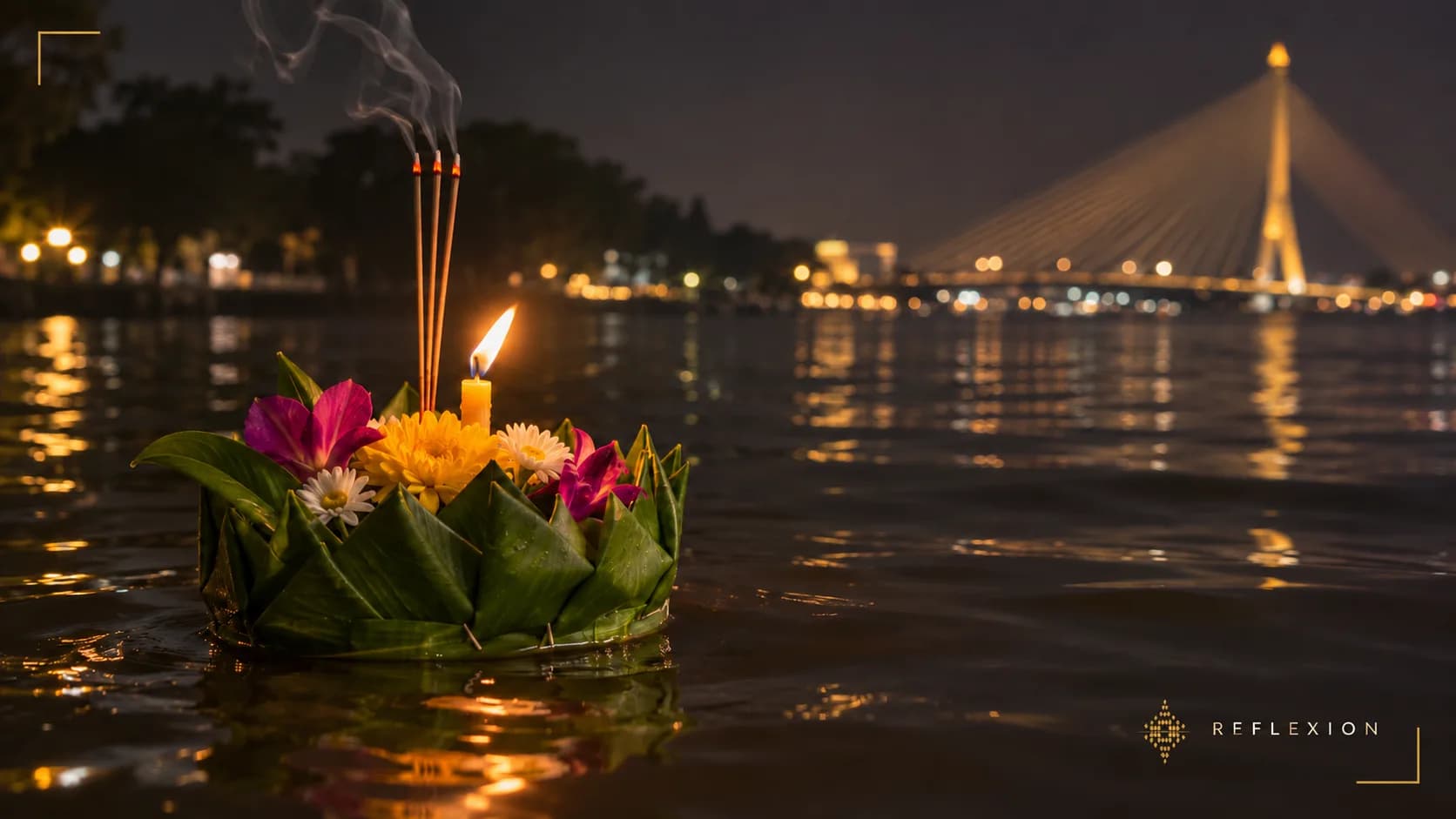
On the night of the full moon, at the foot of Phra Sumen Fort on the bank of the Chao Phraya, people crouch at the water’s edge. They light a candle and sticks of incense set in the heart of a corolla of banana leaves, raise the offering to their forehead, then lay it on the river. A little upstream, beneath the stay cables of the Rama VIII Bridge, the small flames drift away on the current. This is Loy Krathong, ‘floating the krathong’, and the same gesture is repeated at the same moment on a khlong in Don Mueang, before the ruins of Sukhothai and on the seafront at Saphan Hin, in Phuket.
In 2026, the festival falls on Tuesday 24 November, the full moon of the twelfth lunar month. It is not a public holiday, and in Bangkok it is lived above all along the river, close to the residential neighbourhoods we have described. What it asks comes down to three intentions, which Thailand’s Ministry of Culture describes as follows: to thank the water and honour Phra Mae Khongkha, the mother of waters; to ask its forgiveness for having fouled it; and to let the current carry away whatever one wishes to see go. For a foreigner living here, the point is not to watch the festival but to take part in it, with neighbours and children. Here is where it comes from, what goes into a krathong, what sets it apart from Yi Peng, and where to celebrate it this year.
Where does Loy Krathong come from, and what do historians really know?
The most common answer comes down to one name: Nang Noppamas. According to tradition, this lady of the court of King Phra Ruang fashioned the first lotus-shaped krathong at Sukhothai. Even official publications disagree on her portrait: one Ministry of Culture booklet makes her a royal consort, another the daughter of a Brahmin who became a lady of the court. The story is beautiful, and it says something about the spirit of the festival. It belongs to tradition, not to history.
The ministry’s booklet offers a more sober reading, and a more interesting one. In the inscription attributed to King Ramkhamhaeng, the booklet picks out the words phao thian len fai, ‘to burn candles and play with fire’, without reading them as an explicit mention of Loy Krathong: these are the very words taken up today in the official name of the Sukhothai festival. Published in 2014 by the Department of Cultural Promotion, the booklet looks for the earliest trace of a comparable rite in a bas-relief at the Bayon, in Angkor Thom, which it dates to after about 1157.
At Ayutthaya, the court celebrated a royal rite called Chong Priang, Lot Chut Loy Khom, a Brahmanical procession of lanterns; this is the basis of the hypothesis of a Brahmanical origin. As for the story of Nang Noppamas, preserved in the Tamrap Thao Si Chulalak, the prince and historian Damrong Rajanubhab (1862-1943) attributed it to the reign of Rama III, King Nangklao (1824-1851), on the strength of a style characteristic of the Rattanakosin period. The booklet goes on to describe how the krathong gradually spread from the court to the people of Bangkok, and then to the neighbouring towns. Rama VI later abolished the royal rite, which he considered too costly; the people, for their part, kept it alive.
Since 2011, Loy Krathong has been inscribed on Thailand’s national intangible cultural heritage list. On 27 March 2025, the Cabinet approved a nomination file for UNESCO entitled ‘Loy Krathong: Traditional Water-honouring Festival in Thailand’; the Minister of Culture, Sudawan Wangsuphakijkosol, described it, according to the Bangkok Post, as a crucial step for Thai soft power. On the UNESCO website, the file appears among pending nominations, with no year of examination set. The Thai nomination being examined from 30 November to 5 December 2026, in Xiamen, concerns the chut thai, the traditional dress.
The krathong, piece by piece
The word means, first of all, a receptacle. The classic base is a slice of banana trunk, which floats on its own, edged with folded banana leaves. Flowers, a candle and sticks of incense are arranged on it. Nothing more is required, and it is this simplicity that the authorities now recommend: banana leaves, lotus, or even ice krathong.
Two additions are more personal. Many people slip in a lock of hair or nail clippings, so that misfortune leaves with the offering; others a coin, which children then fish out. The ministry’s booklet also reports a belief linked to certain rites in the South: people avoid retrieving the raft of offerings, for fear of taking on the misfortune it carries away.
The gesture varies little from one region to another. You light the candle and the incense, raise the krathong to your forehead, make a wish or give thanks, then set it on the water. The Thai booklet gives a Pali formula for this moment; most people pray in silence. Three words are enough to follow a conversation with your neighbours: Phra Mae Khongkha, the goddess of the waters, whom the Thailand Foundation likens to the goddess Ganga; kho khama, to ask forgiveness; and wan phen duean sip song, the full-moon day of the twelfth month, which gives the date.
Loy Krathong and Yi Peng: why does Chiang Mai celebrate differently?
Yi Peng is the Lanna festival of the full moon of the second month of the Lanna calendar, and it falls on the same night as Loy Krathong. The North floats krathong like everywhere else, but adds light in the air: khom fai, flame lanterns that rise into the sky, khom khwan, smoke lanterns, and the lamps that adorn houses and temples. According to the Thailand Foundation, the lanterns rise as an offering to the relics of the Buddha in the heavens.
In Chiang Mai, the 2026 programme published by Thansettakij spans six days. From 20 to 23 November, Wat Chedi Luang hosts Tam Phang Pratheep, the lighting of oil lamps; on the 23rd, a procession makes its way to Wat Chedi Luang, while lamps are lit at the four corners of the old city; Yi Peng runs from the 23rd to the 25th and, according to Thansettakij, the only detailed source consulted on this move, its main hub shifts from Tha Phae Gate to the park of the Ton Lamyai market; and on the 25th, fifteen large krathong parade from Tha Phae to the city hall.
The images of skies filled with lanterns, for their part, mostly show private, ticketed releases organised outside the city. In 2026, the TAT announces the CAD Khomloi Sky Lanterns Festival at the CAD Lanna cultural centre in Mae On, on 24 and 25 November; Thansettakij reports others at Doi Saket and San Pa Tong.
The airport arranges itself around the festival. According to The Nation and Krungthep Turakij, flight schedules have been adjusted to avoid 10am to noon on 24 November, for the smoke lanterns, then 7pm to 1am on the 24th and 25th, and more than 200,000 lanterns are expected. The airport’s statement of 2 November, relayed by the Chiang Mai office of the Public Relations Department (PRD), gives the position as of 30 October: 108 flights cancelled, 80 rescheduled and 105 added, an interim count rather than a final tally. The airport’s director, Group Captain Sakan Udol, reminds the public that any release is strictly prohibited in the ‘red zone’, beneath the take-off and landing paths.
Chiang Mai’s 2026 release rules.
The provincial authorities have published their 2026 guidelines: releases require an application via Bampen to the district chief, and are possible only on the dates, at the times and in the places authorised. The official communication of 5 November reiterates that they are banned within the city of Chiang Mai, where you can join the lighting of lamps instead. For an event outside the city, ask the organiser to confirm that its site and its time slot are authorised. We have read these official communications, not the original provincial order.
Where can you celebrate Loy Krathong in 2026?
The official calendar published by the TAT on 5 November covers much of the country. The sites below are those that matter to residents of the main destinations; the dates are the TAT’s wherever it publishes them, preferred to earlier versions that appeared in the press.
The announced Loy Krathong and Yi Peng events for 2026:
| City | Site | Dates 2026 | What you will find |
|---|---|---|---|
| Bangkok | Rama VIII Bridge, Bang Phlat | 16-25 Nov | BMA site on the Chao Phraya |
| Bangkok | Phra Sumen Fort | 23-25 Nov | BMA site on the Chao Phraya |
| Bangkok | Mahakan Fort | 23-25 Nov, 5pm-10pm | official opening on the 24th at 6pm |
| Bangkok | Khlong Prem Prachakorn, Don Mueang police station | 23-25 Nov | BMA canal-side site |
| Bangkok | Khlong Prem Prachakorn, Wat Samian Nari | 24 Nov | BMA canal-side site |
| Bangkok | Wat Saket, Wat Ratchanatdaram, Wat Thepthidaram, Mahakan Fort | 17-29 Nov | historic trail; Golden Mount fair |
| Bangkok | Kasetsart University | 23-24 Nov | festival on campus |
| Bangkok | Vijit Chao Phraya, 13 sites between the Rama III and Rama VIII bridges | 13 Nov-13 Dec | lights, drones, fireworks |
| Sukhothai | Historical Park | 15-24 Nov | show at 7pm, at 8.30pm on the 24th; tickets THB 500, 900 and 1,200 (£10, £20 and £30) |
| Chiang Mai | Ton Lamyai park, Wat Chedi Luang, four corners of the old city | 20-25 Nov | Yi Peng from the 23rd to the 25th |
| Chiang Mai, Mae On | CAD Lanna | 24-25 Nov | private, ticketed lantern release |
| Phuket | Saphan Hin | 16-25 Nov | ‘Loi Krathong by the Sea’ |
| Chonburi | Pong, Bang Lamung | 24 Nov | sub-district festival |
| Chonburi | 80th Anniversary Park, Laem Chabang | 23-24 Nov | municipal festival |
Bangkok. The BMA has placed its edition under the theme ‘Preserving Thai Traditions along Rattanakosin’s Waterways’. The official opening takes place on 24 November at 6pm at Mahakan Fort, with security gates and the Prime Minister expected. The same evening, the Wat Saket fair at the foot of the Golden Mount is in full swing: it runs from 17 to 29 November, with ceremonies around the relics from the 17th to the 26th. For those who live along the river, the TAT’s Vijit Chao Phraya transforms the view from the riverside towers for a whole month; our Chao Phraya guide maps these banks neighbourhood by neighbourhood.
Sukhothai. This is the setting of the tradition, and the most theatrical of the festivals: ten evenings of performances in the Historical Park, from 15 to 24 November, under the official name ‘Loy Krathong, Burning Candles and Playing with Fire’. Seats are booked in advance.
Phuket and Pattaya. In Phuket, the festival is held by the sea, at Saphan Hin, from 16 to 25 November; our article on life in Phuket describes the neighbourhoods from which people make their way there. In Chonburi, the TAT announces Pong on the 24th and Laem Chabang on the 23rd and 24th. In 2025, according to The Thaiger, Pattaya banned fireworks and lanterns and steered krathong towards purpose-built pools rather than the sea; the mayor, Poramet Ngampichet, said the city was not banning the tradition but guiding it towards a cleaner future.
Hua Hin and Koh Samui. Neither appears in the TAT calendar of 5 November, and we have not found a 2026 programme for either destination. For those living in Hua Hin or on Samui, the information will come from the municipality or the neighbourhood temple, in the days leading up to the full moon.
What is the right way to take part when you live here?
What to wear. In temples, shoulders and knees covered, shoes removed before entering a sacred building. The Thailand Foundation adds two simple rules: be discreet, observe first, ask afterwards. At the BMA sites, the ‘Wear Chud Thai to Loy Krathong’ activity lends traditional dress free of charge; it is an elegant way into the festival.
The krathong. The BMA’s figures tell of a real change, and a nuance. The number of krathong collected from Bangkok’s waters has fallen since 2017, and foam had almost disappeared by 2024. In 2025, its share climbed back above 7% of the krathong collected.
Krathong collected by the BMA in Bangkok, 2017-2025:
| Year | Krathong collected | Of which foam | Foam share |
|---|---|---|---|
| 2017 | 811,945 | 51,926 | 6.40% |
| 2018 | 814,327 | 44,883 | 5.51% |
| 2019 | 502,024 | 18,760 | 3.74% |
| 2020 | 492,537 | 17,731 | 3.60% |
| 2021 | 403,235 | 14,281 | 3.54% |
| 2022 | 572,602 | 24,516 | 4.28% |
| 2023 | 639,828 | 20,877 | 3.26% |
| 2024 | 514,590 | 8,270 | 1.61% |
| 2025 | 391,027 | 28,298 | 7.24% |
In 2025, of 391,027 krathong, 323,626 were made from natural materials, 28,298 from foam and 39,103 from bread. The ‘online’ krathong offered by the city on greener.bangkok.go.th fell from 36,832 in 2024 to 23,347 in 2025. The overall fall of 24% came in the year of a more restrained edition, held during the period of national mourning that followed the passing of Her Majesty Queen Sirikit The Queen Mother; it is probably not explained by a single factor. In the sources consulted, we found no legal ban on foam: the rule is a matter of official guidance.
‘A bread krathong is the most eco-friendly kind, because it feeds the fish.’
the Pollution Control Department classes bread as food waste and recommended, for Loy Krathong 2025, banana leaves, lotus or ice krathong, and a single krathong per family. Bread accounted for 39,103 of the krathong collected in Bangkok in 2025.
One krathong per family. This is the BMA’s slogan, ‘1 family, 1 krathong’, and the simplest way to make the evening a shared moment: you make it together in the afternoon, everyone slips in a coin or a lock of hair, and you set it on the water together at night.
The case of Emma and Tom, a first Loy Krathong in Sathorn
Emma and Tom, both in their forties, moved to Sathorn in June with their two children, Isla, 9, and George, 6. Their building overlooks the Chao Phraya. In early November, their next-door neighbours, a Thai family, suggest making a krathong together on the 24th and setting it on the river.
They first read what the festival asks: to thank the water, to ask its forgiveness, to let go. They learn that the BMA is opening five sites, two of them on the river, and that the official opening at Mahakan Fort, at 6pm on the 24th, will bring crowds and security checks. They also note that the share of foam rose again in 2025, and that bread, which they had thought virtuous, is classed as food waste.
What they decide: a single krathong for the two families, made of banana trunk and leaves, put together in the afternoon with the neighbours, who show the children how to fold it; each person slips in a coin. In the evening, they head for the Phra Sumen Fort site rather than the opening at Mahakan Fort, shoulders and knees covered, the children in chut thai borrowed on site. They forgo lanterns altogether, pick up no drifting krathong, and save the lights of Vijit Chao Phraya for another evening, seen from the riverbank in their own neighbourhood.
Modelled scenario. This profile is not a client; the parameters are working assumptions.
What you can do now
Set aside the evening of Tuesday 24 November: choose a waterside site from the table, plan clothes that cover shoulders and knees, and suggest to your neighbours that you make a krathong together, from banana leaves, one for the family. If you are thinking of Chiang Mai, choose an event whose organiser confirms the authorised site and time slot, or join the lighting of lamps, and check your flight times. To place your neighbourhood in relation to the river and the festival sites, open the Reflexion map.
Frequently asked questions
When is Loy Krathong in 2026?
On Tuesday 24 November 2026. The date moves from year to year, because the festival follows the Thai lunar calendar and is held on the full-moon night of the twelfth month. It is an ordinary working day, not a public holiday. Many venues open well before the night itself: from 15 November in Sukhothai, and from the 16th at Bangkok’s Rama VIII Bridge and at Saphan Hin, on Phuket.
What does Loy Krathong mean?
Literally, ‘to float the krathong’, a small vessel of offerings. The Ministry of Culture gives the act a threefold meaning: thanking Phra Mae Khongkha, the goddess of the waters; apologising for having polluted them; and entrusting one’s troubles to the current. A lock of hair or a coin tucked into the offering carries that last wish further. The story of Nang Noppamas belongs to tradition.
What is the difference between Loy Krathong and Yi Peng?
They are two festivals that share one night. Loy Krathong is celebrated on the water all over the country; Yi Peng belongs to the North and the old Lanna kingdom, and adds lanterns, both those released into the sky and those hung on houses and temples. In Chiang Mai, the two merge in the 2026 celebrations, which the provincial authorities have announced for 23 to 25 November.
Where can you celebrate Loy Krathong in Bangkok?
By the water, at one of the city’s five sites: Rama VIII Bridge, Phra Sumen Fort and Mahakan Fort, or the Prem Prachakorn canal in Don Mueang. Mahakan Fort hosts the opening ceremony at 6pm on 24 November, with security checks at the entrance. The illuminations staged by the TAT on the Chao Phraya can be seen from 13 November to 13 December.
Can you release a lantern for Loy Krathong?
In Chiang Mai, releasing a lantern is not a free-for-all: the province’s 2026 guidelines require permission and ban releases within the city. Booking an organised event outside the city does not spare you from checking with the organiser which site and time slot have been approved. You can also take part in Yi Peng by joining the lighting of lamps, without sending up a lantern at all.
Method and sources
30 sources · checked November 8, 2026
Sources checked November 8, 2026
Exchange rate used: 1 GBP = 44.54 THB (ECB euro reference rates, cross rate, 1 October 2026)
- Sources checked on 8 November 2026, amounts converted at 1 GBP = 44.54 THB (1 October 2026); conversions are indicative, calculated on the exact value and then rounded.
- What this article draws on:
- Department of Cultural Promotion, Ministry of Culture, booklet on the Loy Krathong tradition, October 2014, Thai and English editions, hosted by the Ministry of Foreign Affairs.
- Ministry of Foreign Affairs, ‘Loy Kratong Tradition’ booklet.
- TAT News, ‘Loi Krathong 2026 lights up Thailand’s rivers and historic cities’, 5 November 2026.
- thailand.go.th, Loy Krathong, Burning Candles and Playing with Fire Festival, Sukhothai, 2026.
- PRD Chiang Mai, 7 October 2026: dates of the Loy Krathong and Yi Peng celebrations, 23 to 25 November.
- PRD Chiang Mai, 20 October 2026: lantern release guidelines, applications via Bampen to the district chief.
- Radio Thailand Chiang Mai, 1 November 2026: no-release zones and application deadlines for lanterns.
- PRD Chiang Mai, 3 November 2026: Chiang Mai airport’s statement of 2 November on flights.
- PRD Chiang Mai, 5 November 2026: lamps lit at the four corners of the old city, procession to Wat Chedi Luang, releases banned in the city.
- Bangkokbiznews, date of Loy Krathong 2026.
- Krungthep Turakij, Chiang Mai airport and Yi Peng 2026.
- The Nation, the BMA’s programme in Bangkok, 2026.
- The Nation, Vijit Chao Phraya 2026.
- The Nation, Wat Saket fair and Bangkok sites, 2026.
- The Nation, Chiang Mai airport, flights and red zone, 2026.
- Thansettakij, Yi Peng 2026 programme in Chiang Mai.
- Thailand Foundation, ‘Loy Krathong Festival: All You Need to Know’, 19 November 2021.
- Thailand Foundation, ‘Festivals of Thailand: What You Need to Know’.
- The Nation, Cabinet approval of the UNESCO nomination, March 2025.
- Bangkok Post, statement by the Minister of Culture on the UNESCO nomination.
- UNESCO, ‘Thailand’ page of the intangible cultural heritage site, consulted on 7 November 2026.
- UNESCO, calendar of statutory meetings for 2026.
- The Nation, krathong collected by the BMA, 2017-2024 series and 2025.
- ONEP, report on the BMA’s krathong collection, 6 November 2025.
- Khaosod English, recommendations of the Pollution Control Department, 3 November 2025.
- TAT News, official announcement on mourning practices, October 2025.
- TAT News, Loi Krathong 2025, November 2025.
- The Thaiger, Loy Krathong in Pattaya, 2025.
This article is general information, not legal or tax advice. The rules cited are dated: check with a qualified professional that they are still in force before acting.