Spirit houses in Thailand: meaning and everyday customs
In Bang Rak, a Chulalongkorn study recorded 154 spirit houses in 2023. San phra phum, offerings, condominiums, villas: the keys to an everyday rite in Thailand.
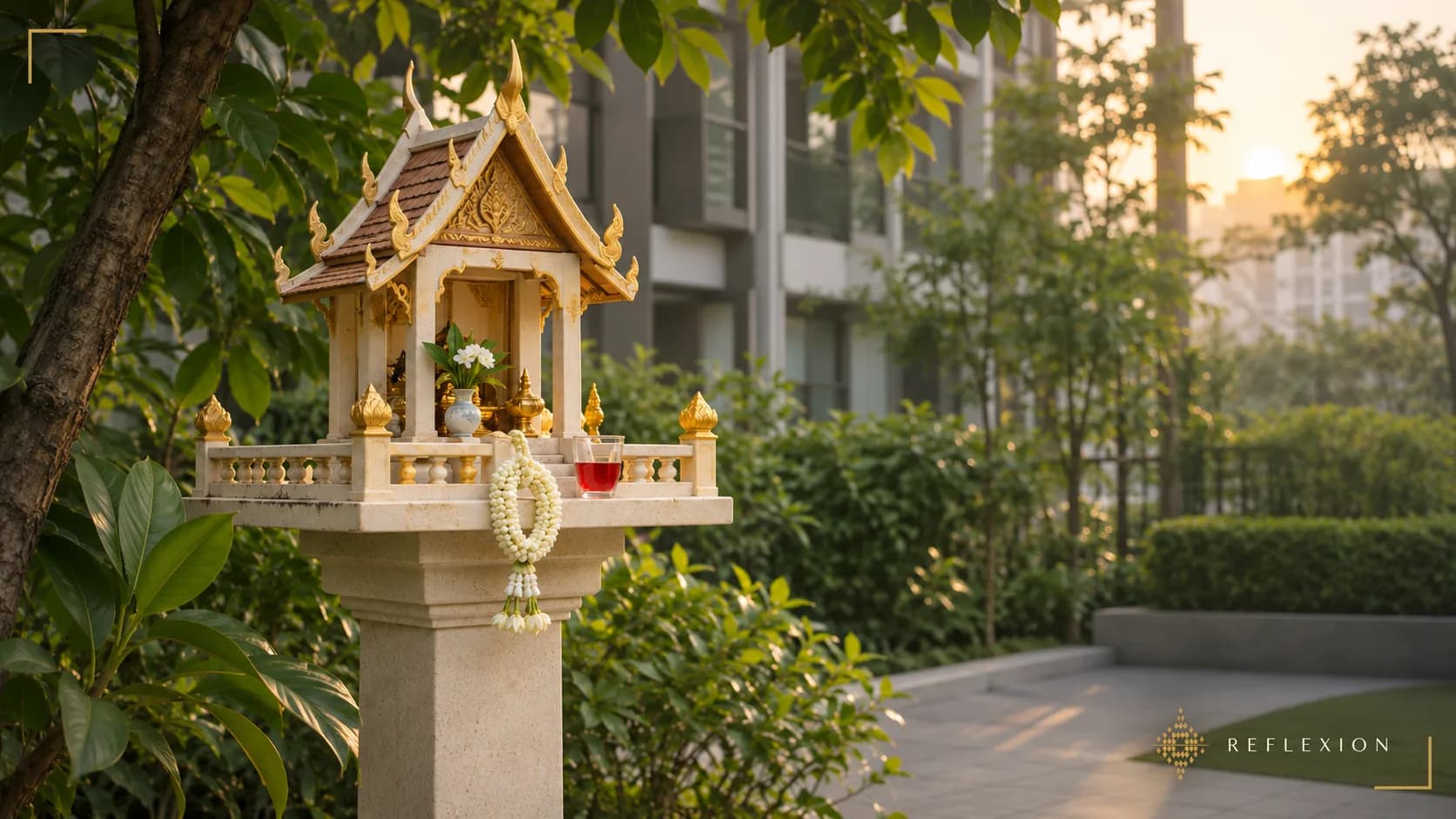
In a report published in June 2020, Hannah Beech describes a sultry day in late May at the foot of Baan Pitak, a residential building in Bangkok: incense and chanting fill the air for nearly an hour, punctuated by a gong. Standing on tiptoe, the spiritual adviser Kitsana Phattharasirisap passes the spirits’ figurines through the carved doorway of their new home, a miniature house set on a post. Before them lie papayas, mangoes, pineapples, coconuts and, in the centre, two pig’s heads. The building’s manager, Nutthikan Bunthanalaksamee, films the scene on her phone; she believes in science, she says, but respects those who hold their own beliefs.
According to that New York Times report, picked up by the Bangkok Post, the ceremony costs the owners of the land THB 34,000 (£760): the old spirit houses are judged too plain and badly oriented, and the workers housed on the site say they have been receiving nocturnal visits. In Thailand, the san phra phum (ศาลพระภูมิ) goes with the land, from the villa to the tower in Bangkok’s prime neighbourhoods, and whoever moves in inherits it. Here is what it is, where it comes from, how it is installed and honoured, and what a foreign owner gains from understanding it.
What is a spirit house, and who lives in it?
San means shrine; phra is a title of veneration, the one also given to monks; phum comes from the Sanskrit bhumi, the earth, as Ron Emmons points out in the South China Morning Post. The san phra phum is therefore the dwelling of the ‘venerable one of the earth’, the guardian spirit of the land on which one builds. The idea behind it fits into one sentence from the same writer: for many Thais, owning a plot of land is not enough to live on it happily and safely; you also need the consent of the one who guards it.
The house of Phra Phum stands on a single post, and Kelly Davidson’s thesis, submitted at Chulalongkorn University in 1996, notes that it is one and the same deity who is invited into every shrine. The study by Kittisak Ruangmun and Prin Jhearmaneechotechai, of Chulalongkorn’s Faculty of Architecture, puts it in a line: the single-post shrine has existed since antiquity, and a four-post shrine is not a san phra phum.
The second shrine, often installed alongside, is the san chao thi (ศาลเจ้าที่). Lower, at the height of a kneeling person, it stands on four posts, sometimes six, and welcomes the spirits that belong to the place, often the ancestors. As one informant quoted by Davidson sums it up, the Thai chao thi is the guardian of the land, and he does not move.
The third, finally, is not a spirit house in the strict sense. At the Ratchaprasong intersection, the Erawan Shrine honours Brahma, Phra Phrom, a Hindu deity absorbed into Buddhist belief. According to the Bangkok Post, it was built and blessed in 1956 along with the Erawan Hotel: Rear Admiral Luang Suwichanpat, consulted on the opening date, had noted that no rite had informed the deities of the site.
The main shrines you will come across at the foot of houses and buildings:
| Shrine | Who is honoured | Form | Where you find it |
|---|---|---|---|
| San phra phum (ศาลพระภูมิ) | Phra Phum, the guardian spirit of the land | single post, altar at eye level | garden, courtyard, foot of a building, balcony or roof |
| San chao thi (ศาลเจ้าที่) | the spirits of the place, often the ancestors | four posts, sometimes six; lower | next to the san phra phum |
| Phra Phrom shrine | Brahma (Thao Maha Phrom) | open altar on a broad base | hotels and large buildings; Erawan, at Ratchaprasong |
Where does the spirit house come from?
What researchers establish is a layering. Davidson draws on the author K. Landon to describe three layers, animist, Brahmanical and then Buddhist, which combined without replacing one another. Phra Thanee Samanaco, of Mahachulalongkornrajavidyalaya Buddhist University, noted in 2019 that the earth, water, mountains, trees and buildings have long been held to be guarded by spirits, and that the rites were enriched by Buddhist and Brahmanical contributions. He cites Prince Damrong, who observed this blend, and states that King Rama IV had monastic rites added to the Brahmanical ceremonies.
The Buddhist reading has its own texts. In a journal from the same university, Gritsanaphon Wannavithyapa in 2026 links Phra Phum to the earth deities of the Mahasamaya Sutta, and sees in the palace-shaped house a figuration of Mount Meru, the centre of Buddhist cosmology. Phra Thanee had already read the single post as a reference to this mountain.
The exact origin is still debated. Davidson reports the thesis of Phra Banya Nanda Bhikkhu, for whom Phra Phum would be an adaptation of Chinese ancestral altars, and points out that the word itself is Sanskrit. She also describes a village guardian who, over time, became the guardian of the house.
Alongside history, there is tradition. According to a legend collected by Davidson, a divine king sent nine princes to govern a part of the kingdom each. Phra Chaiyamongkhon received homes and businesses; it is he who is honoured in the spirit house, while Phra Thamekarat watches over orchards and gardens. These are stories handed down, and they are told as such.
How is a spirit house installed?
The officiant. The Bang Rak study describes officiants who are, for the most part, lay people: some come from lineages of folk Brahmins, others are specialists known as mo san (หมอศาล), who have often spent time in a monastery and dress as Brahmins. Monks may also take part in the rite; their presence is meant to notify the deities. Phra Thanee stresses that the ceremony is presided over by the owner of the land, and that it has been tied to ownership of the land since title deeds were introduced.
The day. An astrologer sets the day, the hour and the auspicious moment, and the spirit house is installed at the end of construction, before moving in, according to the same researchers. Among the days to avoid, Davidson cites Thursdays and Saturdays in January, May and September.
The location. In the practices these sources describe, the spot must, among other things, avoid certain relationships of shadow between the shrine and the house. The Bang Rak study spells them out: the shadow of the house should not fall on the shrine, nor that of the shrine on the house. It is preferably placed near the boundary fence, away from the kitchen, the toilets and the rubbish, with the altar at the owner’s eye level.
Customs, not laws.
We found no official text that sets the orientation of a spirit house, and the sources diverge. Davidson reports a preference for the north, with north and south both acceptable, and orientations linked to rank. The Bang Rak study considers the east, north-east and south-east favourable, and observes that in today’s Bangkok, orientation depends mainly on the space available. On height, both studies take the owner’s eye level as the reference.
The ceremony. Davidson describes how it unfolds: candles lit towards the eight directions; formulas in Pali and lustral water; three small bags of earth, then the post raised; the effigy of Phra Phum, the chawet (เจว็ด), placed on a table draped in white, under a parasol; invitations in Thai and Pali; a scarf tied around the post; then the miniature servants and animals, and a pause of some twenty minutes to let the spirit taste the offerings. The adviser Narongdet Sapprathueang, interviewed by Deutsche Welle in 2021, adds one step: a pit into which the owners place coins, amulets, metals and coloured stones.
What is offered each day, and why?
Everyday offerings are those of a well-mannered guest: flowers, food, drinks, incense and candles, set on the small front step of the shrine. The flowers often take the form of the phuang malai, the hand-threaded jasmine garland that, according to Khaosod English, is offered in temples and shrines.
The glasses of red drink intrigue newcomers. According to Patrick Winn’s report for the radio network PRI in 2017, the most widespread explanation on Thai websites sees them as a substitute for the animal sacrifices of old; Watcharapol Fukjidee, host of the programme Ghost Radio, disputes this and suggests that the red dye of incense sticks, dissolving in the water, came to associate the colour with spirits. An offering seller, Chatgaew Pinjulai, simply observes that strawberry soda is by far the most requested.
Then come the figurines: servants, dancers, horses, elephants, already described by The Christian Science Monitor in 1991 and by Deutsche Welle thirty years later. People readily add more when a wish has been granted. Davidson also notes that the spirit is addressed before a wedding, an investment or a journey.
For a foreign resident, the door is open and nothing is required. Professor Chatsumarn Kabilsingh, who taught religion at Thammasat University, made the point to The Christian Science Monitor in front of a hamburger platter left at the foot of a shrine: whatever is good for you, she said, is good for the spirit. At Baan Pitak, it was the building’s manager who attended the ceremony; in a building, joining in the gesture of those who perform it begins with not disturbing it.
Why do towers, hotels and shopping centres have their own?
Because the shrine goes with the land, however high the building. The Bangkok Post tells what followed Erawan at Ratchaprasong: in 1990, the World Trade Centre department store, today CentralWorld, installed a shrine to Phra Trimurati facing Erawan’s energy. For the MahaNakhon tower, near Silom, and its 209 Ritz-Carlton residences, the developer Pace held Buddhist, Christian and Brahmanical ceremonies, according to its director Kipson Beck. The company’s spiritual advisers, he told Khaosod English, consider spirits powerful, and able to help.
In the district of Bang Rak, between Silom and Charoen Krung, the Chulalongkorn researchers recorded 154 spirit houses on foot, 67 of which meet their criteria for ordinary urban heritage. They found them in front of buildings, at the end or in the middle of lanes, on balconies and roofs; 99% of the shrines selected are made of cast concrete, whose usual lifespan is 30 to 40 years. The merging of plots into large buildings has done away with those of the old houses and shophouses, but their conclusion is clear: urbanisation has not interrupted the transmission of the belief.
Verticality invents its own answers. In 2013, in Sena, in Ayutthaya province, Laksana Ekkatin had a teak spirit house raised to the top of a pole some ten metres high, for THB 70,000 (£1,600), Khaosod English reports: her family prays from the third-floor balcony, at eye level.
In a condominium, the law says who manages the spot. Section 15 of the Condominium Act B.E. 2522 lists the land on which the building stands among the common property; section 33 gives the condominium’s juristic person the purpose of managing and maintaining that common property. Section 48 makes certain works that alter the common property, among other matters, subject to a vote representing at least half of all the co-owners’ votes at the first general meeting. We found no text or decision applying these rules to a spirit house: the question is one for the condominium office, building by building.
Buying a villa that already has its spirit house
A resale villa may already have one, put in place by the first owner. The sources describe three paths; none follows from any legal text we have found.
Keep it and look after it. This is the simplest path: cleaning, renewing the offerings, having it repainted. The Bang Rak study presents repair and replacement as the normal ways of making a shrine last.
Replace or move it. The Baan Pitak case shows the custom: an officiant, a chosen date, a ceremony that moves the spirit from its old home to the new one. According to Thairath, some entrust the replacement to a specialist; others, after a ceremony of apology, the kho khama, carry out the repairs themselves. We found no public price list. The only sourced amounts are one-offs: THB 34,000 (£760) for the Baan Pitak ceremony in 2020; nearly THB 400,000 (£9,000) for the most expensive concrete houses made by a craftsman quoted by The New York Times.
Entrust it rather than throw it away. Thairath describes the beliefs and practices of some people: a spirit house that has been removed is handed over to a temple, or set down at the foot of a large tree. The paper cites many temples that set aside a space where retired shrines stand in rows, such as Wat Yan Sen, in Lopburi province. Dumping them, by contrast, causes offence: the Bangkok Post described more than 500 dilapidated spirit houses piled at the foot of a tree on rural road 4050, in Chai Nat province, to the indignation of the people of Pho Ngam.
In Phuket as on Koh Samui, both of them villa markets, the question arises from the first viewing, alongside those raised by Phuket’s neighbourhoods or by buying a villa on Koh Samui.
Blessing a new home
The spirit house has a Buddhist sister, the tham bun khuen ban mai (ทำบุญขึ้นบ้านใหม่), the merit-making ceremony for a new home. The Thailand Foundation describes how it unfolds: an odd number of monks, five, seven or nine; the sai sin, a sacred thread linking an image of the Buddha to the monks’ seats; a meal served around eleven o’clock, which must end before noon; prayers, lustral water and sometimes a yantra drawn above the door. The merit thus made is believed to reach Phra Phum and the spirits of the house. The same source gives the name tham bun ban to the ceremony renewed each year or after a significant event; the end of a major renovation, of the kind an older condo in Bangkok often calls for, can be the occasion.
How should you behave in front of a spirit house?
What to do and what to avoid, according to reported custom:
| Situation | What is done | What is avoided |
|---|---|---|
| Walking past | a discreet wai, palms joined | ignoring someone at prayer, cutting in front of them |
| Making an offering | flowers, fruit, water or a drink, incense | leaving an offering without renewing it |
| Around the shrine | keeping the spot clean | leaning anything against it, leaving rubbish there |
| Touching, photographing | looking, photographing from a distance | touching the effigy, moving an offering |
| Having guests to stay | letting the spirit know they are sleeping over | — |
| A damaged house | having it repaired, or entrusting it to a temple | throwing it out with the rubbish or by a roadside |
The case of Rachel and Andrew, a villa in Phuket
Rachel, 48, and Andrew, 52, are leaving Bath for a resale villa near Cherng Talay. At the end of the garden, a concrete spirit house, faded by the monsoons, stands exactly where they would like to extend the pool. The caretaker, employed by the seller, still leaves flowers there in the morning.
They distinguish the cultural practices described by the sources from the rules that apply to their works. To move or replace the shrine, they plan to consult an officiant and choose a date according to custom. The Bang Rak study reminds them that a concrete shrine lasts 30 to 40 years, and that replacing it is part of its normal life.
What they decide: keep the spirit house where it is for the first season and design the pool differently; ask the seller, in writing, who looked after it and how often; offer the caretaker the chance to carry on, for a fee; and arrange, in the week they move in, a tham bun khuen ban mai with nine monks from the neighbouring temple.
Modelled scenario. This profile is not a client; the parameters are working assumptions.
What our neighbourhood guides help you place
Our surveys do not count spirit houses: they describe the neighbourhoods where people live, and that is where you come across them. Bang Rak, the setting of the Chulalongkorn study, is covered in our Bangkok neighbourhoods guide; to see a villa or a condominium in its surroundings, place it on the map.
What you can do now
When viewing a property, look at the spirit house as one of the rooms of the home: its condition, its location, the person who looks after it. Ask the seller or the condominium office how it is honoured, and note the name of the officiant who installed it. If you are planning works that affect it, put the ceremony in the building schedule.
Frequently asked questions
Do you have to keep the spirit house when you buy a home in Thailand?
We have not identified any general text that requires such a shrine; for a particular building, the applicable rules and decisions need to be checked with its manager. The sources describe three options: looking after it where it stands, having an officiant repair or replace it on an auspicious date, or entrusting it to a temple. To remove it before building work, some owners call in a specialist.
Can a foreigner make an offering at a spirit house?
Yes, with no formality at all. A simple gesture is enough: a few flowers, water or a piece of fruit, a stick of incense, then a wai, palms joined. Respect counts for more than knowledge of the rite. In a condominium, the shrine stands on the common property, so it is better to join the offerings others already make than to add your own and then let them lapse.
Why is there red soda in front of spirit houses?
Two explanations circulate, and neither is settled. The one most often found on Thai websites sees it as a modern stand-in for the animal sacrifices of earlier times. The radio host Watcharapol Fukjidee, interviewed by PRI in 2017, leans towards the red dye of incense, which once coloured the water in the glasses. Offering sellers mostly observe that strawberry Fanta sells best.
What should you do with an old spirit house?
Take it down with the proper rite, as custom requires, then find a place that expressly agrees to receive the old shrine. Many monasteries keep a corner for this purpose, where retired shrines stand in rows; Thairath cites Wat Yan Sen, in Lopburi. Some families have theirs restored instead, after a ceremony of apology. Shrines dumped by the roadside, as in Chai Nat, are frowned upon by local residents.
Which direction should a spirit house face?
Customs differ, and each has its advocates. A Chulalongkorn study considers east, north-east and south-east favourable; a 1996 thesis puts north first. The practices these studies describe also call for avoiding certain configurations of shadow between the house and the shrine, and for keeping the shrine well away from the toilets and the kitchen.
Method and sources
20 sources · checked November 8, 2026
Sources checked November 8, 2026
Exchange rate used: 1 GBP = 44.54 THB (ECB euro reference rates, cross rate, 1 October 2026)
- Sources checked on 8 November 2026, amounts converted at 1 GBP = 44.54 THB (1 October 2026); conversions are indicative, calculated on the exact value and then rounded to the nearest ten pounds below £1,000 and to the nearest hundred above.
- What this article draws on:
- Kelly Davidson, Spirit house worship in Bangkok’s modern context, master’s thesis in Thai Studies, Chulalongkorn University, 1996, supervised by Srisakra Vallibhotama.
- Kittisak Ruangmun and Prin Jhearmaneechotechai, ‘Ordinary Urban Heritage: Pattern and Transformation of Thai Spirit Houses, Case Study in Bangrak District’, Academic Journal of Architecture, No. 77, Chulalongkorn University, 2023.
- Phra Thanee Samanaco, ‘Environmental Problems with Beliefs in Thailand Society: A Case Study of Land-Spirit Shrine’, Journal of Multidisciplinary in Humanities and Social Sciences, vol. 2, no. 3, 2019.
- Gritsanaphon Wannavithyapa, ‘The Sacralization of the San Phra Phum’, Journal of MCU Philosophy Review, vol. 9, no. 2, 31 August 2026.
- Aomchai Vongmonta and Banchar Sumrejkit, study of installation rites in Khok Pho (Pattani), Journal of Language, Religion and Culture, Prince of Songkla University, 2022.
- Department of Lands, Condominium Act B.E. 2522 (1979), unofficial English translation, sections 15, 33 and 48.
- Hannah Beech, The New York Times, republished by the Bangkok Post, June 2020 (Baan Pitak, craftsmen, prices).
- Bangkok Post, history of the Erawan Shrine, 19 August 2015.
- Bangkok Post, abandoned spirit houses in Chai Nat province.
- Thairath, a toppled spirit house and temple practice, 11 July 2023.
- Khaosod English, MahaNakhon and the ceremonies of the developer Pace.
- Khaosod English, the Sena spirit house (Ayutthaya), 14 June 2013.
- Khaosod English, jasmine and phuang malai, 10 August 2026.
- Deutsche Welle, republished by Thaiger, 1 September 2021.
- Patrick Winn, PRI The World, red soda offerings, 14 April 2017.
- Sheila Tefft, The Christian Science Monitor, 30 August 1991.
- Ron Emmons, South China Morning Post, Post Magazine.
- Thailand Foundation, Thai Housewarming Ceremony, 31 May 2024.
This article is general information, not legal or tax advice. The rules cited are dated: check with a qualified professional that they are still in force before acting.