Older condos in Bangkok: where to buy, how to renovate
On Sukhumvit, a pre-2000 condo is listed at THB 101,400 per m², half the price of new-build. Where to find older stock, and what the law lets you renovate.
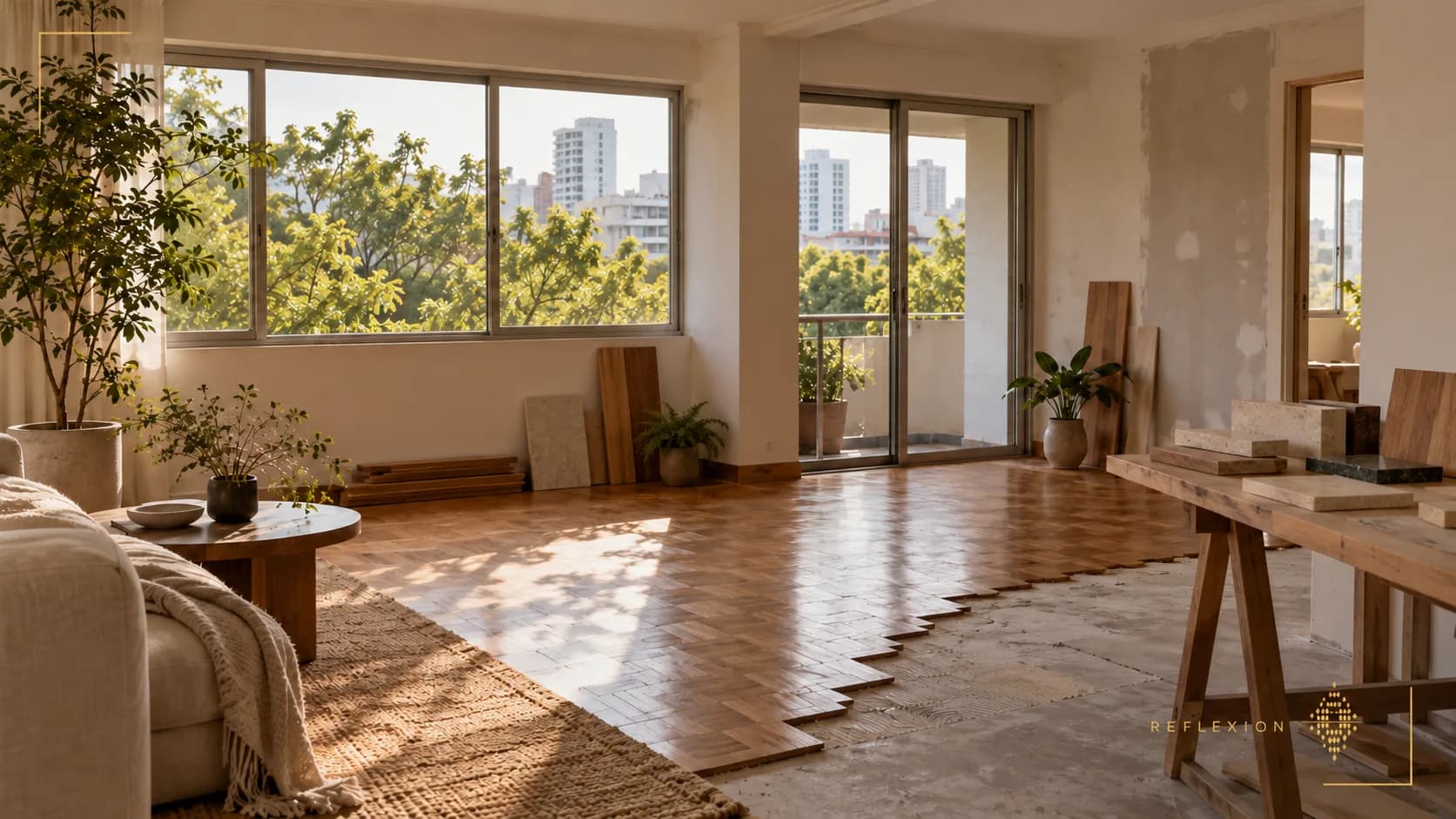
In the sois off Sukhumvit, between two glass towers, you can still glimpse buildings from the 1980s and 1990s: deep balconies, planted gardens, lobbies more modest than those of recent towers. Their apartments are large, and their price per square metre bears no relation to that of new-build. In the districts of Khlong Toei and Watthana, a condominium completed before 2000 is listed at a median THB 101,400 per square metre, against THB 205,937 for a building completed since 2020, according to our survey of 1 November 2026, carried out under the protocol of our Bangkok neighbourhoods guide. Here is where this older stock is, what it offers, and what the law and the condominium allow you to change in it. Texts checked on 1 November 2026.
Where is Bangkok’s older condo stock?
Along Sukhumvit, first of all. Of the 307 condominiums completed before 2000 that our database tracks, Watthana has 50 and Khlong Toei 23: 23.8% of the city’s older stock in two districts. At the scale of our guide’s neighbourhoods, Nana and Asok come first with 32 pre-2000 buildings, or 30.5% of the neighbourhood’s completed condominiums; Thong Lo and northern Sukhumvit have 29, Chatuchak and Lat Phrao also 29, Ratchada and Rama IX 19.
Elsewhere, older buildings exist but weigh less in the supply. Silom and Sathon have 16 pre-2000 condominiums, Lumphini, Langsuan and Chidlom 14, Ari and Phaya Thai 11. These neighbourhoods were built early, but their older buildings are too few for a price median to be published: our protocol publishes nothing below 20 developments. Conversely, the newer neighbourhoods to the east have almost none: 5 in Ekkamai and Phra Khanong, just one in On Nut and Bang Chak.
Condominiums completed before 2000, by neighbourhood, survey of 1 November 2026:
| Neighbourhood | Completed condominiums (year known) | Of which pre-2000 | Share of the neighbourhood |
|---|---|---|---|
| Nana and Asok | 105 | 32 | 30.5% |
| Lumphini, Langsuan and Chidlom | 67 | 14 | 20.9% |
| Thong Lo and northern Sukhumvit | 147 | 29 | 19.7% |
| Phrom Phong, south side | 37 | 7 | 18.9% |
| Silom and Sathon | 91 | 16 | 17.6% |
| Chatuchak and Lat Phrao | 191 | 29 | 15.2% |
| Ari and Phaya Thai | 84 | 11 | 13.1% |
| Ekkamai and Phra Khanong | 108 | 5 | 4.6% |
The addresses where older buildings dominate are often those we described in our article on Bangkok’s prime neighbourhoods: sois built early, close to the first BTS stations.
How much does an older condo cost compared with new-build?
Across Bangkok, a condominium completed before 2000 is listed at a median THB 59,857 per square metre (£1,300), against THB 130,474 (£2,900) for a building completed since 2020, across 287 and 386 developments respectively. But this gap mixes age and address, because older buildings are not always where new ones go up. The fairest comparison is made within the same area.
Asking price per square metre of condominiums, by year of completion:
| Area | Before 2000 | 2000–2009 | 2010–2019 | Since 2020 |
|---|---|---|---|---|
| Khlong Toei and Watthana | 101,400 (71) | 121,880 (100) | 156,636 (149) | 205,937 (69) |
| All of Bangkok | 59,857 (287) | 87,328 (416) | 94,299 (883) | 130,474 (386) |
In the heart of Sukhumvit, then, the asking price per square metre in a building from before 2000, THB 101,400 (£2,300), is roughly half that of a tower completed since 2020, THB 205,937 (£4,600). These medians compare two samples of buildings; they do not measure the effect of age itself, which is mixed up with height, amenities and the condition of the common areas. How price then reads by station and by address is set out in our analysis of Bangkok prices.
Two other differences matter as much as price. Size first: pre-2000 units for sale measure 68 m² (median of median sizes by development), against 33 m² in buildings completed since 2020. Fees next: according to our survey of 7 October 2026, condominiums completed before 2000 ask a median THB 31 per square metre a month, those completed since 2020, 55, as we showed in our article on the cost of ownership.
What can you change in an apartment without permission?
Thai law distinguishes repair from alteration. The Building Control Act B.E. 2522 defines alteration, ดัดแปลง, as changing, adding to, reducing or extending the nature, plan, form, weight or area of the structure or parts of an existing building. It excludes repair, which replaces parts to keep them in their original condition, and acts designated by ministerial regulation. Its section 21 makes any alteration subject to a permit from the local authority, in Bangkok the BMA, or to a notification under section 39 bis.
Ministerial Regulation No. 11 of 1985, amended in 2015 and 2025, lists these acts that are not alterations. The manual of the Department of Public Works and Town & Country Planning (2022) reproduces the list:
| What the text says | Condition |
|---|---|
| Replacing non-structural elements, with the same material or another | adding no more than 10% to the weight of any part of the existing structure |
| Changing, adding to, reducing or extending non-structural elements | the same 10% condition |
| Reducing or extending the area of a floor | 5 m² in total at most, without removing or adding columns or beams |
| Reducing or extending the area of a roof | 5 m² in total at most, same condition |
| Replacing the structure with materials of the same size, number and type | except reinforced concrete, prestressed concrete or structural steel |
These exceptions remain subject to the other applicable regulatory and local requirements.
Replacing certain finishes or non-structural partitions may fall within these exceptions when all their conditions are met. A kitchen or bathroom renovation is not classified by its name alone: the planned works, the added loads, the services and the other applicable rules must be distinguished, and compliance with the 10% threshold is a matter for an engineer’s calculation. Structural work that is neither a repair nor a regulatory exception follows the permit or notification regime provided by law.
The building is not yours alone.
The law classes condominiums among ‘controlled-use buildings’ (section 32 of the Building Control Act), and a 2005 regulation made under section 32 bis subjects condominiums of 2,000 m² and more to inspection. A works project therefore sits within the building’s obligations; the available plans and the latest inspection documents are among the papers to request from the manager.
What does the condominium reserve, and who decides?
The Condominium Act B.E. 2522 draws the line between the unit and the common property. Under its section 13, in the translation by the law firm Siam Legal, the co-owner owns their unit and co-owns the common property; the floor and the partition separating two units belong jointly to those two units, and their use follows the regulations; and the co-owner must do nothing in their unit that could affect the structure, stability or protection of the building. Section 15 classes as common property the structure, the equipment and installations for common use, and the safety and environmental systems: fire protection, ventilation, shared air conditioning, drainage.
Three levels of decision follow.
The unit, within the limits of the regulations. Interior finishes are the co-owner’s affair. The building’s regulations, which section 32 has cover matters including the use of private and common parts, set the rules for works. We found no provision in the law on working hours, deposits or contractors’ access: these are set out in each condominium’s regulations.
The manager, for anything touching the shared services. A water riser, a drain, a ventilation duct or a shared electrical riser belongs to the condominium. Connections are made with the manager, who may also act alone in an emergency for the safety of the building (section 36).
The general meeting, for the façade and the common property. Section 48 requires at least half the votes of all co-owners to authorise a co-owner to alter their unit at their own expense in a way that affects the common property or the external appearance of the building. If those present do not reach that number, a new meeting is called within fifteen days, and the resolution then requires at least one third of all votes. An enlarged window, an enclosed balcony or an air-conditioning unit moved onto the façade may fall into this case, depending on their effect; the vote does not, on its own, amount to compliance with building and planning rules.
‘It’s my apartment, so I can do what I like.’
the shared floor and partition are jointly owned by the two neighbouring units (section 13), the structure and the services are common property (section 15), and work that affects the common property or the external appearance requires a vote of at least half of all votes, under the procedure of section 48.
Electricity, asbestos, budget: what should you check before signing?
Electrical capacity. An apartment from the 1990s was often wired for fewer appliances than today. The Metropolitan Electricity Authority offers online applications for additional capacity; in the procedure described by Thansettakij in February 2024, it inspects the internal wiring before replacing the meter, with inspection fees announced from THB 700. In a condominium, the supply runs through the building’s risers: the application is prepared with the manager.
Asbestos. The Thammasat University book published in 2022 and distributed by the Pollution Control Department described chrysotile at the time as a category 3 hazardous substance, subject to authorisation; the Ministry of Public Health has supported banning it since 2017. The import status of this material says nothing about its presence or absence in any given apartment. In the sources consulted, we found no published rule requiring an asbestos survey before works in a home; that is no reason to work without precautions, and in an older building the question is one to put to the manager and the contractor.
The budget. We found no reliable public benchmark for renovation costs per square metre in Bangkok. Material prices, however, are tracked: the Trade Policy and Strategy Office index reached 112.8 in July 2026 (2021 = 100), up 5.8% year on year, and 12.6% for electrical and plumbing equipment, driven by copper. In September, according to the same office cited by Naewna, the index stood at 113.7, up 6.8%.
What separates a good older building from an average one?
Accounts that have planned for its age. A thirty-year-old building needs well-maintained lifts, risers and façade. The last two audited financial statements, the sinking fund balance and the minutes of general meetings show whether this work has been done, voted or deferred. Fees of THB 31 can reflect frugal management, or maintenance put off until later.
Regulations that make the works liveable. Hours, deposit, contractors’ access, protection of the common areas: clear regulations and a manager on site make the difference between a job of a few months and a dispute with the neighbours.
An address that holds up regardless of the building. Renovation remakes the apartment, not the neighbourhood. The older buildings of Nana, Asok and Thong Lo share addresses where new-build is listed at twice the price per square metre; the address remains what works cannot change.
A place in the foreign quota. For a foreign buyer, the building must still offer a unit under the foreign quota. According to our survey of 20 October 2026, buildings that offer it in Bangkok have a median of 22 floors, those selling only under the Thai quota, 8. An older building is therefore checked unit by unit; in Watthana, however, 90% of buildings whose regime is known do offer the foreign quota.
When we model the case of James and Sophie, between Asok and Thong Lo
James, 46, and Sophie, 44, are moving to Bangkok for five years with their two children. They are torn between a 75 m² two-bedroom apartment in a tower completed in 2022 near Thong Lo station and a 130 m² apartment in a 1994 building on a soi in Asok, with a deep balcony and a garden, at a comparable price.
Our surveys place the two worlds: in Khlong Toei and Watthana, the asking price per square metre goes from THB 101,400 before 2000 to THB 205,937 since 2020, and Nana and Asok form the neighbourhood where older buildings weigh most in the supply. These medians describe developments, not these two buildings.
They ask the manager of the 1994 building for the regulations, the last two audited accounts and the minutes of general meetings, then view the apartment with an engineer. The regulations allow works on weekdays during the day, with a deposit; the water risers were renewed three years ago; the engineer identifies two load-bearing walls that must stay.
What they decide: to pursue the Asok apartment and have the programme of works defined around the two walls that must stay. Kitchen, bathrooms and electrics will be examined with the plans, the shared services and the applicable procedures; they do not plan to alter the façade.
Modelled scenario. This profile is not a client; the parameters are working assumptions.
How our database places a building within its neighbourhood
Our development records show, for each building we track, its district, its year of completion where known, its units for sale and their asking price per square metre: enough to place an older building among neighbours of the same age, and against the new-build on its street. To compare two addresses before any viewing, place them on the map.
What you can do now
Before making an offer on an older apartment, ask the manager for four documents: the building’s regulations, the last two audited financial statements with the sinking fund balance, the minutes of the last general meeting, and the building plans. View with an engineer, who will tell load-bearing walls from partitions. This file will help you separate the works you have in mind, the condominium’s rules and the procedures to look into with the competent authorities.
Frequently asked questions
Where can you find an older condo in Bangkok?
Mostly along Sukhumvit. Our survey of 1 November 2026 puts 73 of the 307 pre-2000 condominiums we follow in the districts of Watthana and Khlong Toei, close to one in four. The Nana and Asok neighbourhood has 32 of them, nearly a third of its completed condominiums with a known completion year; Thong Lo and Chatuchak have 29 each.
Is an older condo cheaper in Bangkok?
Its asking price per square metre is, yes, for buildings whose completion year is known. In the heart of Sukhumvit, the median drops from THB 205,937 in recent towers to THB 101,400 in pre-2000 condominiums, according to our November 2026 survey. Those gaps blend age, height and facilities; the older apartments on the market are also twice the size.
Do you need a permit to renovate a condo in Thailand?
It depends on the work. The Building Control Act requires a permit or a notification for any alteration, but Ministerial Regulation No. 11 carves out certain replacements and modifications of non-structural elements that add no more than 10% to the weight of the structure involved. A job is not classified by its label: the planned works and the other rules that apply are to be checked with a professional.
Can the condominium refuse works in an apartment?
It has a say as soon as the job reaches beyond the unit. Walls and floors shared with a neighbour, the structure and the shared services are not private. For work touching the façade or the common property, consent comes from the general meeting, under the thresholds and procedure of section 48 of the Condominium Act. The building’s regulations, for their part, lay down the rules for works on site.
How much does it cost to renovate an apartment in Bangkok?
No reliable public benchmark of cost per square metre turned up in the sources we consulted. Material prices, by contrast, are tracked by the Ministry of Commerce: its index reached 113.7 in September 2026, 6.8% higher than a year earlier according to Naewna; in July, electrical and plumbing equipment was rising faster than everything else, pushed up by copper.
Method and sources
Sources checked November 1, 2026
Exchange rate used: 1 GBP = 44.54 THB (ECB euro reference rates, cross rate, 1 October 2026)
- Sources checked on 1 November 2026, amounts converted at 1 GBP = 44.54 THB (1 October 2026); conversions are indicative, calculated on the exact value and then rounded to the nearest hundred pounds.
- What this article draws on:
- Reflexion survey of 1 November 2026: 3,790 geolocated developments in Bangkok, asking prices of units for sale, median by development then median of developments, with a minimum of 20 developments; completion year as declared in the development record; neighbourhoods and allocation rule from the Bangkok neighbourhoods guide.
- Reflexion survey of 7 October 2026, ‘The true cost of ownership’ guide: fees by age of Bangkok condominiums.
- Reflexion survey of 20 October 2026, ‘Ownership and price’ guide: quota regime of Bangkok buildings.
- Building Control Act B.E. 2522 (1979), sections 4, 21, 32 and 39 bis, consolidated text.
- Ministerial Regulations No. 11 (B.E. 2528, Royal Gazette of 26 September 1985), No. 65 (B.E. 2558) and No. 72 (B.E. 2568, Royal Gazette of 19 November 2025).
- Department of Public Works and Town & Country Planning, manual on applying the Building Control Act for local authorities, 1st edition, 2022.
- Ministerial Regulation designating buildings subject to inspection, 2005, Royal Gazette vol. 122, part 99 Kor.
- Association of Siamese Architects, directory of building legislation.
- Condominium Act B.E. 2522 (1979), Thai text published by the Department of Lands, sections 13, 15, 32, 36 and 48; English translation by Siam Legal.
- Metropolitan Electricity Authority, online services, 23 June 2025.
- Thansettakij, increasing electrical capacity with the MEA, 12 February 2024.
- Buranatrevedh and Tumwiphat, book on asbestos, Thammasat University Press, 2022, published by the Pollution Control Department.
- National Health Commission Office, the Ministry of Public Health and the asbestos ban, 2017.
- Trade Policy and Strategy Office, construction materials price index, July 2026.
- Naewna, construction materials price index for September 2026, 16 October 2026.
- The published medians describe the developments tracked at the survey date; no public series of prices by building age was found from the REIC or the Bank of Thailand.
This article is general information, not legal or tax advice. The rules cited are dated: check with a qualified professional that they are still in force before acting.