Bangkok neighbourhoods: Sathorn, Langsuan, Thonglor, the river
Langsuan, Sathorn, Thonglor, the river: four ways of living in Bangkok, at asking prices of THB 147,000 to 205,000 per square metre, leasehold or freehold.
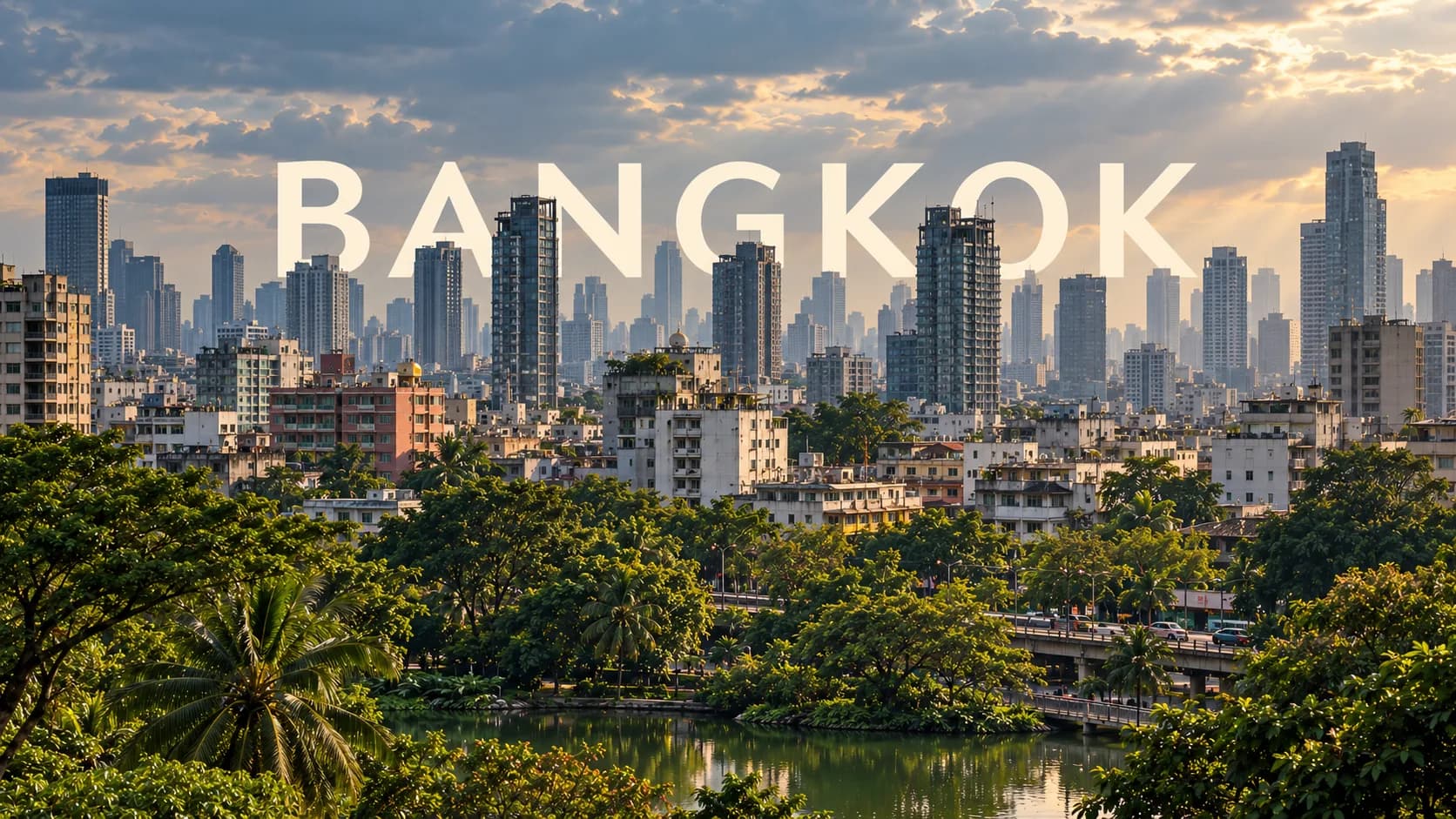
At 4.30am the gates of Lumphini Park open, and the first runners set off on the 2.5 km loop before the heat builds. A little later, a few kilometres away, the express boats begin their rounds from Sathorn Pier on the Chao Phraya. In the evening in Thonglor, tables fill up at the foot of the towers. Three scenes, three ways of living Bangkok, and as many ways of choosing an address. Access to the rail network weighs on how a price should be read, as our analysis of prices by station explains. The neighbourhood, for its part, decides what an ordinary day will be.
What do you look for when buying in central Bangkok?
Buyers at the top of the market are buying a routine more than an apartment. A park ten minutes’ walk away, a metro station at the foot of the building, a school or a hospital on the way, a neighbourhood restaurant for Sunday. In Bangkok, these markers are not evenly spread: they cluster in a handful of neighbourhoods, which developers and agents each name in their own way.
The market bears this out. According to Knight Frank, the average asking price of condominiums in the central business district stood at around THB 236,800 per square metre in the first quarter of 2026, and no new development was launched there during the quarter. According to JLL, around 1,900 luxury homes are expected in Bangkok by 2029, close to 3% of the existing stock in this segment. Scarce new supply, on ground that does not expand: that is the backdrop against which each of the four neighbourhoods should be read.
Foreign buyers are taking a growing share. In its press release of 19 August 2026, CBRE states that in the first half of 2026, 32% of home buyers in the city centre were foreign, compared with an average of 18% from 2021 to 2025. The release does not detail the sample used.
Langsuan, Ploenchit, Wireless: living opposite Lumphini Park
Lumphini is Bangkok’s foremost garden. King Rama VI gave it to the public in 1925, across 360 rai, close to 58 hectares. A footbridge now links it to Benjakitti Forest Park, opened in 2022 on the grounds of the former tobacco monopoly, with its elevated walkway of around 1.6 km above the wetlands. The pedestrian link lets you cross from one park to the other, then follow Benjakitti’s inner path.
Around the park, the neighbourhood has changed scale. One Bangkok has been opening to the public in phases since 25 October 2024. The announced overall scheme comprises five office towers, five hotels and three residential towers across around 17 hectares, about half of it given over to open and green space, for an investment of THB 120 billion, with direct access to Lumphini MRT station. On Wireless Road, the radio-telegraph station that gave the street its name, dating from the beginnings of Thai radio in 1913, was reconstructed in 2025 and is free to visit.
It is also the most expensive land in the country. According to the 2025 ranking by the Agency for Real Estate Affairs, land changed hands at around THB 3.85 million per square wah in Siam, Chidlom and Ploenchit, and THB 3.07 million on Wireless Road, or around THB 962,500 per square metre of land in the first zone. In the 68 developments we track in Lumphini, the median asking price stood at THB 204,595 per square metre on 27 September 2026.
In Langsuan, tenure is part of the address.
Part of the land in the neighbourhood belongs to the Crown Property Bureau, which leases it rather than selling it. Several Sindhorn residences and those of Dusit Central Park are marketed on leasehold. The remaining term of the right on offer and the conditions of any announced extensions are checked in the unit’s documents. Other buildings in the area are freehold, such as the Upper House Residences announced by Swire Properties on Wireless Road for 2030. CBRE reports a split of 55% leasehold and 45% freehold among the transactions it mentions at Central Lumpini, without specifying how many there were or how representative they are of the whole neighbourhood.
Sathorn: the address of embassies and head offices
Sathorn is the neighbourhood of institutions. Along the broad avenue lined with bank headquarters, a few old mansions still stand. The best known, now The House on Sathorn, was built around 1889 and housed the Soviet, then Russian, embassy from 1948 to 1999. Today it serves afternoon tea.
The Silom–Rama IV intersection has been entirely renewed. The Dusit Thani hotel, opened in 1970 and then the tallest building in the city, reopened in rebuilt form on 27 September 2024. The Central Park shopping centre, opened on 4 September 2025 at the heart of the same complex, carries on its roof a garden of around 2.8 acres, a little over a hectare, presented by Central Group as the largest in Thailand, facing Lumphini Park.
Sathorn remains more accessible than Langsuan. In the 37 developments we track in the Thung Mahamek sub-district, the median asking price was THB 153,705 per square metre on 27 September 2026, with 855 units for sale. Land there was worth THB 2.35 million per square wah in 2025 according to the Agency for Real Estate Affairs, against THB 3.85 million in Ploenchit. Further south, Soi Suan Phlu forms the residential side of the neighbourhood, with its cafés and local restaurants.
Thonglor, Ekkamai, Phrom Phong: the life of Sukhumvit
Thonglor is the Sukhumvit street people live on rather than pass through. In the evening, people dine there, meet friends, walk home. Part of its character comes from the Japanese presence: according to Japan’s Ministry of Foreign Affairs, 50,146 Japanese nationals lived in Bangkok on 1 October 2024, and several of their landmarks are on Sukhumvit. Samitivej Hospital, on Soi 49, has a Japanese Medical Center dedicated to Japanese patients, and the country’s first Don Don Donki opened on Ekkamai in February 2019.
The neighbourhood park is Benchasiri. Opened in 1992 at the foot of Emporium, it hosts a group exercise session every evening at 6pm. Around it, the ‘EM District’ shopping complex has been rounded out by EmSphere, which opened in December 2023.
This is the sub-district with the most developments of the three we compare. We track 190 developments in Khlong Tan Nuea, which covers the northern part of Thonglor and Ekkamai and part of Phrom Phong, with 3,668 units for sale on 27 September 2026. Their median asking price, THB 146,992 per square metre, covers very different realities, from affordable buildings to some of the most expensive towers in the city. Across Sukhumvit, outside this sub-district, on Soi 38, Ananda Development is selling the Porsche Design Tower freehold, from one million baht per square metre, with completion announced for 2028.
‘The most expensive neighbourhood is the one with the highest median price.’
that depends on what you count. Development by development, Lumphini comes first of the three sub-districts we compare. Unit by unit, Khlong Tan Nuea overtakes it: the apartments for sale there are concentrated in the most expensive buildings, while many cheaper developments have only a few units on the market. Both readings are right; they do not answer the same question.
How do the four neighbourhoods compare in 2026?
The table brings together our asking-price surveys for the three neighbourhoods that correspond to a sub-district. The riverside, which spans several districts and both banks, is measured separately. Neighbourhoods as people live them cross administrative boundaries: our figures describe only the developments indexed in the sub-districts named below, and do not fully cover the Sathorn or Sukhumvit areas described in the narrative.
Our surveys by sub-district at 27 September 2026:
| Neighbourhood (sub-district) | Developments tracked | Units for sale | Median asking price by development | Median counted unit by unit |
|---|---|---|---|---|
| Langsuan, Ploenchit, Wireless (Lumphini) | 68 | 872 | THB 204,595/m² (£4,600) | THB 336,005/m² (£7,500) |
| Sathorn (Thung Mahamek) | 37 | 855 | THB 153,705/m² (£3,500) | THB 231,125/m² (£5,200) |
| Northern Thonglor–Ekkamai and part of Phrom Phong (Khlong Tan Nuea) | 190 | 3,668 | THB 146,992/m² (£3,300) | THB 361,087/m² (£8,100) |
These are sellers’ asking prices, not transaction prices. The first median gives each building the same weight; the second gives each unit for sale the same weight, and rises when supply is concentrated in expensive buildings.
The river: Charoen Krung, ICONSIAM and the Khlong San bank
Charoen Krung, the ‘New Road’, is the country’s first paved road, opened in 1864. The Mandarin Oriental, founded in 1876 as the Oriental Hotel, celebrates its 150th anniversary there in 2026. The neighbourhood has kept its warehouses and trading houses, now turned into creative venues: the Grand Postal Building houses the Creative Economy Agency, which organises Bangkok Design Week, and the pre-war warehouses of Warehouse 30 were restored in 2016 by the architect Duangrit Bunnag.
Opposite, on the Khlong San bank, ICONSIAM opened in November 2018, at a cost of THB 54 billion; the complex includes the Residences at Mandarin Oriental. Since December 2020, the Gold Line has linked it to the BTS network. On Charoen Krung, the Chao Phraya Estate brings together the Four Seasons, the Capella, opened in October 2020, and the Four Seasons Private Residences. The Four Seasons Private Residences are marketed on leasehold; the remaining term and the renewal mechanisms are checked in the unit’s contract. Shrewsbury International School’s Riverside campus is on the same road.
The riverside remains scarce. According to Knight Frank, condominiums on the banks of the Chao Phraya accounted for 2.3% of Bangkok’s supply at the end of 2023, with resale prices of between THB 91,415 and THB 249,742 per square metre that year. Our own measurement of the riverside, development by development, will accompany the map guide devoted to the river.
Leasehold or freehold: what separates two addresses at the same price
Two apartments of the same size and the same price do not confer the same rights. Under freehold, the foreign buyer owns the unit with no time limit, within the foreign quota, set at 49% of the total floor area of the units in the registered condominium. Under leasehold, the buyer holds a registered right of use, whose term and renewal conditions are set out in the contract. We explain these regimes in our article on freehold, leasehold and company ownership.
Leasehold is not a second-best choice: it opens up locations that would not otherwise be for sale, facing the park or on the water, and the price of a leasehold right depends in particular on its remaining term, so two offers are compared on equivalent terms and conditions. The question is one of horizon: a fifteen-year plan to live there is not approached in the same way as a property you want to pass on.
Hotel brands are present in all four neighbourhoods, from the Chao Phraya Estate to the residences of Dusit Central Park, and their premium is a separate discussion, as we set out for branded residences in Thailand.
When we model the case of Fiona and Graham, between the park and Thonglor
Fiona, 57, and Graham, 60, are moving to Bangkok for about a decade and are looking for a two-bedroom apartment of around 150 m², with a budget fixed at THB 45 million (£1,010,400). Two apartments catch their attention. The first, in Langsuan, overlooks Lumphini Park; it is sold on a thirty-year lease. The second, in Thonglor, is freehold, in a recent tower a few minutes from the BTS.
The first suits the way they live: the park loop in the morning, the metro on foot, the restaurants of One Bangkok. The second suits their estate plans: they want to be able to leave it to their children. So they check the share of the foreign quota still available, and ask the juristic person manager of the Thonglor condominium for a written statement of the floor area already held by foreigners.
What they decide: to buy in Thonglor, freehold, once that statement is in hand, and to keep Lumphini for their mornings, a few BTS stops away.
Modelled scenario. This profile is not a client; the parameters are working assumptions.
How our database places each development in its neighbourhood
Our records place each development in its district and sub-district, with its distance to the nearest station and, where published, its asking price. These are the records that make it possible to compare two buildings in the same neighbourhood beyond their brochures. To see these four neighbourhoods and their developments on a single map, start by placing them on the map.
What you can do now
First, choose the neighbourhood by the day you want to live there: the park, the river, the street or the institutions. Then weigh the rights on offer against how long you intend to use the property and your plans for passing it on. Finally, for each building on your shortlist, ask the condominium’s juristic person manager how much of the foreign quota is already used, and the exact term of the lease where there is one. Three questions that place an apartment better than its view does.
Frequently asked questions
Which is the most expensive neighbourhood in Bangkok?
For land, Siam, Chidlom and Ploenchit, according to the Agency for Real Estate Affairs in 2025. For apartments, among the three sub-districts in our comparison, the answer depends on how you measure: building by building, Lumphini comes first; counted by units for sale, Khlong Tan Nuea, around Thonglor, moves ahead.
Can a foreigner buy freehold in Langsuan?
Yes, in buildings that stand on freehold land, and within each one’s foreign quota. Part of the area is built on land leased out by the Crown Property Bureau, where apartments are sold on leasehold; the form of tenure has to be confirmed for each development.
Thonglor or Sathorn for living year-round?
Thonglor suits those who put going out close to home first, depending on the soi and the actual distance, with a very wide choice of buildings. Sathorn offers a more institutional pace, proximity to Silom and Lumphini Park, and more moderate asking prices in our surveys.
Is living on the Chao Phraya compatible with neighbourhood life?
Yes, especially on the Charoen Krung side, where shops, cultural venues and the express boat give the day its shape. On the opposite bank, ICONSIAM and the Gold Line bring the services of a shopping centre and the connection to the BTS.
How do you find out whether a building still has foreign quota available?
Ask the condominium’s juristic person manager in writing: they keep the tally of floor area held by foreigners. The quota covers 49% of the total floor area of the units, building by building, so a neighbouring building may be full when this one is not.
Method and sources
Sources checked October 22, 2026
Exchange rate used: 1 GBP = 44.54 THB (ECB euro reference rates, cross rate, 1 October 2026)
- Sources checked on 22 October 2026, amounts converted at 1 GBP = 44.54 THB (1 October 2026); conversions are indicative, calculated on the exact value and then rounded to the nearest hundred pounds.
- What this article draws on:
- Reflexion survey of asking prices by sub-district at 27 September 2026: number of developments tracked, units for sale, median by development and median counted unit by unit.
- Knight Frank, Bangkok Condominium Market, first quarter of 2026.
- Knight Frank, Waterfront Living in Thailand, 2023.
- JLL, Residential Bangkok, fourth quarter of 2025.
- Real Estate Asia, reporting JLL data on Bangkok’s luxury segment, 25 August 2026.
- CBRE, press release of 19 August 2026 on the first half of 2026.
- Agency for Real Estate Affairs, 2025 land price ranking, reported by Matichon on 27 February 2025.
- Frasers Property, One Bangkok opening press release, 8 October 2024.
- One Bangkok, press release on The Wireless House, January 2025.
- Central Pattana, opening of Central Park, September 2025.
- Dusit International, reopening of the Dusit Thani Bangkok, September 2024.
- Swire Properties, press release of 17 October 2025 on the Upper House Residences.
- Sindhorn Residence, the development’s legal disclaimer.
- Thansettakij, tenure of the Langsuan and Wireless developments, 26 April 2023.
- Country Group Development, 2024 annual report, notes 31.1 and 31.2.
- Department of Lands, Condominium Act B.E. 2522, section 19 bis (official translation).
- Ministry of Foreign Affairs of Japan, statistics at 1 October 2024.
- Samitivej, hospital overview.
- Kyodo News PR Wire, opening of Donki Mall Thonglor, February 2019.
- Tourism Authority of Thailand, opening of ICONSIAM, November 2018.
- Mandarin Oriental Bangkok, 150th anniversary.
- Bangkok Design Week, presentation of the 2026 edition by the Creative Economy Agency.
- Warehouse 30, history of the site.
- Shrewsbury International School, Riverside campus.
- Country Group Development, opening of Capella Bangkok.
- Time Out Bangkok, Lumphini Park centenary, 25 July 2025.
- Bangkok Metropolitan Administration, Benjakitti Park.
- Bangkok Metropolitan Administration, Benchasiri Park.
- The House on Sathorn, history of the house.
- The published medians describe the developments we track in each sub-district at the survey date; they do not apply to any individual building.
This article is general information, not legal or tax advice. The rules cited are dated: check with a qualified professional that they are still in force before acting.