Koh Samui: buying a villa, and what the island allows
On Koh Samui, the median villa is listed at THB 12.9 million for 224 m². The island’s coasts, the lease, and what can be built on its wooded hillsides.
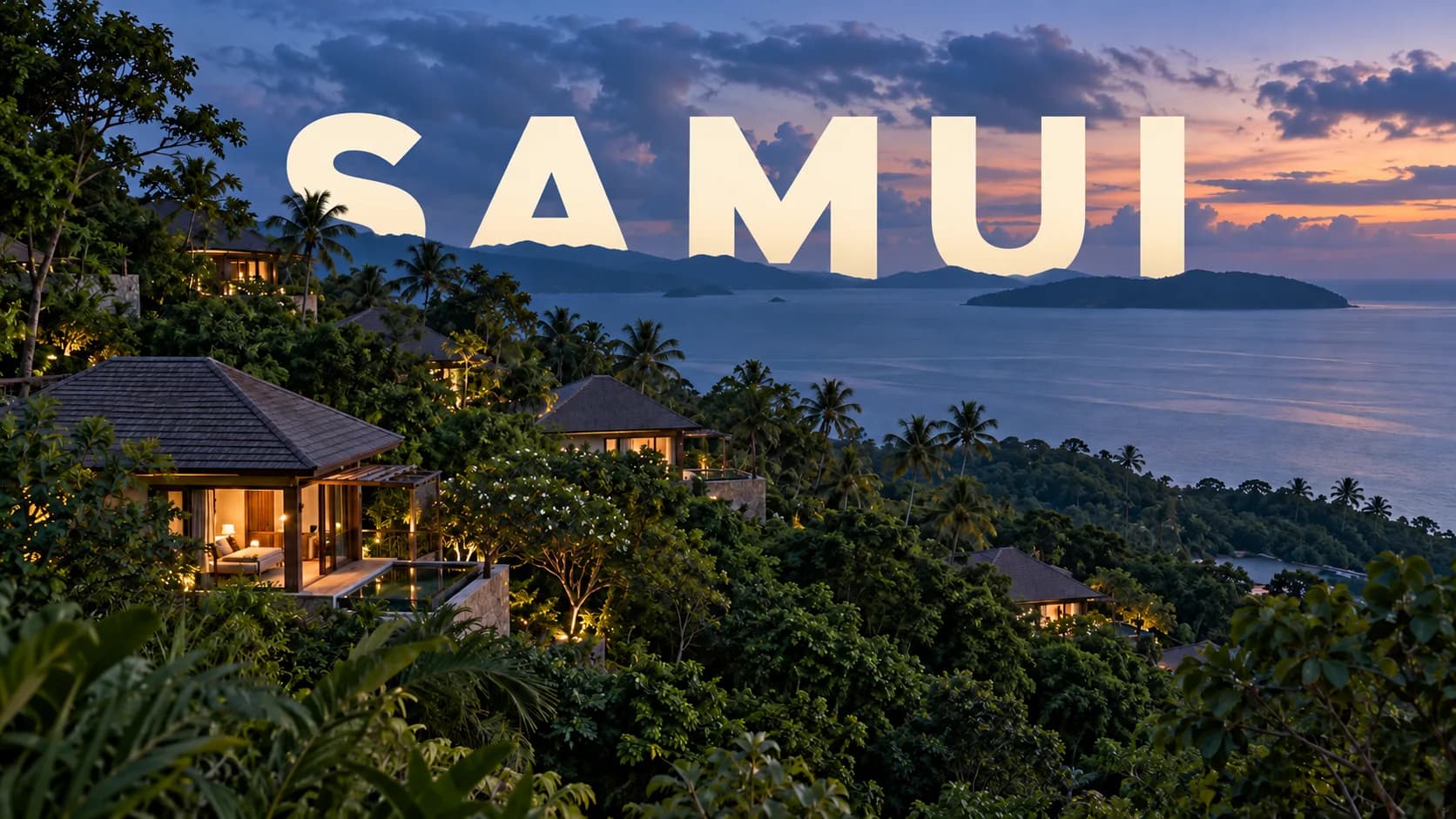
In the evening in Bophut, the beachfront street of Fisherman’s Village lights up; above it, on the hills, villa terraces look out as Koh Phangan fades into the Gulf of Thailand. Koh Samui is lived in houses: of the 315 developments we track here, 85.7% are villas, and more than half of those whose status is known are sold off-plan. You land on a private runway, around a quarter of an hour’s drive from our developments at the median, in our traffic-free model. What the island offers those who settle here is read coast by coast, as in our map-based guide ‘Phuket or Koh Samui’; what it allows you to own and to build, plot by plot.
Why is Koh Samui the island of villas?
Because the island rises quickly. Behind a narrow coastal strip, a mountainous massif fills the centre of the island, and houses have followed the relief: beneath our developments, the land stands at 31 m above sea level at the median, and up to 438 m for the highest. Apartment buildings remain rare: of the 19 condominiums whose number of floors we know, none rises above the fifth. The supply we track is dominated by houses with a pool and garden, often on a slope.
The market has grown with this model. According to Colliers, quoted by The Nation on 6 June 2026, 65 villa developments offered 749 homes in the first quarter of 2026, or 31% of the homes for sale on the island but 56% of their value, by our calculation. Between 85% and 90% of buyers are foreign, Europeans first, according to the same firm, quoted by Thairath in September 2025.
The very top of the market remains rare: 13 villas at one hundred million baht or more in our survey of 24 September 2026, against 164 in Phuket.
Chaweng, Bophut or Lipa Noi: which coast for which life?
Chaweng, the island’s beach. The liveliest, according to the Tourism Authority of Thailand, with the full range of accommodation. It is also, together with Bophut, the side of the island where its private healthcare is found. For villas, the Chaweng-Bophut area posted the island’s best sales rate in the first half of 2025, 67.91%, according to Colliers.
Bophut and Fisherman’s Village. A long beach facing Koh Phangan, and the old fishing village turned evening promenade. On the islet of Koh Fan, linked by a causeway, the 12 m golden Buddha can be seen from several kilometres away, according to the Tourism Authority. The hills above the village are home to some of the largest houses on the island.
Choeng Mon, the north-eastern tip. A discreet cove a few minutes from the airport, where several luxury hotels have settled.
Maenam, the quiet coast. White sand, a peaceful atmosphere and dive clubs, according to the official tourism directory; opposite, Koh Phangan takes shape on the horizon.
Lamai, the other lively beach. A long stretch of sand in the south-east, with, around 2 km to the south, the Hin Ta and Hin Yai rocks, considered lucky by local people according to the Tourism Authority.
The west coast, the sunset side. Nathon, the island’s main town, from where speedboats leave early in the morning for Ang Thong Marine Park; then Lipa Noi and its coconut palms, facing the setting sun. It is the quietest coast in the market: according to C9 Hotelworks (June 2025), the sub-districts of Ang Thong, Lipa Noi and Taling Ngam together accounted for around 5% of homes on the primary market.
The hills. They run through all these areas. Our database counts 44 developments above 80 m elevation, where the median asking price per square metre was THB 69,152 (£1,600) on 19 October 2026, close to the level of villas across the island. Here you pay for the view, under building rules of their own.
Living on the island year-round: flights, school, hospital
An airport on the island’s scale. Opened on 25 April 1989, Samui airport was Thailand’s first private airport; its open-air terminal, under thatched roofs, handled more than 3.02 million passengers in 2025, on 33,823 flights, according to Bangkok Airways. The airline operates direct flights to Suvarnabhumi in around 1 hour 10 minutes, to Phuket in around an hour and to Singapore in around 1 hour 55 minutes. From our developments, the terminal is a median 15.7 minutes’ drive away, against 30.4 in Phuket. By sea, the ferry links Don Sak, on the mainland, in around 90 minutes, according to the Tourism Authority; a sea bridge is still under study, with approval targeted for 2027 according to Khaosod English (February 2026).
Healthcare. Bangkok Hospital Samui, opened in 2004 within the BDMS group, says it is the only facility on the island to offer MRI, and more than 60% of its patients are foreign. In Nathon, the public Koh Samui Hospital is accredited by the Healthcare Accreditation Institute, HA, until 12 May 2028. From our developments, the nearest hospital in the Bangkok Hospital network is 3.1 km away as the crow flies, at the median.
School. The island has several international schools; PBISS, in Bophut, teaches the Cambridge International curriculum, according to its website.
The calendar. On the Gulf coast, the wet season lasts until the end of the year, and November is the wettest month, according to the Land Development Department. Samui’s calendar is thus out of step with that of Phuket, where the south-west monsoon dominates from May to October: the two islands complement each other more than they resemble each other.
How does Samui compare with Phuket?
Our surveys: asking prices and everyday markers:
| Indicator | Koh Samui | Phuket | Survey date |
|---|---|---|---|
| Developments tracked | 315 | 1,356 | 5 October 2026 |
| Median villa for sale | THB 12.9m (£289,600) | THB 24.7m (£554,600) | 5 October 2026 |
| Floor area of the median villa | 224 m² | 320 m² | 5 October 2026 |
| Median villa price per m² | THB 63,439 (£1,400) | THB 70,564 (£1,600) | 5 October 2026 |
| Villa price per m², 300 m or less from a beach | THB 82,567 (£1,900) | THB 142,144 (£3,200) | 5 October 2026 |
| Villas for sale at THB 100m or more | 13 | 164 | 24 September 2026 |
| Drive to the terminal, median | 15.7 min | 30.4 min | 5 October 2026 |
| Villa service charges, per month | THB 5,850 | THB 9,820 | 7 October 2026 |
| Villa units offered on leasehold | 71.3% | 81.6% | 20 October 2026 |
The price per square metre of a villa differs by only 10% between the two islands: on Samui, it is the house that shrinks, and the seafront that costs less. Within 300 m of a beach, a villa is listed 42% higher than beyond a kilometre on Samui, against 110% in Phuket. Service charges follow the same gradient: THB 5,850 a month for a villa, or THB 70,200 a year (£1,600). These figures are asking prices, not transaction prices.
What does the island allow a foreign buyer?
Land. The Land Code in principle reserves ownership of land to Thais; it opens it to a foreigner only through narrow exceptions. The one in section 96 bis, set out in detail by a 2002 ministerial regulation, requires an investment of at least THB 40 million (£898,100) held for five years in designated investments, and applies only in certain areas. The forms of tenure and their limits are set out in our article on freehold, leasehold or a company.
The lease, the villa route. Section 540 of the Civil and Commercial Code limits a lease of immovable property to 30 years; it may be renewed at the end of its term, for no more than 30 years. A lease of more than three years that is not registered at the land office is valid for three years only, the Department of Lands points out (July 2026). The same code provides for the right of superficies (sections 1410 onwards), which allows a person to own a building on someone else’s land. In our survey of 20 October 2026, 71.3% of villa units for sale on Samui are offered on leasehold and 27.4% shown as freehold: the listing describes the tenure of the property, not who is able to acquire it.
The condominium, a narrow door. Under the Condominium Act B.E. 2522, foreigners who meet one of the conditions of section 19 may own a condominium unit, within a collective limit of 49% of the total floor area of the units in the condominium, calculated at its registration (section 19 bis, มาตรา 19 ทวิ). On an island of villas, this door stays narrow: few condominiums, and too few listings declaring service charges to derive a median. A villa sold as a condominium unit is the exception here; its status is read on the unit’s title, the condominium chanote.
What the island allows you to build, from the shore to the ridges
Three texts decide what gets built, and the strictest prevails: the Building Control Act and its municipal regulations, the town plan, and the environmental protection order. Samui’s order, signed by the Minister of Natural Resources and Environment on 24 April 2025, was published in the Royal Gazette on 21 May 2025 and has applied since the following day, for five years; it covers all seven sub-districts of the island, according to ONEP, and repeals the 2014 text.
Its logic rests first on the terrain. On the island’s land below 80 m above sea level, zone 2, the order protects access to the beaches: walls and sea defences must not block it, and, for hotels and multi-unit housing, at least half of the required open space is to be planted, mainly with perennial trees (ข้อ 6(1)). From 80 m up to 140 m, zone 3, the principle is a ban on building, with exceptions: on land lawfully owned or possessed by a private person, a single detached house or standalone building of no more than 6 m, provided in particular that half the plot is left open, half of that open space is planted, and the building is covered by a pitched roof in the local style, over at least 80% of its area, in a natural colour (ข้อ 6(2)(ง)). Above 140 m, the same conditions apply with 70% of the plot left open (ข้อ 6(2)(จ)). These projects first require the opinion of Surat Thani province, before any application for a building permit.
Slopes have rules of their own. From a gradient of 35%, only a single detached house or standalone building of no more than 6 m is allowed, with a footprint of 90 m² and 70% permeable surface on a plot of more than 100 square wah, or 400 m², or 70 m² and 50% on a smaller plot; the case of a plot of exactly 400 m² is a matter for the authority’s interpretation (ข้อ 7(1)(ก)). Cut and fill is limited to one metre, subject to the technical exceptions set out in the text (ข้อ 7(2)). The 10 m setbacks apply to the islets, not to the main island (zones 4 and 5). Buildings existing on or before 22 May 2025 and certain works authorised before that date come under separate transitional provisions (ข้อ 15 to 17). On the island’s shoreline, height is governed by the municipal regulations and the town plan, which the order does not replace (ข้อ 13 and 14). The other coasts are compared in our article on zoning and building limits; for hotels and multi-unit buildings, the order also lowers the impact assessment thresholds, set out in our article on EIA.
‘On Samui, you can build wherever you like on the hills.’
the environmental protection order for Koh Samui and Koh Phangan, published in the Royal Gazette on 21 May 2025, starts from a ban on building from 80 m above sea level, then allows there, on private land, only a single detached house or standalone building of no more than 6 m, after the province has given its opinion (ข้อ 6(2)). From a gradient of 35%, the same logic applies, with a limited footprint (ข้อ 7(1)). Elevation and slope are measured on the plot, by a surveyor.
The steepest slopes.
The 2014 order, repealed by that of 2025, banned all building on gradients above 50%, according to the daily Naewna. The 2025 text adds no general ban at that threshold: there, it protects the roots and trunks of natural trees with a girth of 50 cm or more, measured at 1.30 m (ข้อ 7(3)), without setting aside the order’s other rules or those of other laws.
What separates a good purchase from an average one?
A plot that is measured, not estimated. Terrain models smooth out embankments: an actual slope may be steeper than the one on a map. A surveyor’s report locates the elevations and changes in gradient on the plot; these measurements are then examined alongside the zoning, the title, the permits and the other applicable rules.
A permit checked with the municipality. In March 2026, Koh Samui municipality invited villa owners to check their building permits after forged signatures were discovered, according to Daily News (21 March 2026); the same article reports that joint inspections in 2024 and 2025 found more than a hundred buildings with irregular permits. Well-advised buyers ask for a copy of the permit and have it confirmed by the municipal offices.
A lease read line by line. The lease is registered at the land office, and its renewal clause is read in the light of section 540. In its judgment No. 4655/2566, analysed by the law firm Addleshaw Goddard on 10 March 2025, the Supreme Court held void clauses promising two renewals of 30 years on the original terms, with future rent paid in advance.
A clear owner. Since 2025, joint operations on the island have targeted nominee ownership; their seventh phase, in August 2026, covered among other things hillside villas sold through share transfers, according to MGR Online. The form of tenure is examined before the property is chosen.
Water. In July 2026, after a long dry season, water was supplied by zone and by time slot, according to Thairath. A storage tank and a borehole are part of any viewing.
When we model the case of Rachel and Mark, on the hills above Bophut
Rachel, 52, and Mark, 55, want to spend January to September on Samui, and the rest of the year at home in Surrey. Their budget is set at THB 30 million (£673,600). Two four-bedroom villas catch their eye on the hills of Bophut: a completed house, at around 70 m above sea level according to the listing; and an off-plan villa, a little lower down, on an estate still under construction.
The first offers what they came for: the terrace facing Koh Phangan, with Fisherman’s Village and the airport a few minutes away; but the top of the plot approaches 80 m, on a slope. The second depends on a completion timetable and a permit yet to be issued.
What they decide: to pursue the completed villa, subject to a surveyor’s report on elevation and slope, confirmation of the building permit by the municipality, a 30-year lease registered at the land office, and a check by a Thai lawyer of the form of tenure that applies to their situation. They will come back in November to see the island in the rain before signing.
Modelled scenario. This profile is not a client; the parameters are working assumptions.
Placing developments on the island with our database
Our records place each development in its sub-district, with the elevation of the land, its distance from the beach, its driving time to the airport and, where published, its asking price and the tenure shown for its units. To see Samui’s villas, from the beaches to the ridges, start by placing them on the map.
What you can do now
First choose your coast: the lively beach, the calm bay or the sunset. Then shortlist the developments less than twenty minutes from the airport and the hospital, and note their elevation. Before any reservation, ask for three documents: the plot survey, a copy of the building permit and the draft lease.
Frequently asked questions
Can a foreigner buy a villa on Koh Samui?
Yes, most often through a lease covering both the villa and its land, the usual route on the island. The Civil and Commercial Code caps such a lease at 30 years, renewable for no more than 30 years; if it is not registered at the land office, a lease of over three years is valid for three years only. Foreign ownership of land itself rests on narrow exceptions in the Land Code.
How much does a villa on Koh Samui cost?
Around THB 12.9 million (£289,600) for the median villa on the market, with 224 m² of floor space, in our survey of 5 October 2026. Within 300 m of a beach, the median price per square metre climbs to THB 82,567. These are asking prices: negotiation and the final sale price may differ.
Can you build on the hills of Koh Samui?
Only under strict conditions. From 80 m above sea level, the 2025 environmental order starts from a ban, then allows on private land a single detached house or standalone building of no more than 6 m, with much of the plot left open and the province consulted first. Slopes of 35% or more follow a similar logic, with a limited footprint. Each plot is measured by a surveyor.
How do you get to Koh Samui?
Usually by air, with Bangkok Airways: around 1 hour 10 minutes from Suvarnabhumi, an hour from Phuket and 1 hour 55 minutes from Singapore. The ferry from Don Sak, on the mainland, takes around 90 minutes. The sea bridge discussed for several years is still a project under study.
When does it rain most on Koh Samui?
Mostly at the end of the year, peaking in November according to the Land Development Department: the island follows the calendar of the Gulf of Thailand, not that of the Andaman Sea. Phuket, by contrast, gets most of its rain from May to October. A visit in November lets you see a plot in the rain.
Method and sources
Sources checked October 27, 2026
Exchange rate used: 1 GBP = 44.54 THB (ECB euro reference rates, cross rate, 1 October 2026)
- Sources checked on 27 October 2026, amounts converted at 1 GBP = 44.54 THB (1 October 2026); conversions are indicative, calculated on the exact value and then rounded to the nearest hundred pounds.
- What this article draws on:
- Reflexion survey of 5 October 2026: 315 developments on Koh Samui and 1,356 in Phuket, asking prices of units for sale, median per development then median across developments, with a minimum of 20 developments; land elevation and declared number of floors.
- Reflexion survey of 24 September 2026: exceptional villas in Phuket and Samui, asking prices.
- Reflexion survey of 19 October 2026: Samui developments above 80 m elevation, on a terrain model of around thirty metres.
- Reflexion survey of 20 October 2026: tenure shown for villa units for sale.
- Reflexion survey of 7 October 2026: service charges declared in listings.
- Ministry of Natural Resources and Environment order of 24 April 2025 on the environmental protection area of Koh Samui and Koh Phangan, Royal Gazette, vol. 142, special part 199 ง, 21 May 2025.
- Office of Natural Resources and Environmental Policy and Planning (ONEP), presentation of the Surat Thani order, 23 May 2025.
- Naewna, Samui’s 2014 environmental protection order.
- Civil and Commercial Code, sections 538 and 540, Office of the Council of State text; Department of Lands reminder, July 2026.
- Condominium Act B.E. 2522, sections 19 and 19 bis, consolidated Thai text published by the Department of Lands.
- Ministerial regulation of 2002 issued under section 96 bis of the Land Code (FAO translation).
- Addleshaw Goddard, analysis of Supreme Court judgment No. 4655/2566, 10 March 2025.
- Bangkok Airways, presentation of Samui airport, 8 June 2026.
- Bangkok Airways, pages on its direct routes from Samui.
- Tourism Authority of Thailand, Samui beyond the beach (October 2018).
- Tourism Authority of Thailand, the beaches of Koh Samui (May 2021).
- Tourism Authority of Thailand, Ang Thong Marine Park (May 2021).
- Official Thailand Tourism Directory, Maenam beach.
- Khaosod English, Samui sea bridge project, 13 February 2026.
- Bangkok Hospital Samui, hospital overview.
- Healthcare Accreditation Institute (HA), status of Koh Samui Hospital.
- PBISS International School of Samui, school website.
- Land Development Department, climate of the southern east coast.
- Colliers, Samui market in the first quarter of 2026, reported by The Nation on 6 June 2026.
- Colliers, villa market in the first half of 2025, reported by Bangkokbiznews on 23 October 2025.
- Colliers, buyers in the first half of 2025, reported by Thairath on 25 September 2025.
- C9 Hotelworks, Samui Property Market Update, June 2025.
- Daily News, checks on building permits in Samui, 21 March 2026.
- Khaosod English, operation against nominee ownership on Samui, 25 July 2025.
- MGR Online, seventh phase of inspections on Samui, August 2026.
- Thairath, water shortage on Samui, 29 July 2026.
- The thresholds of the Samui order apply only to Koh Samui and Koh Phangan; those of Phuket or Krabi cannot be transposed to them.
This article is general information, not legal or tax advice. The rules cited are dated: check with a qualified professional that they are still in force before acting.