EIA in Thailand: the thresholds and how to check a project
In Thailand, a condominium with 80 units or 4,000 m² must go through an EIA. The thresholds, the stages of the review, and how to read a project’s file online.

On Sukhumvit, the sales gallery often opens before the first shovel goes into the ground: a scale model under glass, an iced coffee on the table and, at the foot of the brochure, one of two possible lines in small print — ‘EIA approved’ or ‘EIA in process’. A model shows what a development will be; its environmental impact assessment says how it intends to take its place in the neighbourhood: the shadow it will cast, the cars it will bring in, the water it will discharge. Every condominium of 80 units or 4,000 m² and above passes through this filter before its permit, and part of the file is public. Like the height and coastal-strip rules we set out in our article on zoning and construction, it can be read, provided you know where to look.
What is an environmental impact assessment in Thailand?
It is a technical report, prepared by a licensed consultancy, that describes what a project changes around it — traffic, wastewater, shadow, wind, construction noise, drainage — and the measures the developer undertakes to apply to limit those effects. Its legal basis is the Enhancement and Conservation of National Environmental Quality Act B.E. 2535 (1992), whose chapter on impact assessment, sections 46 to 51/9, was rewritten by the amending act published in the Royal Gazette on 19 April 2018.
The system has three tiers, and the vocabulary recurs in every brochure. The IEE, the initial environmental examination, applies mainly in environmental protection areas, where local notifications lower the thresholds. The EIA, the full assessment, is the standard regime for property nationwide. The EHIA, which adds a health impact assessment and enhanced consultation, covers projects likely to seriously affect the environment and health; in the examples published by the authorities, it concerns heavy industry and major infrastructure.
The lead agency is ONEP, the Office of Natural Resources and Environmental Policy and Planning. It does not issue the permit: it examines the report and refers it to an expert review committee, the KCP (คชก.), whose opinion is binding on the authority that grants the permit. According to ONEP, there are nine central committees and twelve provincial committees.
Which property projects require an EIA?
The list is set by the annex to a notification of the Ministry of Natural Resources and Environment dated 20 December 2023 and published on 5 January 2024. An amendment in force since 1 August 2025 added commercial buildings of 10,000 m² and above, according to the analysis published by the law firm Baker McKenzie on 6 August 2025.
The thresholds in the annex that concern residential and tourism property:
| Annex item | Project type | Threshold that triggers an EIA |
|---|---|---|
| 31 | Multi-unit housing, including condominiums | 80 units or more, or usable floor area of at least 4,000 m² |
| 30 | Hotel or resort | 80 rooms or more, or usable floor area of at least 4,000 m² |
| 28 | Residential or commercial land subdivision | 500 plots or more, or an area of more than 100 rai (16 hectares) |
| 27 | High-rise or extra-large building | Height of at least 23 m or total floor area of at least 10,000 m², for the locations and uses covered: beside a river, the sea or a beach, Songkhla Lake, near a national park or a historic site |
A fictional example shows why both criteria matter. A building of 50 units on 4,100 m² requires a full assessment, even though it is well short of 80 units. A building of 79 units on 3,900 m² stays below both residential thresholds; other national criteria, such as those of item 27, or the rules of its zone may nonetheless require an assessment. The number of units is never enough to settle the question.
Phuket and Samui: when the local rule lowers the threshold
On the islands and the tourist coast, a second tier of rules sits on top of the first. These are the environmental protection area notifications, issued province by province for five years, which set heights, setbacks and assessment thresholds more restrictive than the general law.
In Phuket, the notification published in the Royal Gazette on 13 December 2024 requires, under clause 13, a preliminary report for the categories covered with 50 to 79 rooms, or 2,500 to under 4,000 m², located more than 50 m from the shoreline, and a full assessment within the 50 m strip; its clause 12 sets annexed measures for certain projects of 11 to 49 rooms. In Koh Samui, the notification that also covers Koh Phangan and Koh Tao, published on 21 May 2025 and in force the following day, follows the same structure in clause 10: a preliminary report for 50 to 79 rooms or 2,500 to under 4,000 m² more than 50 m from the coastline, and a full assessment from the national thresholds and, for the hotel and residential categories covered, within the 50 m strip. The effects of this strip on height and buildability are set out in our reading of the Phuket and Samui notifications, cited above.
These thresholds target specific categories.
Both notifications name hotels, apartment buildings and condominiums; they do not apply indiscriminately to every plot, every existing building or every extension, and the Samui notification provides for transitional arrangements in clauses 15 to 17. In Phuket, a new draft notification was put to public consultation on 1 September 2026: a draft has no effect until it is published in the Royal Gazette.
How does the review work, from consultancy to committee?
The report is prepared or certified by a consultancy licensed by ONEP, then filed both with the permitting authority — in Bangkok, the Bangkok Metropolitan Administration — and with ONEP. The quality of this work matters: a report judged incomplete or inadequate goes back to the developer, and each revision restarts a clock. The law then sets a time limit for each stage, each with its own starting point:
| Stage | Who | Statutory time limit | Starting point |
|---|---|---|---|
| Completeness check | ONEP | 15 days | Filing of the report |
| Preliminary opinion | ONEP | 30 days | Complete file |
| Expert committee decision | KCP | 45 days, failing which the opinion is deemed favourable | Receipt of the report by the committee |
| Revised report after a rejection | Developer | 180 days | Notice of rejection |
| Second review | KCP | 30 days, same rule | Receipt of the complete revised report |
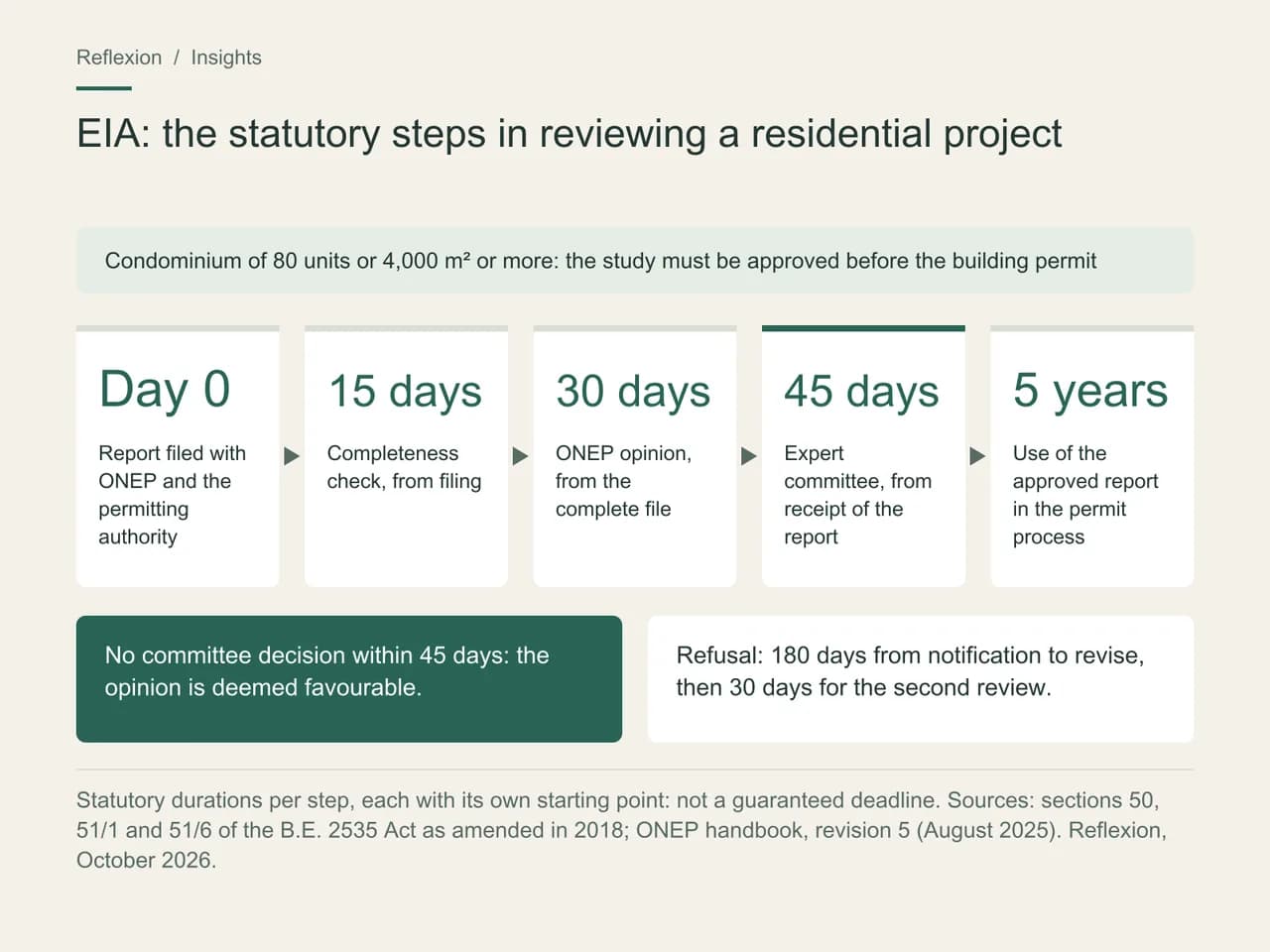
These durations describe stages, not a guaranteed deadline. The ONEP handbook sets out a path of around 105 days for the sequences it describes, not counting the preparation of the report itself or any additional information requested during the review.
Three mechanisms give the system its real reach. First, public participation: an EIA requires at least two consultations, one on the scope of the study, the other on the draft report and its measures, according to ONEP’s guideline of 25 July 2023. This is when local residents have their say, and their objections may later feed a legal challenge, as the 125 Sathorn case will show. Second, the legal force of the commitments: section 51/3 makes the mitigation measures conditions of the permit, and section 51/5 requires a report on their implementation to be submitted to the competent authority at least once a year. Finally, duration: under section 51/6, the approved report may be used in the permit procedure for five years from the notification letter, and reusing it beyond that is subject to specific conditions.
What an approval tells the future resident
For anyone buying a flat, the value of the assessment is concrete. Its measures describe the daily life of the building and its neighbours: the shadow cast on neighbouring buildings, cars coming in and going out, wastewater treatment, drainage in heavy rain. They do not disappear at handover. In 2024, according to InfoQuest, the Supreme Administrative Court held the assessment for the Aspire Ngamwongwan development to be lawful while ordering the Lak Si district director to enforce its measures strictly.
What separates a sound development from a fragile one often comes down to sequence. An approved EIA means that an expert committee has validated the impact and measures of a specific project, on a specific date; it is neither a building permit nor permission to start work. We found no rule prohibiting sales before approval, and the Thai business press reports that bookings open beforehand. Since 31 January 2025, however, the reservation contract for a condominium unit must follow a regulated template: clauses allowing all or part of the sums paid to be forfeited are prohibited, unless the buyer is in breach of contract. Cancellation and refund terms are to be read in each contract.
Recent court decisions show where the line between documents falls. At Ashton Asoke, the Supreme Administrative Court confirmed on 27 July 2023 the annulment of the documents that served as the building permit, for lack of 12 m of frontage on an 18 m public road as required by Ministerial Regulation No. 33; the sources consulted do not report any annulment of the assessment itself. This road-width rule is explained in our article on Bangkok prices and stations. The approval itself can also be challenged: the Central Administrative Court annulled at first instance the approval of Supalai Loft Ratchada-Wongsawang on 31 May 2023, and that of 125 Sathorn, permit included, on 27 September 2023, on a petition by the unit owners of the neighbouring The Met. These rulings illustrate possible challenges; they are not an up-to-date record of the legal status of these developments.
How do you read a project’s EIA file?
Online, and without an account. ONEP lists assessment reports in its Smart EIA Plus database, searchable by name, owner, project type, province and district, and filterable by review status — under review, approved or not approved — as well as by project stage, from ‘not started’ to ‘in operation’. Monitoring reports for the past three years are attached to each record, and the full report can be downloaded where it has been filed. ONEP itself recommends checking this database rather than relying on a sales claim.
Reading a Smart EIA Plus record.
The report number identifies the file. The owner is most often a company set up for the development, whose name bears no resemblance to the brand. The approval letter, with its reference and date, appears only once the report has been approved: a record without a letter is a filed application, not an approval. The monitoring reports show that the measures are reported as implemented.
Two habits avoid most false leads. Search by owning company as well as by marketing name. And draw no conclusion from an empty result: first check the project’s identity and the regime that applies to it.
Three documents belong together, because each establishes something different: the assessment approval letter, which sets the commitments; the building permit, or the receipt for a notification under section 39 bis of the Building Control Act, which authorises the works; and, for a completed building, the latest monitoring report. They complement what we have written on forms of ownership and title, which tell you what you are buying.
When we model the case of Alison and Mark, buying off-plan in Bangkok
Alison, 52, and Mark, 55, are looking for a one-bedroom flat in Bangkok where they will spend six months a year, with a budget fixed at THB 15 million (£336,800). They are offered two developments of comparable quality on Sukhumvit, both off-plan, both above 80 units. The first promises earlier completion and a slightly lower price. The second is a little more expensive, and its brochure reads ‘EIA approved’.
Their first check on Smart EIA Plus returns two different results. The second development has a record with a dated approval letter, in the name of a company that, according to its articles of association, leads back to the advertised developer. The first has a record without a letter: its report is under review. This finding says nothing about the quality of the first development; it says that its timetable still depends on a committee.
What they decide: to pursue the second, asking the developer, before signing, for a copy of the building permit and the reference of the approval letter, so as to match them against the record. They will come back to the first if its letter is published.
Modelled scenario. This profile is not a client; the parameters are working assumptions.
What our project pages let you cross-check
Our project pages show the developer, district and sub-district of every residence we track. These are the three filters that let you find a development in the ONEP database without getting lost between marketing names and special-purpose companies. To place a development and its surroundings before any search, start by locating it on the map.
What you can do now
Before booking, identify the regime that applies to the development: number of units, usable floor area and any local rules. Then look up its record on Smart EIA Plus, by province, district and owning company, and note the reference and date of the approval letter. Finally, ask for the building permit or the section 39 bis receipt, which alone authorises the works. Three steps, at no cost, and the best question to ask in a sales gallery.
Frequently asked questions
Does a 50-unit condo need an EIA?
Not on the unit count alone: floor area decides as well. If its usable floor area reaches 4,000 m², a 50-unit building also needs a full assessment. In Phuket and Samui, a preliminary report can be required from 50 rooms or 2,500 m², and a full assessment within 50 m of the shoreline for the categories covered.
How long does an EIA review take?
The rules set a time limit per stage, each running from a different starting point: 15 days for the completeness check, 30 days for the opinion, 45 days for the committee from receipt of the report. None of this guarantees a date for the permit; preparing the report and supplying any additional information take extra time.
Can a developer sell before approval?
We found no rule that prohibits it, and bookings do open before approval. Since 31 January 2025, the reservation contract has followed a regulated template that forbids keeping the sums paid, unless the buyer is in breach. Cancellation terms have to be checked contract by contract.
Can an approved EIA be annulled?
Yes, by the administrative courts, when third parties bring a challenge. In 2023, the approvals of two Bangkok developments were annulled at first instance, one because its assessment of shadow and wind was found inadequate, the other at the request of neighbouring unit owners. Those rulings say nothing about the current status of the developments concerned.
Where can you find a project’s status?
In ONEP’s public Smart EIA Plus database. Search it by the province, the district and the company that owns the project rather than by its marketing name, then take down the approval letter’s reference and date and compare them with the project’s documents and its building permit.
Method and sources
Sources checked October 17, 2026
Exchange rate used: 1 GBP = 44.54 THB (ECB euro reference rates, cross rate, 1 October 2026)
- What this article draws on, with documents read in their primary version unless otherwise stated:
- Act B.E. 2561 amending the Enhancement and Conservation of National Environmental Quality Act B.E. 2535, Royal Gazette of 19 April 2018, sections 46 to 51/9.
- Notification of the Ministry of Natural Resources and Environment of 20 December 2023 and its annex, Royal Gazette of 5 January 2024, items 27, 28, 30 and 31.
- 2025 amendment on commercial buildings: Baker McKenzie analysis of 6 August 2025 (secondary source).
- Phuket environmental protection area notification, Royal Gazette of 13 December 2024, clauses 12 and 13.
- Koh Samui, Koh Phangan and Koh Tao environmental protection area notification, Royal Gazette of 21 May 2025, clauses 10 and 15 to 18.
- ONEP handbook on impact assessment, revision 5, August 2025, pages 4 and 5; guideline on public participation of 25 July 2023; Smart EIA Plus database.
- Note from the Office of the Consumer Protection Board of 3 December 2024 on the condominium reservation contract, in force from 31 January 2025.
- Court rulings: Thai PBS and Thansettakij (27 July 2023) for Ashton Asoke; The Standard (1 June 2023) for Supalai Loft; press release from the law firm DLA Piper, counsel to the unit owners of The Met (October 2023), for 125 Sathorn; InfoQuest (1 May 2024) for Aspire Ngamwongwan.
- National thresholds apply across the country; those of a protection area apply only in the province that adopted them.
This article is general information, not legal or tax advice. The rules cited are dated: check with a qualified professional that they are still in force before acting.