International schools in Phuket: where to live with children
BISP, UWC, HeadStart, KIS, BCIS: curricula, 2026-2027 fees and neighbourhoods around Phuket's international schools, to choose the school, then the address.
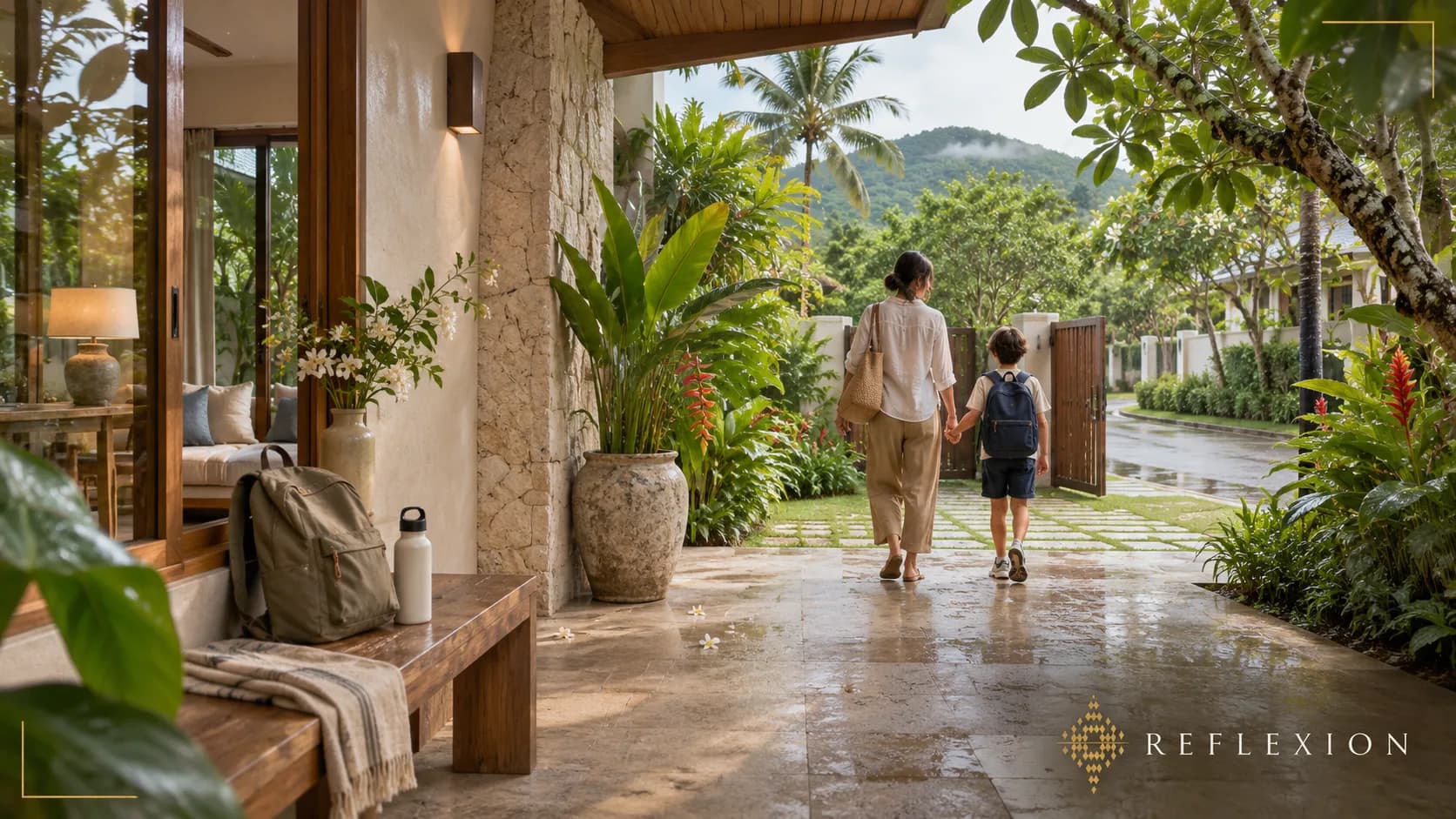
In Phuket, the 2026 start of the school year was spread over ten days. UWC Thailand opened its doors on 17 August, in Thalang, in the north of the island; Kajonkiet International School on 20 August in Kathu; HeadStart on 21 August on both its campuses; the British International School of Phuket (BISP), in Koh Kaew, and BCIS, in Chalong, on 24 August; Finnway on 26 August in Koh Kaew. As many calendars, curricula and campuses as there are ways of organising family life on the island.
For a family settling in, the right question is therefore not "which is the best school in Phuket?" but "which curriculum, which campus and which routine suit our children?". The school comes first, based on the children's ages and continuity of schooling; the home comes next, around the chosen campus. Our map guide to Phuket's international schools places each campus and the homes on offer around it; this article provides the reading grid, the published fees for 2026-2027 and what each area offers families.
How to read the international school offer in Phuket?
By separating four notions that brochures readily mix up.
School accreditation is granted by an independent body after inspection: the Council of International Schools (CIS), the American ACS WASC or the Middle States Association (MSA). It covers the whole school and is renewed. In Phuket, CIS confirmed BISP's reaccreditation on 31 January 2025 and UWC Thailand's on 19 December 2025. The ACS WASC public directory lists Kajonkiet International School (KIS) as "Accredited"; the school states validity until June 2032.
Programme authorisation concerns a specific curriculum. The International Baccalaureate (IB) authorises a school to teach its Primary Years Programme (PYP), its Middle Years Programme (MYP) or its Diploma (DP): BISP has been authorised for the Diploma since 1999, UWC for all three programmes, and HEI Phuket for the PYP since 17 June 2026. French accreditation (homologation) falls under the French Ministry of Education: the decree of 19 June 2026 accredits BCIS's French stream, from petite section to terminale générale, for the 2026-2027 school year. The Government of Alberta, for its part, lists Lighthouse at Rawai among its accredited international schools.
Membership of an association, such as ISAT (International Schools Association of Thailand), signals belonging to a network of international schools in Thailand. It is not equivalent to an accreditation inspection.
The class actually open matters as much as everything else. Several schools are growing year by year: Finnway opened its first secondary class in August 2026, Glenalmond announces its secondary school for August 2027, HEI announces the MYP for 2027. A fee schedule that mentions a class does not prove it already exists; that is the first question to ask admissions, along with whether a place is available.
Which schools for which pathway?
The island's five main curriculum families are read first by the child's age and the target diploma.
| School | Area | Curriculum | Documented ages or levels | Documented recognition |
|---|---|---|---|---|
| British International School Phuket (BISP) | Koh Kaew | English curriculum, IGCSE, IB Diploma, BTEC | 2 to 18 years, day and boarding | CIS (reaccreditation 2025), IB DP |
| UWC Thailand | Thepkrasattri, Thalang | IB continuum (PYP, MYP, DP) | from age 2 to Grade 12, boarding offered | CIS (reaccreditation 2025), IB |
| HeadStart, Chaofah City campus | Vichit | English curriculum, IGCSE, A Level, BTEC | up to Sixth Form | ISQM Gold stated by the school |
| HeadStart, Cherngtalay campus | Cherng Talay, Thalang | English curriculum | Foundation, primary, secondary documented at least up to Year 9 | ISQM Gold stated by the school |
| Kajonkiet International School (KIS) | Kathu | English curriculum, IGCSE, A Level | Pre-Nursery to Year 13 | ACS WASC |
| BCIS | Chalong | Separate Cambridge and French streams | 2 to 18 years | French accreditation 2026-2027 |
| QSI International School of Phuket | Kathu | North American, Advanced Placement | from age 2 or 3 depending on the class | MSA notification 2022; current status not corroborated in this check |
| Oak Meadow International School | Wichit | American | Kindergarten to Grade 12 | CIS member according to the school |
The British schools follow the English National Curriculum up to IGCSE, at around 16, then prepare for A Levels or, at BISP, the IB Diploma. UWC's IB continuum takes the child from kindergarten to the Diploma within a single pedagogy. BCIS offers something rare: two streams under one roof, Cambridge on one side and accredited French programmes on the other, up to the baccalauréat. For younger children, the island also has primary schools with their own pedagogy, such as Finnway (Finnish curriculum, Koh Kaew), HEI (Thalang), Montessori House (Chalong) or Glenalmond (Thalang).
A child who will sit the baccalauréat in France is better off staying in the accredited French stream; a teenager aiming for a British or international university can aim for the IB or A Levels. The choice is made on the exit diploma, then on continuity: better a school where the child can go all the way than two changes of school in five years.
How much does an international school in Phuket cost?
Schools publish their annual tuition fees for 2026-2027. In the examples in our table, they range from THB 281,800 to THB 982,700 depending on the school and the level; other schools on the island publish different amounts.
| School | Primary (example level) | End of secondary |
|---|---|---|
| BISP | THB 750,000 in Years 1 to 3 (€19,544) | THB 982,700 in Year 12 (€25,608) |
| UWC Thailand | THB 753,500 in Grades 1 to 5 (€19,636) | THB 933,000 in Grades 11 and 12 (€24,313) |
| Glenalmond | THB 750,000 in primary (€19,544) | secondary announced for 2027 |
| HeadStart | THB 480,000 in Years 1 to 6 (€12,508) | THB 540,000 from Year 7 to Year 13 (€14,072) |
| HEI | THB 423,000 in Grades 1 and 2 (€11,023) | schedule published up to Grade 6 |
| BCIS | THB 403,500 from CE1 to CM2 (€10,515) | THB 502,500 in première and terminale (€13,095) |
| KIS | THB 345,000 in Years 1 and 2 (€8,990) | THB 454,000 in Years 12 and 13 (€11,831) |
| Finnway | THB 362,000 in Grades 2 and 3 (€9,433) | secondary open up to Grade 7 |
| Oak Meadow | THB 317,520 in Grades 1 to 5 (€8,274) | THB 408,240 in Grades 9 to 12 (€10,638) |
| Montessori House | THB 281,800 in Lower Elementary (€7,344) | primary only |
These amounts are the published annual tuition. The first year adds others, which each school details separately: non-refundable contributions (application, entry or placement fee, development fund) and, depending on the schedule, deposits refundable under conditions (security deposit, endowment). At BISP, a family with one child pays a non-refundable THB 6,000 application fee and THB 200,000 for placement, and pays a THB 150,000 deposit returned under conditions. For a family with one child, UWC publishes THB 7,000 for the application, THB 100,000 for placement and THB 165,000 for the development fund, non-refundable, plus a THB 25,000 deposit refundable after deduction of any sums owed. HeadStart charges a THB 100,000 entry fee and a THB 75,000 endowment refundable under conditions; KIS, a non-refundable THB 60,000 entry fee and a THB 50,000 endowment refundable under conditions.
Depending on the case, there is also school transport (THB 99,900 per year at BISP, THB 72,600 at KIS for a round trip), English-language support for a non-English-speaking pupil, exams, uniforms and activities. Some schools include meals, others do not. For a reliable budget, the safest course is to ask admissions for a written quote for each child's exact class, first-year fees included. Boarding, offered at BISP and UWC, is priced separately: at BISP, from THB 396,400 to THB 509,300 per year depending on age and formula.
Where to live around the schools, area by area?
Once the school is chosen, the area takes shape. Our survey of 23 November 2026, the same one used for the map guide, covers 14 international school campuses documented one by one; 13 are located, Glenalmond is not yet. It counts the homes for sale within 1.5 km and 3 km of each. Within this perimeter, supply is markedly more family-oriented than across the island as a whole: within 1.5 km, 39.5% of homes for sale have three or more bedrooms, against 25.8% for Phuket as a whole. Within 3 km, houses account for 28.7% of homes for sale, against 25.4% on the island.
| Around the 13 located campuses, within 3 km | Median asking price per m² | Whole island |
|---|---|---|
| House | THB 68,437 (470 projects) | THB 71,000 (881 projects) |
| Condominium | THB 110,204 (170 projects) | THB 117,556 (404 projects) |
| Home with 3 or more bedrooms, median price | THB 20,750,000 (€540,731, 479 projects) | THB 22,298,462 (€581,083, 942 projects) |
In this dated survey, median asking prices are lower than those for the island for comparable property types. This descriptive comparison does not measure the effect of a school on the price of a home. These are asking prices in listings, not sale prices.
Koh Kaew, north of the town. This is the area of BISP and Finnway, on Thepkrasattri Road. Within 3 km of these two campuses, 91.5% of homes for sale are houses and 86.9% have at least three bedrooms; the median floor area is 260 m² and the median asking price THB 60,870 per m² (51 projects). A neighbourhood of family villas, north of the town, on the road to the airport.
Thalang and the north of the island. UWC Thailand, HEI and Glenalmond are based in Thalang, along the Thepkrasattri and Srisunthorn roads. Around UWC, supply is almost entirely houses: 99.7% of homes for sale within 3 km. HeadStart's Cherng Talay campus is also in Thalang district, on Srisoonthorn Road. Around the district's three located campuses, UWC, HEI and HeadStart Cherngtalay, the median floor area reaches 264 m² within 3 km, for a median asking price of THB 87,948 per m² (259 projects); the Glenalmond campus is not yet located in our survey.
Kathu, in the centre. KIS and QSI are in the Kathu valley, between the town and Patong. Supply here is primarily apartments: within 3 km of the two schools, only 11.2% of homes for sale are houses, the median floor area is 103 m² and the median asking price THB 70,500 per m² (69 projects). An option for a family that prefers a well-located condominium to a villa.
Phuket Town, Vichit and Chalong, in the south-east. The area with the highest density of schools: HeadStart Chaofah City, Oak Meadow, BCIS, Ruamrudee Phuket and Montessori House, five located campuses. Within 3 km of these campuses, 38.2% of homes for sale have at least three bedrooms, with a median floor area of 160 m² and a median asking price of THB 60,398 per m² (166 projects). Further south, in Rawai, Lighthouse offers an Alberta curriculum; within 3 km of the campus, the median asking price is THB 84,566 per m² (146 projects). In this southern part of the island, a family can thus find, a few kilometres from one another, an accredited French stream, a British pathway, an American programme, a Canadian programme and a Montessori pedagogy. It is the area where the choice of school remains most open if the children do not yet have a set curriculum, and the one where it is most useful to compare campuses before comparing houses.
To place a specific property in relation to these campuses and the island's other services, our guide to Phuket's neighbourhoods and our article on where to live in Phuket complete the picture.
How to plan the daily school run?
By testing it, rather than deducing it from a map. The 1.5 km and 3 km radii in our guide are straight-line distances: they tell you what lies around a school, not how long it takes to get there at 7:30 a.m. Depending on the road, the terrain and traffic at school start times, two houses at the same distance can involve very different journeys.
School transport can simplify the routine. HeadStart offers a bus service for both its campuses, with an escort and GPS tracking according to the school. At UWC, the advertised bus serves certain areas of the west coast, depending on demand. Before signing a lease or a preliminary sale agreement, get confirmation that the exact address is served, and at what time.
The season matters too. The south-west monsoon generally sets in from mid-May to mid-October, with heavier rain on the coasts and high ground, according to the Thai government portal; our article on the seasons in Phuket and Koh Samui details this calendar month by month. Trying the journey on a rainy morning, if the timing of your visit allows, tells you more than a route calculated in fine weather.
The case of Élodie and Karim's family, children aged 7 and 13
Hypothetical family. Élodie, 41, and Karim, 44, are leaving Lyon for Phuket in summer 2027. Karim works remotely for a European group. Their 13-year-old son will enter quatrième (French lower-secondary level), taught in English for the first time; their 7-year-old daughter will enter CE1. They want a single school for both, and a curriculum that keeps European universities open.
They first rule out schools where their son's class is not yet open, then compare three options. BCIS, in Chalong, would keep their daughter in the accredited French stream, and their son could follow the Cambridge pathway or stay in French. BISP, in Koh Kaew, and UWC, in Thalang, would lead the son towards the IB Diploma, with English-language support to be costed. They note the published 2026-2027 fees for each level, ask for a written first-year quote, and put the same question to each admissions office: is there a place, for both children, for the August intake?
What they decide: choose the school before the house; rent for a year in the area of the chosen school before buying; visit in September, in the middle of the monsoon, and do the morning journey from both shortlisted neighbourhoods; check that their street is served by the school bus.
Modelled scenario. This profile is not a client; the parameters are working assumptions.
What our database lets you place on the map
Reflexion tracks property projects for sale in Phuket, with their type, floor areas, bedrooms, asking prices and the advertised ownership regime. Our map guide to Phuket's international schools overlays this data on the campuses: school by school, it shows the share of family homes, the share of houses and the asking price per m² within a 1.5 and 3 km radius. For a condominium, the foreign-quota regime is read unit by unit in the listings; it shows what the seller is offering, not that quota remains in the building. For a house, the question of land ownership arises differently, as explained in our article on freehold, leasehold and company ownership.
What you can do now
Note each child's age at the intended start date and the diploma they will prepare for. Shortlist the two or three schools where their class already exists, ask them for a written first-year quote and place availability, then open the map guide to see the homes on offer around each campus. In Bangkok, our article on international schools and their neighbourhoods follows the same approach.
Frequently asked questions
Should you choose the school or the home first in Phuket?
The school, in almost every case. The curriculum, an available place in the right class and the target diploma cannot be made up for later, whereas an address can then be chosen around the campus. Renting first in the area of the chosen school lets you test the journey and the neighbourhood before buying.
What is the difference between accreditation and ISAT membership?
Accreditation is granted by an independent body, such as CIS, ACS WASC or MSA, after an evaluation of the whole school. ISAT is an association of international schools in Thailand: membership signals belonging to a network, not an accreditation inspection. In Phuket, BISP and UWC hold a dated CIS reaccreditation, and KIS is listed as accredited in the ACS WASC directory.
Is there an accredited French school in Phuket?
Yes. The decree of 19 June 2026 accredits (homologue) BCIS's French stream, in Chalong, from petite section to terminale générale, for the 2026-2027 school year. The accreditation covers the French stream only; the same school's Cambridge pathway follows its own framework. Published fees range from THB 302,000 to THB 502,500 per year depending on the level.
Which Phuket schools offer the International Baccalaureate?
BISP prepares students for the IB Diploma, authorised since 1999, after the IGCSE. UWC Thailand is authorised for all three IB programmes, from primary (PYP) to the Diploma (DP). HEI Phuket has been authorised for the PYP since June 2026 and announces the MYP for 2027. The other British schools mostly prepare for A Levels.
How much does an international school in Phuket cost per year?
In the examples in our table, published annual tuition for 2026-2027 ranges from THB 281,800 in Lower Elementary at Montessori House to THB 982,700 in Year 12 at BISP; this is not a minimum for the whole island. The first year adds non-refundable contributions and sometimes a recoverable deposit: at KIS, a non-refundable THB 60,000 entry fee and a THB 50,000 endowment refundable under conditions. A written quote for the exact class remains the only reliable basis.
Do HeadStart's two campuses offer the same classes?
The documented levels differ by campus. The Chaofah City campus, in Vichit, takes students up to Sixth Form. In Cherngtalay, in Thalang district, Foundation, primary and secondary classes at least up to Year 9 are documented for 2026-2027; whether the class you need will be open is to be confirmed. For a lower- or upper-secondary student, ask which campus will take their class in the intended intake year.
What is the difference between BISP and UWC Thailand?
Both are reaccredited by CIS and offer boarding. BISP, in Koh Kaew, follows the English curriculum up to IGCSE, then prepares for the IB Diploma or BTECs. UWC Thailand, in Thalang, follows the IB continuum from kindergarten to the Diploma. Their published primary fees are similar, around THB 750,000 per year.
Where to live near Phuket's international schools?
It depends on the campus. Around BISP, in Koh Kaew, and UWC, in Thalang, supply consists mainly of family houses. Around KIS and QSI, in Kathu, it is mostly apartments. The south-east, between Vichit and Chalong, has the most schools. Our map guide shows the homes on offer within 1.5 and 3 km of each campus.
Are homes more expensive around the schools?
Not according to our survey of 23 November 2026. Within 3 km of the 13 located campuses, the median asking price for a house is THB 68,437 per m², against THB 71,000 for the whole island, and THB 110,204 for a condominium against THB 117,556. This descriptive comparison does not measure the effect of a school on the price of a home.
How long does the school run take?
It has to be measured from the address you are considering. The guide's 1.5 and 3 km radii are straight-line distances, not journey times. Try the trip at school start times and, if possible, on a rainy day during the monsoon, generally between mid-May and mid-October.
Can a child who does not speak English get into an international school?
Often yes, with English-language support charged separately at several schools. KIS publishes a compulsory English programme where needed, from THB 46,000 to THB 62,000 per year depending on the level; HeadStart, THB 60,000; BISP, an intensive programme in Years 7 and 8. Admission assesses the child's level.
Do all Phuket schools follow the same calendar?
No. For 2026-2027, the start of the school year is staggered from 17 August at UWC to 26 August at Finnway, and the end of the year from 18 June 2027 at UWC to 30 June 2027 at HeadStart. The October, December and April holidays also differ. For siblings split between two schools, it is best to compare calendars before booking flights.
Method and sources
47 sources · checked November 21, 2026
Sources checked November 21, 2026
Exchange rate used: 1 EUR = 38.374 THB (1 October 2026)
- School sources checked on 21 November 2026; property data extract of 23 November 2026. Euro amounts converted using the indicative conversion convention adopted by Reflexion, 1 EUR = 38.374 THB (1 October 2026), calculated on the exact value then rounded; this is not an official exchange rate of the day.
- What this article is based on:
- British International School Phuket, School Fees 2026-2027 (PDF, October 2026).
- British International School Phuket, 2026-2027 calendar (PDF of 18 May 2026).
- British International School Phuket, School Profile.
- International Baccalaureate, school profile 001128 (BISP).
- Council of International Schools, BISP reaccreditation announcement, 31 January 2025.
- UWC Thailand, School Fees 2026/2027 (PDF).
- UWC Thailand, 2026/2027 calendar (PDF).
- UWC Thailand, Admissions page (How to Apply).
- UWC Thailand, Boarding Options page.
- UWC Thailand, School Bus page.
- International Baccalaureate, school profile 006309 (UWC Thailand).
- Council of International Schools, UWC Thailand reaccreditation announcement, 19 December 2025.
- HeadStart International School, Tuition Fees 2026-2027.
- HeadStart International School, 2026-2027 calendar (PDF).
- HeadStart International School, Contact Us page.
- HeadStart International School, Sixth Form page.
- HeadStart International School, Transportation page.
- HeadStart International School, Accreditations page.
- HeadStart Cherngtalay, Weekly Update 8, October 2026.
- BCIS, Tuition Fees 2026-2027.
- BCIS, 2026-2027 calendar.
- BCIS, Learning Journey page.
- BCIS, FAQ.
- French Ministry of Education (Ministère de l'Éducation nationale), page listing accredited French schools abroad (établissements d'enseignement français à l'étranger homologués).
- Arrêté du 19 juin 2026 fixant la liste des établissements d'enseignement français à l'étranger homologués, Journal officiel of 30 June 2026 (Légifrance).
- Kajonkiet International School Phuket, School Fees 2026-2027 (PDF).
- Kajonkiet International School Phuket, school calendar.
- Kajonkiet International School Phuket, Accreditation page.
- ACS WASC, public directory of accredited schools (search: Kajonkiet International School, Phuket).
- QSI International School of Phuket, Admissions page.
- QSI International School of Phuket, Accreditation page.
- Middle States Association, QSI accreditation notification, 15 April 2022 (PDF).
- Oak Meadow International School, School Fees 2026-27.
- Lighthouse at Phuket International School, Tuition Fees.
- Government of Alberta, list of accredited international schools.
- Finnway International School Phuket, Admissions page.
- Finnway International School Phuket, Academics page.
- Finnway International School Phuket, 2026/2027 calendar.
- HEI Schools Phuket, School Fees 2026-2027 (PDF).
- HEI Schools Phuket, 2026-2027 calendar (image).
- International Baccalaureate, PYP authorisation of HEI Phuket, 17 June 2026.
- Glenalmond College Phuket, Schedule of Fees 2026-2027.
- Montessori House Phuket International School, School Fees 2026-2027 (PDF).
- Thailand.go.th, "Monsoon winds and the climate of Thailand", based on the Thai Meteorological Department, updated in 2023.
- Reflexion data extract of 23 November 2026 (internal, non-public survey): projects and units for sale within 1.5 km and 3 km of 13 international school campuses located out of 14 documented, asking prices, median per project then median of projects, no median below 20 projects and no share below 20 units with data.
This article is general information, not legal or tax advice. The rules cited are dated: check with a qualified professional that they are still in force before acting.