Phuket or Koh Samui: the calendar of seasons and rains
In November, Koh Samui gets 444.6 mm of rain and Phuket 219 mm. Two offset monsoons: when to come, which coast to pick, how to let the house while you are away.
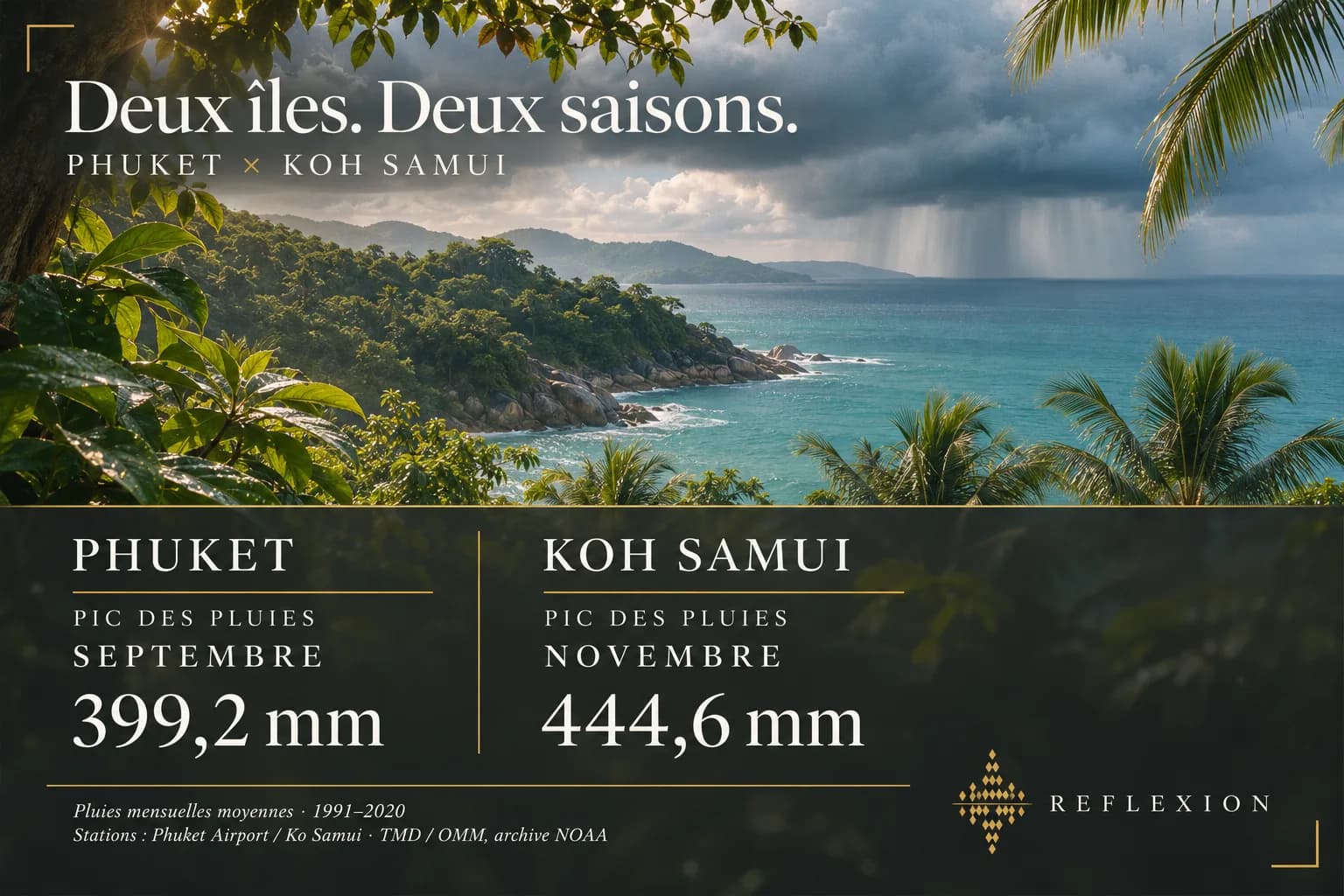
In the last days of December 2025, the north-east monsoon is blowing across both seas of the Thai peninsula. On the Andaman coast, home to the bays of Kata, Karon and Kamala, showers remain isolated. On the other side of the isthmus, on the Gulf of Thailand coast where Koh Samui faces Koh Phangan, rain falls in scattered to fairly widespread spells, according to the monthly summary of the Thai Meteorological Department. Same official season, same wind, two skies.
Over the month, the rain gauge at Phuket airport collected 32.3 mm; Koh Samui’s, 229.4 mm, seven times as much. Five months later, in May 2026, the ratio is reversed: 670.5 mm in Phuket, 112.5 mm on Samui. The two islands do not live through the same monsoon, and for anyone dividing the year between the UK and Thailand, this offset shapes everything else: the months you come, the coast you settle on, the months you leave the house in someone else’s care. Our map guide ‘Phuket or Koh Samui’ compares the two islands by their prices and their beaches; this article compares them by their sky, using the official 1991-2020 normals of their weather stations.
Why don’t Phuket and Koh Samui share the same rainy season?
Because they do not face the same sea. Phuket juts out into the Andaman Sea, on the west coast of the peninsula. Koh Samui sits in the Gulf of Thailand, off Surat Thani province, on the east coast. Between them, the strip of land that separates the two seas is enough to shift the seasons by several months.
The official calendar, that of the Thai Meteorological Department (TMD), has three seasons: summer from mid-February to mid-May, the rainy season from mid-May to mid-October, and winter from mid-October to mid-February. The rainy season is that of the south-west monsoon, which pushes warm, humid air from the Indian Ocean over the country; the sky clouds over, especially on the coasts and high ground. In 2026, the TMD dated its onset to 15 May. Winter is the season of the north-east monsoon, which brings cooler, drier air, felt first in the North and the North-East.
For the South, this national division is not enough. The Land Development Department (LDD) sums it up in two sentences: the west coast of the South receives heavy rain, peaking in September; on the east coast, most of the rain peaks in November and continues into January. The official government portal, citing the TMD, explains the mechanism: crossing the gulf, the north-east monsoon picks up moisture and deposits it on the South, especially its south-eastern part, sometimes until December.
In other words, when the rainy season officially ends in mid-October, Samui’s begins in earnest. Phuket’s rains keep time with the British summer, Samui’s with the autumn.
What do the two stations’ normals say, month by month?
They speak the same language, which is rare. Both series come from the TMD, cover the same thirty years, from 1991 to 2020, and follow the same method: these are the normals the department submitted to the World Meteorological Organization, and those it uses in its monthly summaries to measure departures from normal. The Phuket station is the one at the international airport, in the north-west of the island, near Mai Khao; the Samui station bears the island’s name.
1991-2020 normals for the TMD stations at Phuket airport and Koh Samui, rainfall and rainy days:
| Month | Phuket, mm | Phuket, days | Samui, mm | Samui, days |
|---|---|---|---|---|
| January | 66.2 | 5.1 | 126.8 | 8.5 |
| February | 32.0 | 3.1 | 64.3 | 4.3 |
| March | 117.2 | 6.5 | 115.8 | 4.7 |
| April | 143.7 | 10.4 | 82.9 | 6.1 |
| May | 277.5 | 16.6 | 131.6 | 11.0 |
| June | 314.0 | 16.0 | 133.6 | 10.3 |
| July | 260.4 | 16.2 | 117.0 | 10.7 |
| August | 378.2 | 17.4 | 102.2 | 10.5 |
| September | 399.2 | 19.2 | 117.5 | 10.6 |
| October | 370.5 | 19.9 | 294.9 | 15.8 |
| November | 219.0 | 14.2 | 444.6 | 16.5 |
| December | 86.4 | 7.7 | 263.1 | 11.6 |
| Year | 2,664.3 | 152.3 | 1,994.3 | 120.6 |
The table reads in two stages. From January to April, Phuket is the dry island: 32 mm in February, over 3.1 rainy days. From May, its curve rises and does not come down again until November; September and October approach twenty rainy days a month. Samui follows a flatter line, between 100 and 135 mm a month from May to September, before peaking in November at 444.6 mm, twice Phuket’s total for the same month.
One line is surprising: March on Samui, 115.8 mm for only 4.7 rainy days. A normal is a thirty-year average, which a few exceptional episodes are enough to push up; for anyone planning a stay, the number of days says more than the total about how often it rains.
Heat, on the other hand, hardly separates the two islands. At Phuket airport, the mean monthly temperature ranges from 27.1°C in December to 28.9°C in April; on Samui, from 26.8°C in December to 29.2°C in May.
When should you come if you live there six months a year?
The answer depends less on the island than on the six months chosen. We added up the TMD normals over every window of six consecutive months; four of them correspond to the most common ways of dividing the year.
Six months on the island by chosen window, cumulative 1991-2020 normals:
| Window | Phuket, mm | Phuket, days | Samui, mm | Samui, days |
|---|---|---|---|---|
| November to April | 664.5 | 47.0 | 1,097.5 | 51.7 |
| December to May | 723.0 | 49.4 | 784.5 | 46.2 |
| January to June | 950.6 | 57.7 | 655.0 | 44.9 |
| May to October | 1,999.8 | 105.3 | 896.8 | 68.9 |
The northern winter, from November to April, belongs to Phuket. It is the island’s driest window, with 664.5 mm over six months; Samui receives 1,097.5 mm, because November and December alone account for 707.7 mm there.
Leaving after Christmas changes the answer. From January to June, Samui has only 44.9 days with at least 1 mm of rain, the lowest of any of its rolling six-month periods, while Phuket enters the monsoon in May. In between, the December-to-May window puts the two islands almost level.
The northern summer, from May to October, goes to Samui. It receives 896.8 mm there; Phuket, more than double. This is the only window where the gap is beyond dispute.
A normal is not a forecast. The official portal makes the point: the start of the rainy season can come one to two weeks earlier or later depending on the year. And a year can depart sharply from the average: by the end of 2025, Phuket airport had accumulated 3,010.4 mm, 346.1 mm above its normal, according to the TMD. The sky’s calendar is only one of the parameters of a life split between two countries; the others are gathered in our article on dividing your life between home and Thailand.
Which coast should you choose on each island?
In Phuket, the west coast takes the monsoon head-on. The sunset beaches, from Mai Khao to Kata, open onto the Andaman Sea, from which the south-west monsoon arrives. The TMD’s summaries give the measure of it: in early July 2026, a fairly active monsoon brought widespread rain, particularly on the west coast of the South, and flooding was reported in Phuket on 1 July, then on 24 and 25 July. In August 2025, the same summary recorded landslides on the island on 25 and 31 August.
In town, a lower annual normal than at the airport. The TMD runs a second station in Phuket Town, on the east coast. Its 1991-2020 normals give 2,271.5 mm a year, 15% less than at the airport, and September remains the wettest month there, at 350.4 mm. The east coast, from the Ao Po marina in the north to Cape Panwa in the south, looks out over Phang Nga Bay and its limestone islands rather than the open sea. This single comparison does not measure how sheltered each bay is: the town station describes only itself. The neighbourhoods of this coast, its marinas and its schools are presented in our article on Phuket’s neighbourhoods.
On Samui, Maenam and Bophut show two faces of the north coast. The island has only one TMD station, and descriptions bay by bay come from editorial guides. Frommer’s describes Maenam as often sheltered during the stormy months, and Bophut as fairly calm, with a beach that narrows during the monsoon. These descriptions say nothing about conditions on the day: a red flag means no swimming, as the Tourism Authority of Thailand reminds visitors. In the north-east, according to Frommer’s, the Choeng Mon headland takes wind, waves and currents from mid-October to mid-December, while from May to October the sea there can be very low.
Off Samui, the sea has its season too. According to the lists of seasonal closures published by the tourism authority and the Department of National Parks in 2018 and 2019, Ang Thong Marine National Park, west of the island, closed from 1 November to 15 December, to let its ecosystems rest and because of sea conditions. This year’s dates should be confirmed with the park before booking a trip.
On the east coast of the gulf, end-of-year episodes can be intense. According to the TMD, from 12 to 15 December 2024, a depression caused heavy rain and flooding in several provinces, including Surat Thani, to which Samui belongs; in November 2025, flooding was again reported there, even though the Samui station ended the month below its normal.
What the season changes for a house
Humidity follows the rain. At Phuket airport, mean relative humidity rises to 85.0% in October and falls to 73.9% in February; on Samui, it peaks at 85.5% in November and reaches its low point in August, at 78.0%, according to the same normals. A house left closed during its island’s humid season therefore goes through its most difficult months with no one there. Maintenance is scheduled out of season: roof, gutters, drains and air conditioning are checked before May in Phuket and before October on Samui, and a caretaker who opens and airs the house during those months is worth more than an inspection on your return.
The dry season has its downside too. On Samui, the least rainy months are those in the middle of the year, and that is when water can run short: in July 2026, after a long dry spell, water was distributed by zone and by time slot, according to Thairath. A cistern and a borehole are part of viewing a villa, as we set out in our article on buying a villa on Koh Samui.
Rental demand follows a calendar that is not the sky’s. According to C9 Hotelworks (June 2025), Samui had 3,055 villas offered for rent in January 2025; their occupancy peaked in February, at 76.2%, and reached its low point in September, at 38.7%. Yet September is not the island’s wettest month: it receives 117.5 mm, less than January. The same firm recorded an average rate of THB 13,012 a night (£290) in the first quarter of 2025. These figures describe the Samui market; they do not transfer to Phuket. For the absent owner, the practical question is simple: do your months away fall in the months tenants are looking for? Nightly letting is, moreover, governed by the Hotel Act, which has its own licensing regime.
The case of Helen and Richard, winegrowers in Sussex
Helen, 52, and Richard, 55, run a vineyard in East Sussex. The autumn harvest, the winemaking and the Christmas season keep them in England from July to December. They want to spend the rest of the year in Thailand, from January to June, and are torn between a villa in Phuket, near Kamala, and a villa on Samui.
They lay the TMD normals over their six months. From January to June, Phuket airport receives 950.6 mm over 57.7 rainy days, with the onset of the monsoon in May and June; Samui, 655.0 mm over 44.9 days with at least 1 mm of rain, the fewest of any of its rolling six-month periods. Their absence, from July to December, on the other hand covers Samui’s wettest months, October to December, and its highest humidity, in November. They also note that occupancy of the island’s villas, according to C9 Hotelworks, peaks in February, when they are there, and reaches its low point in September, when they are gone.
What they decide: to look on Samui, on the north coast, between Maenam and Bophut; to come and see the two shortlisted villas in the November rain before signing; to arrange a caretaker from October to December; and not to build their budget on letting the villa while they are away.
Modelled scenario. This profile is not a client; the parameters are working assumptions.
What our database lets you place on the map
The sky does not tell you everything about an island. Our survey of 5 October 2026 counts 72 condominium developments within 300 m of a beach in Phuket, against 2 on Samui, where supply is primarily made up of villas. The two calendars thus intersect with two markets. To place a villa in relation to its coast, its exposure and the island’s services, put it on the map.
What you can do now
Note your six months of presence, then read them off the second table: the total rainfall and the number of rainy days for your window, on each island. Then visit your island at the height of its wet season, in September in Phuket, in November on Samui, and ask the caretaker or the manager what becomes of the house and the beach in those months.
Frequently asked questions
When is the best time to go to Phuket?
From December to March, with February the driest month: 32 mm of rain and barely more than three rainy days on average at the airport, according to the TMD’s 1991-2020 normals. For a long stay, the November-to-April window remains the most favourable on the island. The wet season runs from May to October, peaking in September and October.
When is the monsoon on Koh Samui?
Mainly from October to December. The north-east monsoon, which sets in around mid-October, picks up moisture over the Gulf of Thailand and releases it on the east coast of the South. The peak comes in November, with 444.6 mm and 16.5 rainy days on average at the island’s station; from May to September, Samui is relatively spared.
What is the weather like in Phuket in November?
Transitional: drier than October, without yet being the fine season. The airport records an average of 219 mm spread over just over fourteen days, against nearly twenty the month before. The average temperature stays close to 27°C. December marks the real turning point, with less than 90 mm.
Phuket or Koh Samui: which island is drier?
Samui, over the year as a whole: just under 2,000 mm and around 121 days of rain, while Phuket airport exceeds 2,660 mm over some 152 days, according to the TMD’s normals. But the advantage depends on the months: from November to April, it is Phuket that receives less water.
Can you live on Koh Samui all year round?
Yes, provided the house is organised around two opposite seasons. The end of the year brings the rain and the humidity, up to 85.5% in November; the middle of the year is drier, to the point that water was rationed by zone in July 2026, according to Thairath. For both calendars, the checks are the same: the water supply, the water reserve and pre-season maintenance.
Method and sources
25 sources · checked November 8, 2026
Sources checked November 8, 2026
Exchange rate used: 1 GBP = 44.54 THB (ECB euro reference rates, cross rate, 1 October 2026)
- Sources checked on 8 November 2026, amounts converted at 1 GBP = 44.54 THB (1 October 2026); conversions are indicative, calculated on the exact value and then rounded.
- What this article draws on:
- Thai Meteorological Department (TMD), station 48565 Phuket Airport, 1991-2020 climatological normals: rainfall, rainy days (1 mm or more), temperatures, humidity, submitted to the WMO and archived by NOAA (NCEI, accession 0253808).
- TMD, station 48550 Ko Samui, 1991-2020 climatological normals (rainy days of 1 mm or more), NOAA archive (NCEI, accession 0253808).
- TMD, station 48564 Phuket (town), 1991-2020 climatological normals, NOAA archive (NCEI, accession 0253808).
- TMD, monthly summary for October 2025 (Monthly Weather Summary in Thailand).
- TMD, monthly summary for November 2025 (Monthly Weather Summary in Thailand).
- TMD, monthly summary for December 2025 (Monthly Weather Summary in Thailand).
- TMD, monthly summary for May 2026 (Monthly Weather Summary in Thailand).
- TMD, monthly summary for July 2026 (Monthly Weather Summary in Thailand), provisional data.
- TMD, monthly summary for August 2025 (Monthly Weather Summary in Thailand): landslides in Phuket.
- TMD, climate summary for 2024 (in Thai): the episode of 12 to 15 December 2024.
- TMD, monthly forecast for Surat Thani province for November 2026, Southern East Coast Meteorological Center, 20 October 2026.
- Thailand.go.th, ‘The Seasons of Thailand’, official government portal, based on the TMD, updated in 2023.
- Thailand.go.th, ‘Monsoon winds and the climate of Thailand’, official government portal, based on the TMD, updated in 2023.
- Land Development Department (LDD), ‘Seasons’ page.
- Land Development Department (LDD), ‘Rainfall’ page.
- Land Development Department (LDD), ‘General Climatic Condition’ page.
- C9 Hotelworks, Samui Property Market Update, June 2025.
- Thairath, water shortage on Koh Samui, 29 July 2026.
- Frommer’s, Koh Samui beaches (Maenam, Bophut, Choeng Mon).
- Tourism Authority of Thailand (TAT), swimming guidance during the south-west monsoon, ‘Swimming’ section, 24 July 2018.
- TAT, list of seasonal national park closures, 2018.
- Department of National Parks (DNP), announcement of the closure of Ang Thong Marine National Park, 2019, reported by Panorama Destination.
- Reflexion survey of 5 October 2026, ‘Phuket or Koh Samui’ guide: condominium developments within 300 m of a beach.
This article is general information, not legal or tax advice. The rules cited are dated: check with a qualified professional that they are still in force before acting.