Condo fees in Thailand: the real cost of a property
In Bangkok, a condominium asks a median THB 45 per m² a month in common fees. What those fees buy, how the building is run, and what property tax adds.
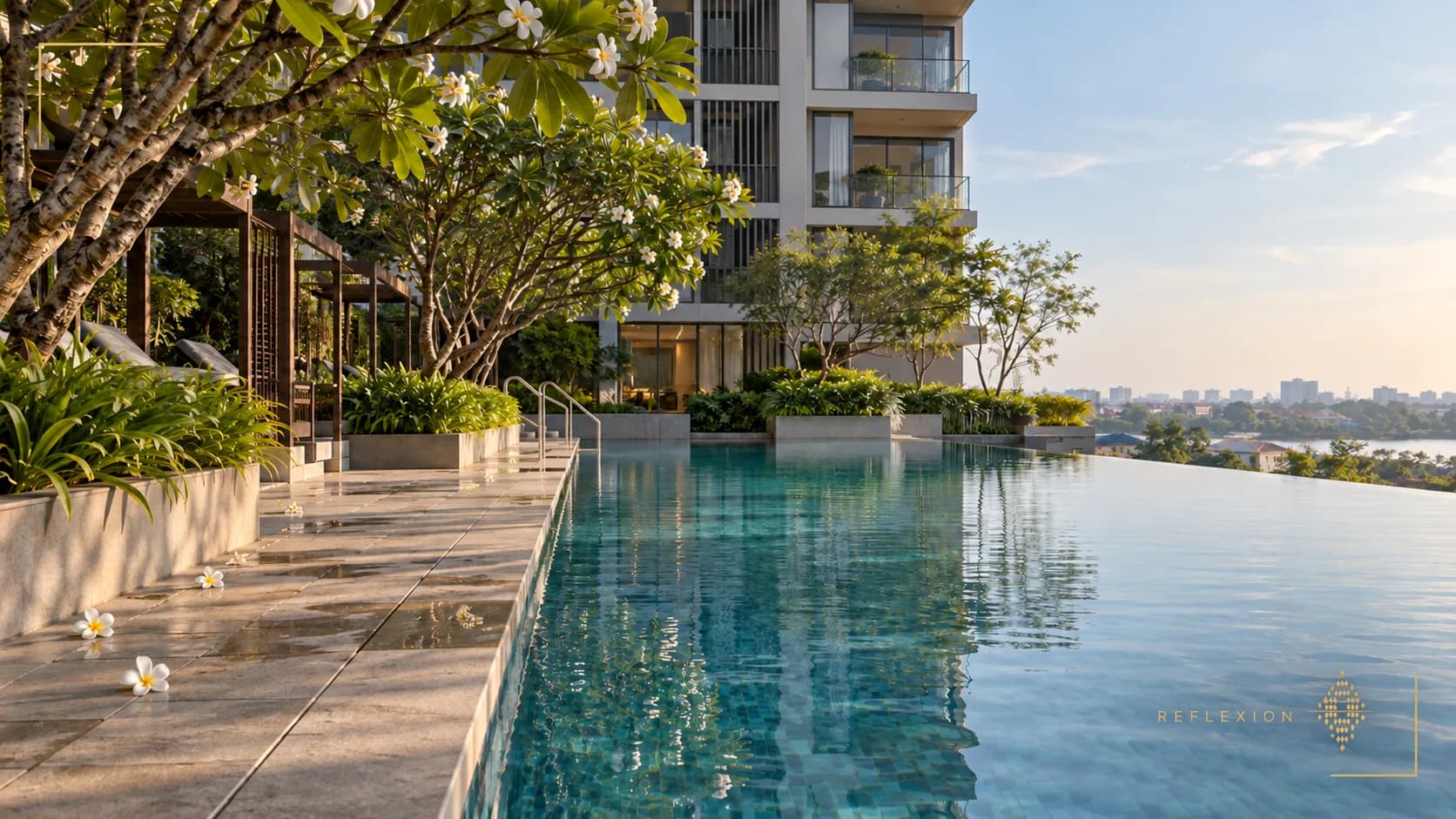
At seven in the morning, the night guard hands over to the day team, the pool water has been checked, and someone has already trimmed the frangipani in the garden. In a Thai residence, all of this sits on a single line: the common area fees. In Bangkok, a condominium asks a median THB 45 per square metre per month, according to our survey of 7 October 2026 covering 50,489 units for sale across six markets. Property tax, by contrast, remains a discreet line in the budget. Here is what you pay once you own, to whom, and who decides, as a companion to our map guide to the cost of ownership.
What do you pay each month in a Thai residence?
You pay for a level of service. The common area fees, as listings call them (the service charge, in British terms), cover security, cleaning, gardens, management staff, energy for the common areas and technical maintenance, according to the Bangkok Post. A high-end building, a JLL director explained in 2018, offers more services and requires better-trained staff. Before it is a cost, then, the fee line is a fairly faithful measure of what a residence promises.
The principle is set in law. Section 18 of the Condominium Act B.E. 2522, as worded by the 2008 amending Act, provides that co-owners jointly bear the costs of common services and of maintaining the common property, in proportion to their ownership ratio, or in the proportion that the building’s regulations set according to each unit’s interest. The owner of units still unsold, often the developer, contributes for those units. In practice, the ownership ratio follows floor area, which is why fees are expressed in baht per square metre per month.
They are usually called once a year, in advance. Pisit Chuprasit, president of the Thai association of condominium managers, described in Krungthep Turakij in 2019 an annual call running from the day of transfer, with the developer paying until then. The law provides for it: section 40 has co-owners pay the juristic person’s expenses in advance, and the building’s regulations state the amount (section 32). According to ThaiLawOnline, the unit’s electricity, water and internet, billed directly, fall outside the fees, as does property tax.
How much are condo fees, from Chiang Mai to Phuket?
Our survey of 7 October 2026, covering 3,526 developments, gives a simple scale. Phuket is at the top, at THB 60 per square metre per month. In Pattaya, the median reaches THB 40 in each of the four price quartiles of our survey; individual buildings’ rates vary around it.
Median condominium fees by market, survey of 7 October 2026:
| Market | Median fees (THB/m²/month) | Monthly bill for a typical apartment (THB) |
|---|---|---|
| Phuket | 60 | 2,870 |
| Hua Hin | 47 | not published |
| Bangkok | 45 | 1,840 |
| Pattaya | 40 | 1,770 |
| Chiang Mai | 40 | 1,520 |
In Bangkok, half of all developments fall between THB 35 and 56. Location matters: of the 22 districts measured, Pathum Wan, between Siam and Lumphini Park, comes first at THB 60, Wang Thong Lang comes last at 32, and the median for the centre stands at 55. The neighbourhoods that charge most are also those where serviced residences cluster, as we described for Bangkok’s prime neighbourhoods.
Age matters just as much. In condominiums completed since 2020, median fees reach THB 55; in those completed before 2000, THB 31, or 1.8 times lower. Developments still sold off-plan announce THB 63, counted separately. Villas follow their own logic: in Phuket, a villa on an estate asks a median THB 9,820 a month, for 354 m² of living space; on Koh Samui, a house or villa, THB 5,850.
Who runs the building, and how are decisions made?
Every registered building has its condominium juristic person, the นิติบุคคลอาคารชุด. Its purpose, under section 33, is to manage and maintain the common property. It acts through a manager, an individual or a specialist company (section 35), under the oversight of a committee of three to nine members appointed by the general meeting (section 37). Among the manager’s seven duties (section 36): security, collecting fees and a monthly statement of income and expenditure, posted within fifteen days.
The general meeting is where an owner carries weight. The first is held within six months of the juristic person’s registration: it appoints the committee and approves the regulations and the manager (section 42). Thereafter, an ordinary meeting is held every year within 120 days of the end of the financial year; it reviews the audited financial statement and the annual report, and appoints the auditor (sections 38/1 and 42/1). Documents are sent out at least seven days beforehand and kept for ten years.
Votes are counted by ownership ratio, subject to the specific rules of the Act (section 45). The quorum is one quarter of the votes; failing that, a second meeting is held within fifteen days, with no quorum requirement (section 43). A simple majority of those present is enough for ordinary business. Some decisions require at least half the votes of all co-owners: amending the regulations on the use of the common property, changing how fees are apportioned, authorising works that affect the common property or the façade. If those present do not reach that number, a new meeting is called within fifteen days, and the threshold becomes at least one third of all votes (section 48). Appointing or removing the manager requires at least one quarter of the votes of all co-owners (section 49). Under a written proxy, a legally authorised representative may represent up to three units; committee members, the manager and certain persons connected to them are excluded (section 47). This is how an absent owner votes from Edinburgh or Bristol.
The sinking fund and insurance: what is settled once
Buying a new apartment adds a one-off contribution to the sinking fund. According to ThaiLawOnline, it is paid at the first transfer and set by the developer in the contract, generally at a few hundred baht per square metre, and it pays for major works: replacing lifts, refurbishing a façade. The general meeting can vote a top-up if the fund runs low. On the same day, the buyer often pays one or two years of fees in advance.
We found no provision creating this fund in the Condominium Act published by the Department of Lands: it arises from the regulations and the sale contract, with section 40 providing for initial capital and for sums voted by the general meeting. The same goes for building insurance: the Act does not deal with it in the text consulted, and ThaiLawOnline lists it among the items the fees pay for. Other regulations may, however, require insurance depending on the category of building: the policy and the obligations that apply are checked in the approved budget and with the manager.
Is Thailand’s property tax a heavy burden?
No, on the evidence of the texts and of our surveys. The Land and Building Tax Act B.E. 2562, published in the Royal Gazette on 12 March 2019 and applied since 1 January 2020, replaced the former local taxes. It is due each year to the local authority from whoever owns the property on 1 January. Its base is not the price paid but the official appraised value; for a condominium unit, the appraised value of the unit itself (section 35). The Act caps the residential rate at 0.3% (section 37) and leaves the effective rate to a royal decree.
That decree is B.E. 2564, published on 13 December 2021 and applied since the 2022 tax year. For a home that is not its owner’s main residence, whether a second home or a let property, it sets 0.02% up to THB 50 million (£1,122,600), 0.03% from 50 to 75 million, 0.05% from 75 to 100 million and 0.1% above that. The actual amount depends on the official appraisal, the use, any exemptions and the rate set by the local authority, within the legal limit (sections 35 and 37).
For a main residence, section 41 exempts an individual owner whose name appears in the house registration on 1 January: up to THB 50 million for land and building, up to THB 10 million (£224,500) for the building alone.
A condominium unit occupied as a main residence.
The official explanations of Bang Rak Noi Municipality and of Khlong Toei District, in Bangkok, apply an exemption of up to THB 50 million to a unit occupied as a main residence, with the owner entered in the house registration. Khlong Toei also covers the registration of a foreign national in the ท.ร. 13 (Tor Ror 13) house register. How this applies to a particular case and tax year is confirmed with the relevant local authority.
In the 2025 and 2026 texts we consulted, nothing alters this framework for housing: the 2025 measures, according to the Ministry of Finance (18 December 2024), concern water production plants, certain green spaces and railway land. For 2026, Krungsri presents the same residential scales, and the Ministry of Interior postponed the collection timetable in an announcement of 28 November 2025, according to Thansettakij. According to Krungsri, a new Treasury Department appraisal is expected for 2027.
‘In Thailand, property tax is heavy, and it changes every year.’
the 2019 Act, B.E. 2562, caps the residential rate at 0.3% of appraised value; Royal Decree B.E. 2564, applied since the 2022 tax year, sets 0.02% up to THB 50 million for a home that is not the owner’s main residence. On an apartment, the line that weighs in the annual budget is the fees.
What is paid on the day of signing?
A statement that can be prepared before the appointment at the Land Office. According to the Department of Lands manual updated on 3 November 2025, the transfer fee is 2% of the appraised value. On top of this comes stamp duty of 0.5%, replaced by specific business tax of 3.3% (3% plus 10% local tax) when the seller sells, save for exceptions, within five years of their own purchase. Finally, a seller who is an individual bears a withholding tax, calculated on the appraised value, the applicable deductions and the length of ownership, under the scale in force, from 5 to 35% according to the Revenue Department’s 2026 documentation. The contract may allocate the economic burden of certain costs; it does not change the statutory tax obligations or the withholding due at transfer.
On 30 June 2026, the government also approved an extension, until 30 June 2027, of the reduction of transfer and mortgage fees to 0.01%, subject to conditions, for individual buyers of Thai nationality and for properties whose price and appraised value do not exceed THB 7 million (£157,200); the criteria and whether they apply are checked with the Land Office. What the purchase changes in your home country, from income tax to declaring the property, falls under that country’s own tax rules, to be checked with a professional there.
What separates a well-run building from an average one?
Accounts that can be read. Section 38/1 requires an annual financial statement, audited and approved at a general meeting within 120 days. The last two statements, the approved budget and the sinking fund balance show whether the fees cover the actual upkeep, or whether a special levy is in the offing. Low fees can signal frugal management or deferred works; the minutes of the meetings tell the difference.
Fees paid by everyone. Section 18/1, added in 2008, allows the regulations to set a non-compounding late-payment surcharge of no more than 12% a year; once fees are six months in arrears, the ceiling rises to 20%, the regulations may suspend use of the common services, and the owner loses the right to vote at general meetings. Section 29 makes the registration of a sale conditional on a certificate of no outstanding fees, which the manager issues within fifteen days of the request and of full payment of the sums due: this is the document that protects the buyer from arrears left by the seller. According to Forvis Mazars, unpaid property tax also blocks the registration of a transfer.
A weight in proportion to the budget. In Bangkok, the lowest price quartile, below THB 3.5 million (£78,600), spends 0.61% of its price a year on fees; the top quartile, above THB 9.8 million (£220,000), 0.37%. The more modest the property, the more the fee line counts in the budget; it belongs there from the outset, just like the price. Price per square metre, for its part, is read from the address and the station, as in our analysis of Bangkok prices.
When we model the case of Gillian and Robert, between Lumphini and Sathorn
Gillian, 58, and Robert, 60, will now spend the winter in Bangkok, with the idea of staying longer once Robert has retired. Their budget is fixed at THB 30 million (£673,600). Two two-bedroom apartments catch their eye: one in a recent tower in Lumphini, above the park, with an infinity pool, concierge and gym; the other in a 1990s building in Sathorn, more spacious, with a mature garden and a simpler pool.
Our surveys place the two worlds. Pathum Wan district, which includes Lumphini, has the highest median fees of the 22 districts measured, at THB 60 per square metre per month, and towers completed since 2020 ask a median THB 55. Buildings completed before 2000 stand at 31. These medians describe developments, not these two buildings: they help to ask the right questions.
So they ask both buildings for the same documents: the last two audited financial statements, the approved budget, the sinking fund balance and the minutes of the general meetings. The recent tower shows a balanced budget and a fund still in its early years. The Sathorn building voted last year to replace its lifts, paid for from the fund, and its accounts are up to date.
What they decide: to make an offer on the Sathorn apartment, on condition of receiving the section 29 certificate of no outstanding fees before transfer, and to set aside part of their budget to renovate the kitchen and bathrooms.
Modelled scenario. This profile is not a client; the parameters are working assumptions.
How our database places a building among its neighbours
Our development records show, for each residence we track, its district, its year of completion where known and, when the listing declares them, its fees per square metre: enough to place a building among neighbours of the same age. To compare two addresses before any viewing, start by placing them on the map.
What you can do now
Before making an offer, ask the building’s manager for four documents: the regulations, the latest audited financial statement, the current year’s budget with the sinking fund balance, and the minutes of the last general meeting. Compare its fees per square metre with the medians for its district and its age. In an hour’s reading, you will know what the residence offers, and whether it has the means to go on offering it.
Frequently asked questions
How much are condo fees in Thailand?
Between THB 40 and 60 per square metre per month at the median, according to our survey of 7 October 2026: 40 in Pattaya and Chiang Mai, 45 in Bangkok, 47 in Hua Hin and 60 in Phuket. For a typical apartment in the capital, that comes to THB 1,840 a month. The exact figure for any building is set out in the budget its general meeting votes.
What is the sinking fund in a Thai condominium?
A reserve for major works, built up from a one-off payment made when a unit is first transferred. The developer sets the amount in the sale contract, most often a few hundred baht per square metre according to ThaiLawOnline. It pays for items such as new lifts or a façade, and the general meeting can vote to top it up.
What is the property tax rate on an apartment in Thailand?
Two in ten thousand, or 0.02%, for an apartment that is let or used as a second home, up to and including THB 50 million of appraised value: that is the scale set by Royal Decree B.E. 2564, in force since 2022. Above that, the rate rises in steps and can never exceed the legal ceiling of 0.3%. An owner who lives there as a main residence may, subject to conditions, qualify for the section 41 exemption.
What happens when an owner does not pay the condo fees?
The regulations can apply a non-compounding surcharge of up to 12% a year, rising to up to 20% once fees are six months in arrears, under section 18/1 of the Condominium Act. At that point, use of the common services can be suspended and the right to vote at general meetings is lost. Above all, the Land Office will not register the sale of a unit without a certificate showing that its fees are settled.
Who decides how much the condo fees are in a Thai building?
The co-owners, meeting in general meeting. The manager draws up the budget, the meeting approves it, and the apportionment key written into the regulations can only be changed by a majority calculated on all the votes in the building. Each owner votes according to their ownership ratio, and a legally authorised proxy can carry the votes of no more than three units, which makes it possible to take part from abroad.
Method and sources
Sources checked October 27, 2026
Exchange rate used: 1 GBP = 44.54 THB (ECB euro reference rates, cross rate, 1 October 2026)
- Sources checked on 27 October 2026, amounts converted at 1 GBP = 44.54 THB (1 October 2026); conversions are indicative, calculated on the exact value and then rounded to the nearest hundred pounds.
- What this article draws on:
- Reflexion survey of 7 October 2026, ‘The true cost of ownership’ guide: 50,489 units for sale in 3,526 developments across six markets, fees as declared in listings, median by development then median of developments, with a minimum of 20 developments.
- Condominium Act B.E. 2522 (1979), as amended in particular by Act No. 4 B.E. 2551 (2008), consolidated Thai text published by the Department of Lands, sections 18, 18/1, 29, 32, 33, 35 to 38/3, 40 to 45 and 47 to 49.
- Land and Building Tax Act B.E. 2562 (2019), Royal Gazette vol. 136, part 30 Kor, 12 March 2019, sections 35, 37 and 41, text published by the Fiscal Policy Office.
- Ministry of Finance, announcement of 21 June 2019 on the THB 50 million and THB 10 million deductions.
- Bang Rak Noi Municipality, guide to the land and building tax.
- Khlong Toei District, questions and answers on the land and building tax.
- Royal Decree prescribing land and building tax rates B.E. 2564 (2021), Royal Gazette vol. 138, part 84 Kor, 13 December 2021, article 3, text published by the Fiscal Policy Office.
- Ministry of Finance, press release No. 129/2567 of 18 December 2024 on the 2025 land and building tax measures.
- Krungsri The Coach, land and building tax for 2026, 27 June 2026.
- Thansettakij, postponement of the 2026 collection timetable, 20 December 2025.
- Forvis Mazars, overview of the 2019 Land and Building Tax Act.
- Department of Lands, public service manual on fees, taxes and duties, updated 3 November 2025.
- Revenue Department, withholding tax, 2026 training material.
- Revenue Department, rules on withholding tax on the sale of real estate.
- Government spokesperson, extension of the reduced transfer fees, 30 June 2026.
- Government Public Relations Department, Trat office, 3 July 2026.
- ThaiLawOnline, common area fees and reserve fund, updated 11 October 2026.
- ThaiLawOnline, land and building tax exemption, updated 19 October 2026.
- Krungthep Turakij, column by Pisit Chuprasit, president of the Thai association of condominium managers, 22 August 2019.
- Bangkok Post, ‘Common area management fee matters’, Dexter Norville, 9 May 2018.
- The published medians describe the developments tracked at the survey date; the fees of any given building are set out in its approved budget.
This article is general information, not legal or tax advice. The rules cited are dated: check with a qualified professional that they are still in force before acting.