Buying off-plan in Thailand: seven checks before you reserve
In Pattaya, 53.7% of condominium units for sale are off-plan. Seven checks, from the developer to handover, before you reserve an apartment in Thailand.
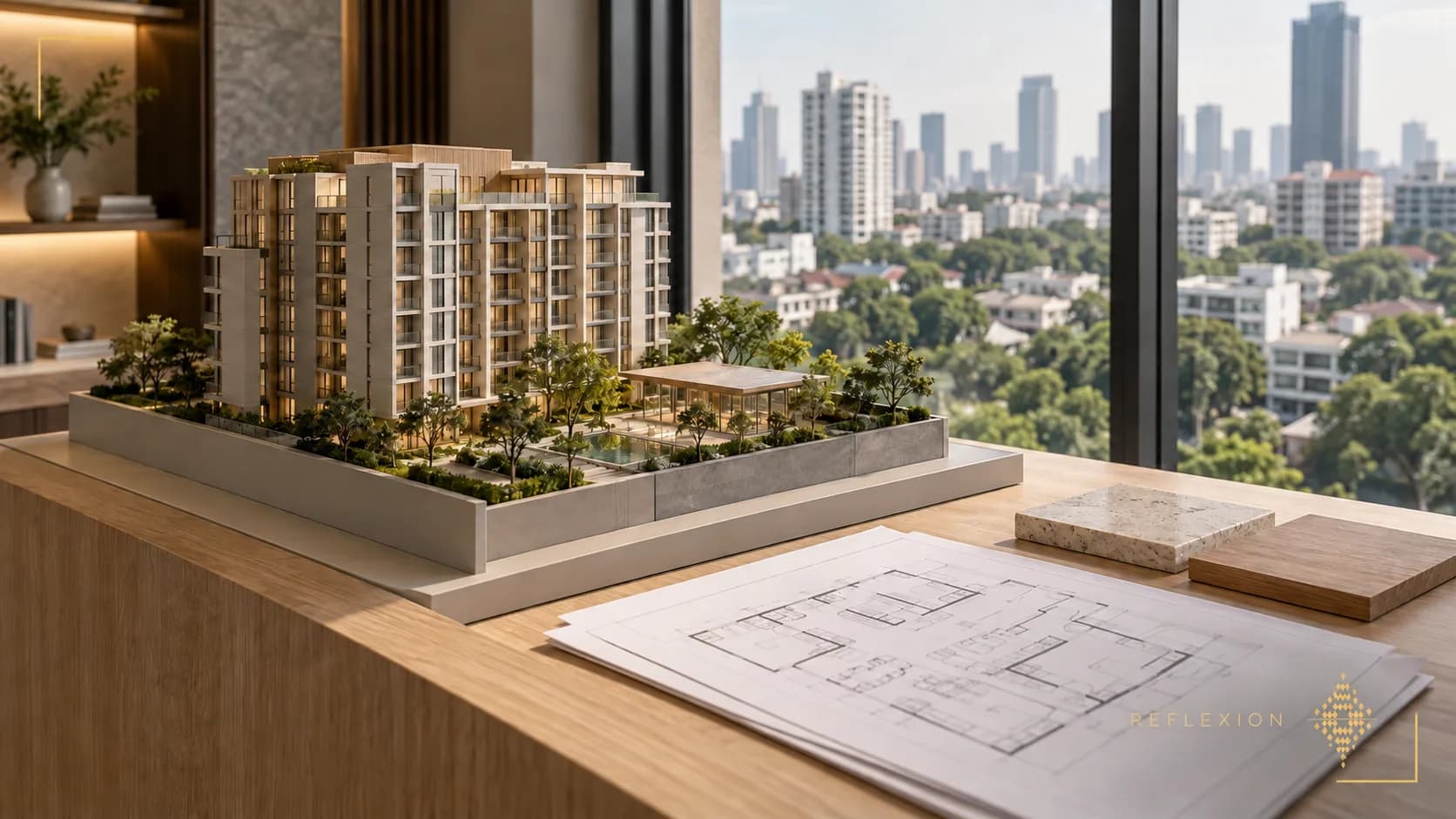
In the sales galleries of Sukhumvit, the model often fits on a single table: a glass tower, a rooftop pool, and floors still unclaimed. Buying off-plan means choosing your unit, your floor and your view before the building exists, at the launch price, with payments spread over the construction period. In the thirteen Bangkok neighbourhoods we track, 60 developments were selling this way on 6 October 2026, with completion announced between 2026 and 2029. Their address reads like that of a finished building, station and soi included, as we showed in our article on Bangkok property prices. Seven checks make it possible to examine, before reserving, the documents available and the commitments that will mark out the development. Texts checked on 27 October 2026; two points are not settled in this article and are listed at the end of the page.
Who buys off-plan in Thailand, and why?
Those who want an apartment the market does not yet offer. In Bangkok, the longest-established addresses are almost entirely built up: in Silom and Sathorn, 98 of the 102 developments we track are already completed; in Ari, 92 out of 93. New-build goes up elsewhere, and it sells early. According to CBRE, developments under construction in central Bangkok showed an average sales rate of 52% in the first half of 2026, and 85% in the super-luxury segment, while completed developments reached 93%. In the same press release, of 19 August 2026, the agency reports that international buyers made up 32% of purchases in the centre, in its own data.
On the coast, the movement takes other forms. In Pattaya, only 14.2% of developments are sold off-plan, but they account for 53.7% of condominium units for sale: a handful of large towers make up the supply. On Koh Samui, an island of villas, more than one development in two is sold before it is built. Hua Hin stands at 15.4%.
What our surveys say about off-plan supply, October 2026:
| Market | Indicator | Value | Survey date |
|---|---|---|---|
| Bangkok, thirteen neighbourhoods | Developments still selling off-plan | 60 | 6 October 2026 |
| Bangkok, Silom and Sathorn | Developments already completed | 98 of 102 | 6 October 2026 |
| Pattaya | Share of developments sold off-plan | 14.2% | 6 October 2026 |
| Pattaya | Share of condominium units for sale that are off-plan | 53.7% | 6 October 2026 |
| Hua Hin | Share of developments sold off-plan | 15.4% | 6 October 2026 |
| Koh Samui | Share of developments sold off-plan | 52.2% | 5 October 2026 |
| Bangkok | Service charges announced by off-plan developments | THB 63/m²/month | 7 October 2026 |
These shares describe supply on the market at the survey date, not transactions. They show where new-build is to be found: in Pattaya’s towers, on the slopes of Samui and, in Bangkok, away from the already built-up addresses of Silom or Ari.
What does a reservation give the buyer?
Three things, which are the whole appeal of buying off-plan. First, the price: the launch price, fixed in the contract. Then, choice: the floor, the orientation and the layout, among the units still available. Finally, time: the reservation, then the sale and purchase agreement, open a payment schedule that follows construction, with the balance paid on transfer of ownership at the land office.
This first commitment is now regulated. The notification of the Contract Committee of the Office of the Consumer Protection Board (OCPB, สคบ.), adopted on 30 August 2024 and published in the Royal Gazette on 3 October 2024, has made the sale of condominium units with a reservation a contract-controlled business since 31 January 2025. The reservation contract takes a standard form: drawn up in Thai, in two copies, one of which is handed to the buyer on signing, it states the development, the unit, the materials, the price, the sum paid, the expected date of the sale and purchase agreement, and the dates on which the building permit is applied for and issued.
The annexed model also gives the buyer clearly defined ways out. The buyer may terminate and recover the full reservation sum if the required environmental impact assessment is not approved, if the developer does not conclude the next contract within the agreed period, if the developer fails, without reasonable cause or through its own fault, to take the planned steps to obtain the building permit, or if the plans, the project or the materials change without the buyer’s consent. Repayment is made within 7 days of termination for payment in cash, by bank transfer or by cheque, and within 15 days for payment by card, in which case any card fees may be deducted. Where the developer knew that the buyer needed a loan, either party may also terminate if that financing is not granted within the agreed period. The sum paid is neither a deposit nor an advance payment; the seller may keep it only if the buyer does not conclude the next contract within the agreed period, after written notice giving the buyer at least seven days from receipt to perform their obligations.
The brochure is part of the contract.
Under section 6/1 of the Condominium Act B.E. 2522, as amended in 2008, the advertising texts, images and brochures of a development are deemed to form part of the sale and purchase agreement; where they conflict, the interpretation more favourable to the buyer prevails. The developer keeps them until the last unit is sold.
What separates a good off-plan project from an average one?
A good project can be verified on paper, and almost every document is available before you sign. The seven checks follow the life of the development, from the land to the handing over of the keys.
The seven checks, document by document:
| Check | Document | Where to find it | What it establishes | Point of reference |
|---|---|---|---|---|
| a. Developer | Record of the project company | DBD DataWarehouse register | Company selling, directors, accounts | Name often different from the brand |
| b. Land | Title deed (chanote) and access plan | Land office file | Ownership, mortgage, access to a public road | Section 6 of the Condominium Act |
| c. Permits | EIA approval letter, building permit | Smart EIA Plus, local administration | Project approved, construction authorised | EIA approval and permit are separate |
| d. Contracts | Reservation on the OCPB model, sale on the อ.ช. 22 model | Handed over on signing | Dates, price, refund cases | Reservation: repayment under clauses 2 and 4, within 7 or 15 days |
| e. Payment schedule | Timetable, late-completion clause, any escrow | Sale and purchase agreement, approved bank | Sums paid before handover | Late-completion clause compared with the model |
| f. Quota and funds | Remaining quota, FET form | Developer, receiving bank | Room available, origin of funds | 49% of the floor area of the units |
| g. Handover | Registration of the condominium and its juristic person | Land office, Royal Gazette | Condominium established, transfer possible | Documents to check at registration and transfer stage |
a. The developer and its project company. In Thailand, a development is often carried by a company separate from the group’s brand. Its registration can be read in the DBD DataWarehouse database of the Department of Business Development (DBD): address, directors and signing powers, financial statements filed, nationality of shareholders. The legal name and registration number shown in the contract, the payee of the instalments and the signing powers are compared against these records: it is this company, not the brand, that will sign.
b. The land and its access. To register a condominium, section 6 of the Condominium Act requires the title deed to the land, the chanote (โฉนดที่ดิน), the building plan showing its access to a public road, and a certificate that the building is free of encumbrances, except for a mortgage over both the land and the building. In that case, section 7 makes registration subject to the creditor’s consent. According to Tilleke & Gibbins, the standard contract provides that the seller warrants its ownership and discloses any mortgage.
c. Permits. Approval of the environmental impact assessment, the building permit and the start of works are three separate stages; how to check them online is explained in our article on environmental impact assessments. The reservation contract now carries the deadlines relating to the permit, so they can be compared against the documents.
Contract, money, quota and handover: what do the texts say?
d. Two contracts, two models. The reservation contract follows the OCPB model; the sale and purchase agreement, for its part, falls under section 6/2 of the Condominium Act: concluded by the owner of the land and the building, it follows the model set by the Minister, and any non-conforming part that is unfavourable to the buyer has no effect. This model, known as อ.ช. 22, was set by a Ministry of the Interior notification of 1 July 2008, according to a study published in 2018 in the Kalasin University journal. According to Tilleke & Gibbins, it includes the completion and transfer dates, the list of common property, the buyer’s right to assign the contract free of charge, and late-payment interest owed by the buyer capped at 15% a year. A thesis from Ramkhamhaeng University noted in 2022 that some developers use their own contracts: comparing them clause by clause with the model is part of the review.
e. Payment schedule, delay and escrow. According to ThaiLawOnline’s analysis, the model provides two routes in the event of delay: keep the contract and receive a daily penalty, or terminate and obtain a refund of the sums paid, with interest. Tilleke & Gibbins adds that force majeure suspends construction only for a limited period. The applicable legal regime, the warranties provided in the contract, their duration and starting point, and the remedies for delay are checked before signing; the payment schedule, meanwhile, is read in the light of the financial strength of the company that signs it.
When termination becomes possible is not settled.
ThaiLawOnline first writes that the buyer may terminate once the penalty reaches its 10% cap, then, in its revision note, as soon as the completion date has passed. Tilleke & Gibbins describes a refund falling due when the transfer does not take place on the scheduled date. The text of the signed model is what counts.
‘Off-plan, the money you pay is locked in an escrow account.’
the Act on the Protection of the Interests of Parties B.E. 2551, known as the Escrow Act, provides for escrow held by an institution approved by the Minister of Finance; the Bank of Thailand has authorised commercial banks to act as such since its notification of 25 April 2011. Escrow arises from a contract between the parties, and Tilleke & Gibbins describes it as voluntary: whether it is in place is checked in the signed contract.
f. The foreign quota and the funds. Section 19 bis of the Condominium Act caps the share held by foreigners at 49% of the total floor area of the units, building by building. Sections 19 and 19 ter distinguish several categories of foreign buyer, each with its own supporting documents; for the imported-currency category, the evidence must cover the price of the unit. In practice, the receiving bank issues a transfer certificate, the FET form (formerly Thor Tor 3, ธ.ต.3), whose thresholds and format are a matter of banking practice, according to ThaiLawOnline. Off-plan, the availability of the quota is confirmed in writing for the chosen unit; a reservation alone does not guarantee it. In Bangkok, 1,289 buildings offered foreign quota on 20 October 2026, or 67.8% of those whose status is known; the forms of tenure are set out in our article on freehold and leasehold.
g. Handover. Under section 31, the transfer of the first unit goes hand in hand with the application to register the condominium’s juristic person, published in the Royal Gazette; the first general meeting is held within six months. Common charges are shared according to the ownership ratios or the regulations (section 18), whose draft forms part of the registration file. Our surveys show that off-plan developments in Bangkok announce THB 63 per m² per month, against THB 55 for buildings completed since 2020; the full budget is set out in our guide to the cost of ownership. Completion, the handover inspection, the rectification of defects, registration of the condominium and transfer of ownership are separate stages. Finally, according to ThaiLawOnline, Tilleke & Gibbins and a NIDA study, the standard contract includes a warranty of at least five years for the structure and fixed installations, and two years for other components.
The starting point given by the sources.
ThaiLawOnline and the NIDA study run the warranties from the registration of the condominium; Tilleke & Gibbins gives the durations without specifying this point. The full regulatory model could not be reread for this review: whether the contract conforms to that model remains to be checked. Separately from these warranties, section 474 of the Civil and Commercial Code sets a time limit of one year from the discovery of a defect for the corresponding claim.
When we model the case of Karen and Steve, a one-bedroom off-plan apartment in Bangkok
Karen, 54, and Steve, 57, live in Bristol and will soon be spending their winters in Bangkok. They are looking for a one-bedroom apartment in a new building around Thonglor and Ekkamai, where the median asking price per square metre stands at THB 145,752 and THB 122,095 respectively in our survey of 6 October 2026. Their budget is set at THB 12 million (£269,400). Two developments, due for completion in two and three years, offer them comparable units.
Their comparison of the documents leads them to pursue the first development. It is carried by a project company whose DBD record points back to the advertised developer; its reservation contract carries the building permit dates, its sale and purchase agreement follows the ministerial model, and the developer confirms in writing that the chosen unit falls within the foreign quota. The second offers a lighter payment schedule, but its draft sale and purchase agreement departs from the model on the late-completion penalty. Neither offers escrow. At THB 63 per m² per month, the announced service charges on a 75 m² unit would come to nearly THB 56,700 a year (£1,300), a line they add to their budget straight away.
What they decide: to ask for the full file on the first development, have a Thai lawyer compare its sale and purchase agreement with the model, and gather the supporting documents for their category of foreign buyer, before making their reservation decision.
Modelled scenario. This profile is not a client; the parameters are working assumptions.
Placing a development in its neighbourhood with our database
For each development, our records show its developer, its sub-district, its status, off-plan or completed, and its year of completion where known. They make it possible to place an off-plan development among its already completed neighbours, and to see what the same developer has already delivered in the city. To see the off-plan developments in your neighbourhood, start by placing them on the map.
Two points the texts leave open
When termination for delay becomes available. Penalty cap reached or completion date passed: ThaiLawOnline gives both readings, while Tilleke & Gibbins takes the transfer date.
A contract that departs from the model. Section 6/2 deprives of effect any non-conforming part that is unfavourable to the buyer; the sources consulted do not say which clause applies in its place, and the 2022 thesis notes that developers use their own contracts.
What you can do now
Before reserving, ask for three documents: the DBD record of the company selling, a copy of the chanote with the access plan, and the draft sale and purchase agreement. Compare the latter with the อ.ช. 22 model, late-completion clause included. Then ask for written confirmation that your unit falls within the foreign quota.
Frequently asked questions
Can you get a reservation deposit back on an off-plan purchase in Thailand?
In certain cases, yes. The condominium reservation model in force since 31 January 2025 provides for a refund in the cases listed in its clauses 2 and 4, including certain failures by the developer or the refusal of a loan the developer knew was needed. Repayment comes within seven days, or fifteen for a card, less any card fees. A buyer who fails to sign in time may lose the sum, after written notice and a grace period.
Is escrow compulsory for an off-plan purchase?
No, according to the sources we consulted. Thailand’s 2008 escrow legislation sets out who may hold the funds, an institution approved by the Minister of Finance, and shields those funds from seizure. But buyer and developer have to agree on it by contract, and both Tilleke & Gibbins and ThaiLawOnline present it as a voluntary arrangement.
Can a foreigner buy an off-plan apartment in their own name?
Yes, within limits. The Act opens condominium ownership to several categories of foreign buyer, provided foreign holdings stay within 49% of each building’s unit floor area. Every category comes with its own paperwork, and imported-currency buyers must show funds covering the full price. Whether quota remains for a given unit, and which documents apply, is confirmed before reserving.
What happens if the developer completes late?
According to published analyses of the ministerial model, the buyer has two routes: keep the sale going and claim the compensation provided for, or terminate and seek a refund with interest, under the applicable conditions. Exactly when termination becomes possible is still debated between these analyses; whether the contract matches the model is checked with a lawyer.
What warranty covers a new apartment in Thailand?
At least five years for the structure and fixed installations, and two for everything else, according to published analyses of the ministerial model. As for when that period begins, ThaiLawOnline and the NIDA researchers point to condominium registration, while Tilleke & Gibbins is silent on it. These are secondary readings: the contract on offer still has to be compared with the model itself.
Method and sources
Sources checked October 27, 2026
Exchange rate used: 1 GBP = 44.54 THB (ECB euro reference rates, cross rate, 1 October 2026)
- What this article draws on:
- Reflexion survey of 6 October 2026, ‘Where to live in Bangkok’ guide: asking prices of units for sale, median per development then median across developments, with a minimum of 20 developments.
- Reflexion survey of 6 October 2026, ‘Hua Hin or Pattaya’ guide: off-plan share calculated on developments whose status is known.
- Reflexion survey of 5 October 2026, ‘Phuket or Koh Samui’ guide.
- Reflexion survey of 7 October 2026, ‘The real cost of ownership’ guide: service charges declared in listings.
- Reflexion survey of 20 October 2026, ‘Freehold, leasehold, foreign quota’ guide.
- CBRE, press release of 19 August 2026 on the first half of 2026 (the agency’s own data).
- Condominium Act B.E. 2522, sections 6, 6/1, 6/2, 7, 18, 19, 19 bis, 19 ter, 31 and 42, unofficial English translation by the Office of the Council of State, published by the Department of Lands.
- Contract Committee, notification B.E. 2567 on the sale of condominium units with a reservation and its annexed model, Royal Gazette of 3 October 2024, official copy circulated by Tha Sao municipality.
- Office of the Consumer Protection Board, explanatory note of 3 December 2024.
- Nishimura & Asahi, Contract Committee notification B.E. 2567 on the sale of units with a reservation.
- Tilleke & Gibbins, the standard reservation contract, 15 October 2024.
- Thansettakij, publication of the OCPB notification, 3 October 2024.
- NIDA, study of the อ.ช. 22 standard contract.
- Supasak Prommomate and Prapin Nuchpiam, Governance Journal, Kalasin University, vol. 7 no. 2, 2018.
- Tilleke & Gibbins, standard purchase agreements, Bangkok Post, 15 August 2011.
- ThaiLawOnline, off-plan delays and refunds, 5 August 2026, updated 21 October 2026.
- ThaiLawOnline, the FET form, 5 August 2026.
- ThaiLawOnline, escrow glossary entry, 5 September 2026.
- Tilleke & Gibbins, Cynthia Pornavalai, using the Thai Escrow Act, Thai-American Business, 2010.
- Bank of Thailand, notification FPG. 1/2554 of 25 April 2011 on escrow services.
- Jarawut Amnakmanee, legal problems in the sale of condominium units, Ramkhamhaeng University, 2022.
- International Telecommunication Union, entry for the DBD Business Data Warehouse, WSIS Prizes 2019.
- The Condominium Act was read in an unofficial English translation, and the standard contract through two law firms’ analyses: only the Thai text is authoritative.
This article is general information, not legal or tax advice. The rules cited are dated: check with a qualified professional that they are still in force before acting.