Airbnb in Thailand: what the law allows in a condo
Letting a condo by the night in Thailand: fines of up to THB 20,000 and up to THB 10,000 a day. The Hotel Act, the 2026 bill and monthly letting explained.
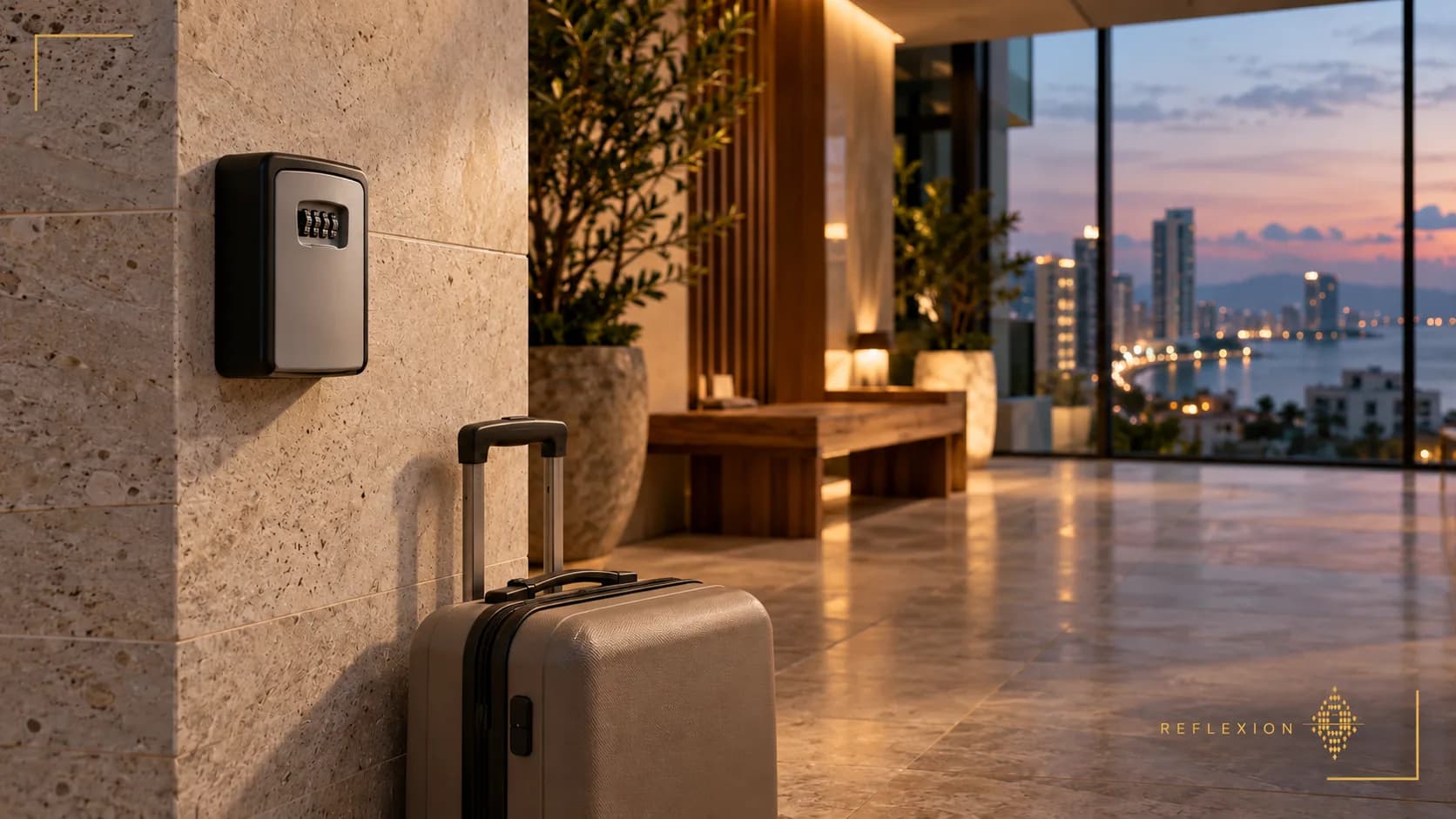
In the lobby of a Jomtien tower, a key safe is fixed to the wall by the lift; a couple arrive at ten in the evening, tap in a code sent to them by text and go up to the twenty-sixth floor. For many foreign buyers, this is the plan: let the flat by the night while they are away. Thai law takes a different view. Since 2004, the Hotel Act has required a licence for paid temporary accommodation established for commercial purposes, subject to the exclusions it provides for, with fines of up to THB 20,000 and up to THB 10,000 for each day of the offence; and, on the reading that Tilleke & Gibbins and Krungthep Turakij give of a Department of Lands circular of November 2023, a condominium unit may not be used for a hotel business. On 29 September 2026, the government approved in principle a bill that would replace the Hotel Act; according to the law firms that have analysed it, it does not lift the restrictions on the use of condominium units. Here is what the texts say, what an offence costs and what remains allowed, as a complement to our guide to the cost of ownership. Texts checked on 1 November 2026; four points that the sources consulted do not settle are listed at the end of the article.
What does Thai law say about letting by the night?
It all starts with a definition. Section 4 of the Hotel Act B.E. 2547, published in the Royal Gazette on 12 November 2004, defines a hotel as a place of accommodation established for commercial purposes to provide temporary lodging to travellers or any other person, in return for payment. Section 4 sets out three exclusions: certain public, charitable or educational accommodation where profits are not shared; places established for a service charged by the month or longer, only, โดยคิดค่าบริการเป็นรายเดือนขึ้นไปเท่านั้น; and other accommodation specified by ministerial regulation. The monthly exclusion is the one examined here for a letting plan.
The word ‘only’ matters, on a reading of the text. The exclusion covers places established for a monthly or longer service, only; a monthly booking within a business that also offers daily stays does not, by itself, fit the description of that exclusion. As for the ‘30 days’ quoted everywhere, they do not appear in the law: they appear in the Bangkok Post’s summary of a 2018 ruling, at Tilleke & Gibbins (‘less than one month’) and in statements by the Department of Provincial Administration (DOPA) in 2025. It is the usual rendering of the monthly exclusion, not a free-standing legal threshold.
Section 15 then prohibits operating a hotel business without a licence issued by the Registrar, and section 16 sets, among other things, the conditions for that licence, including a minimum age of twenty and, in its paragraph 2, a domicile or residence in Thailand. Under section 48, where the offence is committed by a legal entity, the directors whose act, or omission to perform a duty, caused the offence may also be held liable.
What does an offence cost?
The law provides for criminal penalties and administrative fines. Under section 59, operating a hotel business without the licence required by section 15 is punishable by up to a year’s imprisonment, or a fine of up to THB 20,000, or both, and a further fine of up to THB 10,000 for each day the offence continues. Penalties under the Hotel Act B.E. 2547, in force at 1 November 2026:
| Breach | Section | Penalty provided |
|---|---|---|
| Operating without a licence | s.15, punishable under s.59 | up to 1 year’s imprisonment and/or up to THB 20,000 (£450), plus up to THB 10,000 (£220) for each day of the offence |
| Failing to comply with the duties to keep and submit the register under sections 35 and 36 | s.35, s.36, punishable under s.56 | administrative fine of THB 20,000 to 100,000 (£450 to £2,200) |
| False entries in the register, obstructing an official | s.61 | up to 1 month’s imprisonment and/or up to THB 1,000 |
The courts have already applied these provisions. In January 2018, the Hua Hin court convicted two unit owners at the Wan Vayla Condo who were letting by the day or the week without a licence. According to the Bangkok Post, the first paid THB 15,000 (£340), that is THB 5,000 plus 500 a day for a twenty-day stay; the second THB 13,100 (£290), for 81 days spread over several stays; no prison sentence was handed down, and a lawyer explained that the basic fine had been halved because the owners confessed. These are first-instance rulings: they do not bind other courts, and in the sources consulted we found no Supreme Court judgment on the short-term letting of a condominium unit.
‘At worst, it’s only a small fine.’
section 59 of the Hotel Act provides for up to a year’s imprisonment, or a fine of up to THB 20,000, or both, as well as a further fine of up to THB 10,000 for each day the offence continues. These are ceilings, not a tariff. The two Hua Hin rulings of 2018 imposed fines only; they say nothing about the penalty in any other case.
Can the condominium authorise letting by the night?
No, according to the Department of Lands’ position as two sources report it. Department of Lands circular No. มท 0517.3/ว 23302 of 6 November 2023, addressed to the governors of every province, states, on the reading that Tilleke & Gibbins and Krungthep Turakij give of it, that using condominium units for a hotel business is not permitted. On these same two readings, the commercial use that the 2008 law opened up in condominiums does not include hotels; neither the co-owners’ consent nor a change in the building’s designated use alters this, and running a hotel would first require the condominium to be dissolved. The circular is said to rest on a 2007 opinion of the Council of State, which limits the permitted commercial uses to those that serve residents, such as a convenience store or a restaurant.
The Condominium Act also gives each building’s regulations authority over the use of private units and common property (section 32), and prohibits a co-owner from doing what the regulations forbid (section 13). We found no provision in the Act dealing with the letting of units: the rules on letting are to be found in the regulations. According to the Bangkok Post, most condominium regulations prohibit daily letting, and some management offices have banned key safes.
‘If the co-owners’ meeting votes in favour, it’s legal.’
according to the Department of Lands circular of November 2023, as read by Tilleke & Gibbins and Krungthep Turakij, neither the co-owners’ consent nor a change of designated use allows a unit to be used as a hotel. The 2026 bill, according to The Nation, also defers to condominium law.
Does the small-establishment exemption cover a condo?
This is the most widespread argument, and the sources consulted do not support it. The 2008 ministerial regulation, as cited by Methas Nattachayaphol, took out of the definition of a hotel any place with no more than four rooms and twenty guests, run as a supplementary source of income and notified to the Registrar. Ministerial Regulation No. 2 B.E. 2566 (2023), published in the Royal Gazette on 30 August 2023 and in force sixty days after its publication, replaces clause 1 of the 2008 regulation: it covers no more than eight rooms and thirty guests, with notification, inspection by the designated official and the issue of a receipt, valid for five years and obtainable electronically. Its current wording does not carry over the supplementary-income criterion of the earlier text. These thresholds do not, on their own, establish that a condominium unit is eligible. According to Formichella & Sritawat, the inspection covers building safety, fire and hygiene.
The 2023 regulation does not expressly deal with condominium units in this clause, and none of the other sources we read indicates that a unit can be notified in this way. A Naresuan University study reported in 2018 that Registrars had refused notifications filed by condominium owners, on the grounds of the disturbance to other residents. And the 2023 Department of Lands circular, on the two published readings, rules out hotel use of a unit, whatever the number of rooms.
What has been happening on the ground since 2025?
The issue has moved from law to enforcement. According to the Bangkok Post of 1 March 2025, the deputy government spokesman, Anukul Prueksanusak, warned on 28 February that unlicensed daily landlords were breaking the Hotel Act, Thai and foreign alike, and the Ministry of Interior instructed DOPA to carry out inspections. On 5 March, before a House committee, a DOPA legal officer described daily letting as an activity comparable to a hotel business, and therefore prohibited, according to the accounts given by The Nation and the Bangkok Post; he announced joint operations with the police and Immigration, and requests to the platforms to take listings down.
Inspections followed. On 5 and 6 March 2025, in Bangkok, DOPA officers booked two units in Pratunam and filed complaints, then inspected three buildings in Huai Khwang. On 26 March, in Pattaya, a team inspected three buildings in Bang Lamung district with the police and Immigration: in two of them, units were being let short term through platforms, and the data were passed to the Land Office, the city and the Revenue Department. On 13 May, a further inspection targeted Sathorn, citing sections 4, 15 and 59 of the Act. Hoteliers point to the limits of the exercise: officers have to pose as guests, and often only one owner is caught at a time.
Will the 2026 reform legalise letting by the night?
Not on the texts published so far. Two procedures are under way. On 8 July 2026, the House passed an amendment to the Hotel Act at first reading. On 29 September 2026, the Cabinet approved in principle a 98-section bill on accommodation establishments, which would repeal and replace the Hotel Act, following two public consultations in 2025. According to the government’s press release, the bill sets out three regimes based on the number of rooms, guests or units: notification for up to eight rooms and thirty guests, or eight dwellings; registration for nine to forty rooms, thirty-one to one hundred and fifty guests, or nine to forty dwellings; and a licence above 40 rooms or 150 guests. It would also provide for an electronic guest register submitted every twenty-four hours.
For condominiums, the answer lies in section 18 of the bill, as described by The Nation, since the government’s press release does not reproduce its wording: a condominium could obtain notification, registration or a licence only if condominium law allows it. According to Formichella & Sritawat, the bill does not lift the restrictions on the use of condominium units and does not change the November 2023 position; Tilleke & Gibbins point out that the Council of State has still to review it before it goes to Parliament.
A bill is not a law.
The text approved on 29 September 2026 has still to go through the Council of State, readings in the House, the Senate, royal assent and publication in the Royal Gazette; no commencement date has been set. Until then, the Hotel Act applies as it stands. The fines the bill would introduce, up to THB 50,000 a day for certain breaches according to The Nation, remain at the draft stage.
What is still permitted when letting out a condo?
Monthly letting, governed by other texts. The section 4 exclusion covers places established for a service charged by the month or longer, only; the relationship between the owner and the tenant then comes under the law of leases. Section 538 of the Civil and Commercial Code requires written evidence signed by the party against whom enforcement is sought. For a term of more than three years, or for the life of a party, the absence of a written lease and of registration with the competent official limits enforcement in court to three years. This civil-law rule governs how a lease is proved; it says nothing, on its own, about whether the way a property is let complies with other legislation.
Rent is taxable income in Thailand. The Revenue Code classes rent from property as section 40(5) income and makes it taxable whenever the property is located in Thailand, whether the rent is paid in the country or abroad (section 41). The Revenue Department allows a flat-rate deduction of 30% for letting a building, and its translation of the Code provides for 15% withholding tax on rent paid to a non-resident (section 50); according to HLB Thailand, this withholding is not a final tax and the progressive scale applies to residents and non-residents alike. Who must withhold, and at what rate, depends on the payer and on the recipient’s status: this article gives no calculation.
Two separate matters need to be read apart. The first is a report of accommodation: according to the official portal Thailand.go.th, section 38 of the Immigration Act requires anyone who accommodates a foreign national permitted to stay temporarily to report it within twenty-four hours. The second is the tax classification of the property, which does not depend on the tenant’s nationality: the land and building tax rate for a property let as a home is the residential rate, as we set out in our article on the cost of ownership; how a daily let is classified is not settled in the sources consulted.
What separates a sound rental plan from a gamble?
Regulations read before buying. They say what the building allows: minimum letting period, tenant registration, access. You ask the manager for them along with the condominium’s accounts, just as for an off-plan purchase.
A yield calculated by the month. A plan built on nightly letting rests on an activity for which the law in force requires a licence, subject to its exclusions, and which the Department of Lands, on the published readings of its circular, rules out for condominium units; a plan built on monthly letting rests on a written lease and declared rent.
A clear ownership structure. The unit’s tenure, whether freehold under the foreign quota, leasehold or through a company, should be checked before letting is even considered, as explained in our article on property ownership in Thailand.
Fiona’s case: a studio in Jomtien
Fiona, 58, who lives in Glasgow, bought a studio in a Jomtien tower in 2024, freehold under the foreign quota. She spends the winter there and had planned to offer it by the night for the rest of the year, on a platform, with a key safe.
She rereads the texts in order. Section 4 of the Hotel Act provides, among other things, for the exclusion of places established for a service charged by the month or longer, only; section 16 sets, among the conditions for the licence required by section 15, a domicile or residence in Thailand; the Department of Lands circular of November 2023, as read by Tilleke & Gibbins and Krungthep Turakij, rules out hotel use of a unit; her building’s regulations, which she requests from the manager, set a minimum letting period. She also notes that the findings of the DOPA inspections in Bang Lamung in March 2025 were passed to the Revenue Department.
What she decides: to give up nightly letting, to offer the studio by the month from May to October under a written lease, and to have a tax adviser establish what this rent means for her in Thailand.
Modelled scenario. This profile is not a client; the parameters are working assumptions.
Four points the sources consulted do not settle
- Condominium units and the small-establishment exemption. Regulation No. 2 of 2023, as published in the Royal Gazette, sets thresholds and a procedure without expressly referring to condominium units; how it fits with the condominium regime is not settled by that text.
- The force of condominium regulations. Sections 13 and 32 give them authority over the use of units; we found no Supreme Court judgment on a clause prohibiting short-term letting.
- Land and building tax on a daily let. The official 2019 guidance places property let as a home in the residential category; the classification of an Airbnb-style let is reported only by the press.
- The timetable for reform. How the amendment passed at first reading in July 2026 and the September bill fit together has not been made clear.
The absence of a source in this list is not the absence of a rule: these points need checking case by case.
How our database places a unit within its building
Our development records show, for each building we track, its common fees per square metre where the listing states them, its year of completion and its units for sale: enough to gauge the real cost of a unit intended for monthly letting. To compare two buildings before viewing them, place them on the map.
What you can do now
Before buying to let, ask the manager for the building’s regulations and read what they say about letting periods. Base your budget on a monthly rent, with common fees and land and building tax included. And have a tax adviser check what declaring the rent means in your situation.
Frequently asked questions
Is it legal to rent out a condo on Airbnb in Thailand?
The platform does not decide whether it is legal. Section 15 requires a licence for any activity that falls within the definition of a hotel, subject to the exclusions in section 4. For condominium units, Tilleke & Gibbins report a November 2023 Department of Lands position ruling out hotel use. The small-establishment regime does not, by itself, show that a condo unit may be let by the night.
What is the fine for an illegal short-term rental in Thailand?
Up to THB 20,000, to which a further fine of no more than THB 10,000 may be added for every day the activity goes on; imprisonment of up to a year is provided for instead of the fine or alongside it (Hotel Act, section 59). These are maximum penalties. In Hua Hin in 2018, two owners were fined THB 15,000 and THB 13,100, with no prison sentence.
Is renting for more than 30 days allowed in Thailand?
The law does not mention thirty days but a service charged by the month or longer, only: a place established for that use alone falls outside the definition of a hotel. The relationship with the tenant is then a matter for the law of leases. Beyond three years, a written lease and registration are needed to enforce the full agreed term. The building’s regulations may set conditions of their own.
Does the new 2026 law allow Airbnb in Thailand?
No, because it is not yet law: what the government approved in principle at the end of September 2026 is a bill, which must still be scrutinised and voted on and has no commencement date. According to Formichella & Sritawat, it does not lift the restrictions on condominium units; The Nation reports that its section 18 would defer to the legislation on condominiums.
Is rental income from a condo taxed in Thailand?
Yes. The Revenue Code taxes rent from a property located in Thailand, whether it is paid there or abroad. The Revenue Department allows a flat-rate 30% deduction for a let building, and 15% withholding is provided for on certain payments to non-residents. What you owe depends on your own circumstances and should be worked out by a tax adviser.
Method and sources
31 sources · checked November 1, 2026
Sources checked November 1, 2026
Exchange rate used: 1 GBP = 44.54 THB (ECB euro reference rates, cross rate, 1 October 2026)
- Sources checked on 1 November 2026, amounts converted at 1 GBP = 44.54 THB (1 October 2026); conversions are indicative, calculated on the exact value and then rounded to the nearest hundred pounds (to the nearest ten below £1,000).
- What this article draws on:
- Hotel Act B.E. 2547 (2004), sections 4, 15, 16, 35, 36, 48, 56, 59 and 61, English translation by the Office of the Council of State, published by the Department of Provincial Administration.
- Ministerial Regulation on hotel categories B.E. 2551 (2008), cited by Methas Nattachayaphol, Journal of International Thai Tourism, June 2026.
- Ministerial Regulation No. 2 B.E. 2566 (2023) on hotel categories and operating criteria, Royal Gazette, vol. 140, part 52 ก, 30 August 2023.
- Tilleke & Gibbins, amendments to the hotel regulations, 6 October 2023.
- Tilleke & Gibbins, condominiums cannot be used for hotel operations, 13 November 2023.
- Krungthep Turakij, column by Dr Sopon Pornchokchai on the Department of Lands circular, 18 November 2023.
- Condominium Act B.E. 2522 (1979), sections 13, 17/1, 32 and 48, translation published by the Department of Lands.
- Chakri Adunnirat, Naresuan University Law Journal, December 2018.
- Bangkok Post, the Hua Hin rulings, 18 May 2018.
- Khaosod English, analysis by Wirot Poonsuwan, 24 June 2018.
- Bangkok Post, government warning, 1 March 2025.
- Bangkok Post, operations in Bangkok, March 2025.
- The Nation, DOPA evidence to a House committee, 5 March 2025.
- The Bangkok Insight, inspections in Bang Lamung, 26 March 2025.
- The Standard, Sathorn inspection, 13 May 2025.
- Thai Post, first reading of the Hotel Act amendment, 8 July 2026.
- Royal Thai Government, press release on the accommodation establishments bill, 29 September 2026.
- Thai PBS Policy Watch, the accommodation establishments bill, 30 September 2026.
- Tilleke & Gibbins, plans to replace the Hotel Act, 14 October 2026.
- Formichella & Sritawat, published by AustCham Thailand, 9 October 2026.
- The Nation, the bill and condominiums, 25 October 2026.
- Office of the Council of State, opinion No. 293/2528 reproducing section 538 of the Civil and Commercial Code, 1985.
- ThaiLawOnline, Civil and Commercial Code, section 538, updated 11 October 2026.
- Revenue Department, Revenue Code, sections 40, 41, 48 and 50, English translation.
- Revenue Department, personal income tax.
- HLB Thailand, rental income and tax, updated 30 August 2026.
- Thai PBS, land and building tax on let properties, 25 December 2019.
- Thailand.go.th, official portal, reporting the accommodation of a foreign national (Immigration Act, section 38), updated 7 March 2023.
- No public statistics record short-term rental listings in Thailand; the counts available come from commercial portals, which we do not cite.
This article is general information, not legal or tax advice. The rules cited are dated: check with a qualified professional that they are still in force before acting.